












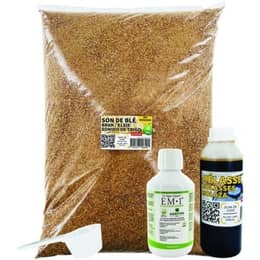
Kit to Make Your Own Bokashi & Compost Activator | 4 kg Kit
Complete 4 or 8 kg kit
$23.25 €20.82
Fast and odor-free, composting worms eat your food scraps and turn them into fertilizer for your plants.

From 2 to 4 trays, with an optional planter.

Up to 18 growing areas around a central worm composter.

Terracotta, with a flower pot.

From 2 to 4 trays, with a lower shelf.

Trays you add over time for easy vermicompost harvesting.

Turn your planters and flower beds into a worm composter: WORMacotta, In-Ground.
 Practical guide

From kitchen to garden, composting becomes simple, fast, and effective for everyone.
 Practical guide
 Practical guide
Live animals (worms and bait) and products to feed and care for pets and livestock.

Eisenia composting worms for your worm composter or compost bin.

Ultra-fresh worms: red worms, Dendros, and Canadian nightcrawlers from 3.5 oz (100 g) to 2.2 lb (1 kg).

Natural solutions dedicated to the well-being of horses, ponies, and donkeys.

Optimize the health and performance of your farm.

Mealworms: natural, nutritious supplements.
Beautify your home with our decorative pieces and care for your house in a natural, sustainable way.
Garden the eco-friendly way, in harmony with nature, for healthy, long-lasting plants.
EM-based products designed to enrich soil, protect plants, support animal health, and make everyday well-being and home care easier.

Contains a blend of 80 families of beneficial microorganisms.

Revitalize, purify, and improve water quality in all your applications.

Stimulate soil microbial activity and plant growth.

Clean and care for your surroundings naturally.

For the well-being and health of pets, livestock, and horses.

Enrich your body care and dietary routines with essential enzymes.
 Practical guidePractical guide

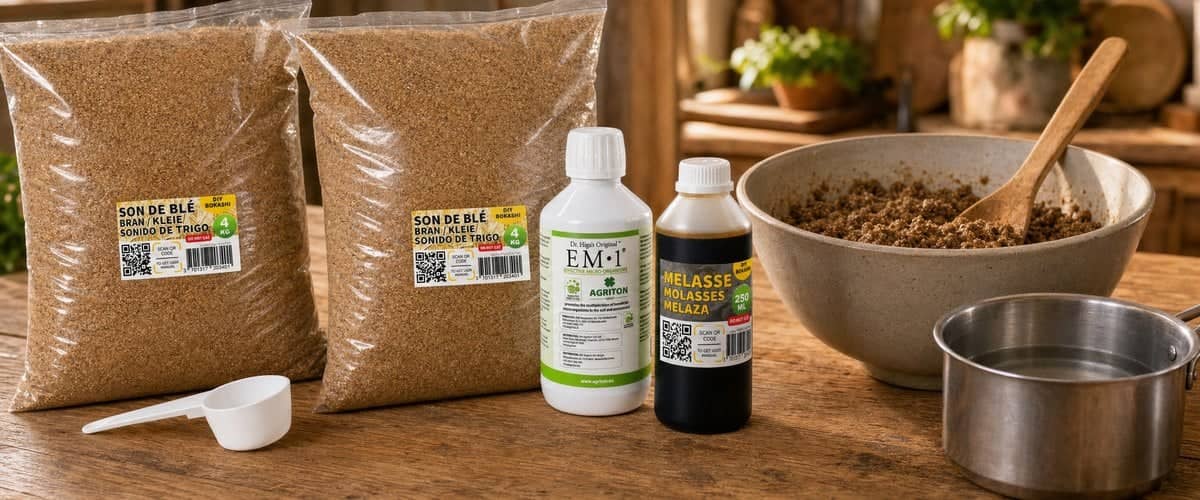
Bokashi bran, the activator you sprinkle over each layer of food scraps, is easy to make at home: three ingredients, an hour of prep at most, then three weeks of patience. It quickly pays for itself if you do bokashi year-round.
Here is our tried-and-true recipe, the one that goes with our kit, with tips for judging the result, drying it, and storing it, plus an EM-free variation. And if you enjoy DIY projects, you can make the bucket yourself too: see our guide Making your own bokashi bucket.
For 2.2 lb (1 kg) of wheat bran, you will need:
 2.2 lb (1 kg) of wheat bran, completely dry and with no musty smell. Our non-GMO wheat bran is ideal;
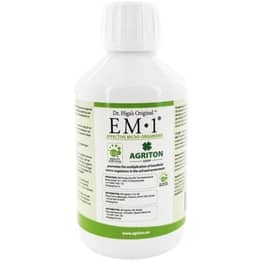
 1 fl oz (30 ml) of EM-1, the stock solution of effective microorganisms: our EM-1 Stock Solution;
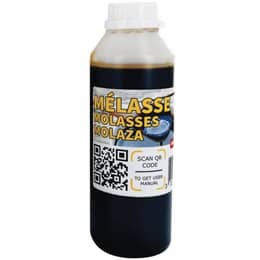
 1 fl oz (30 ml) of molasses, which feeds the microorganisms. Cane or beet molasses, it makes no difference: both provide the sugars the microbes need. Our beet molasses, the one in our kit, is ideal, and so is our sugarcane molasses. Choose pure molasses with no additives;
 17 fl oz (500 ml) of non-chlorinated water.
Equipment: a saucepan, a kitchen scale, a measuring cup, a spoon, a large bowl, an opaque black trash bag, and an airtight container large enough to hold the bag (a bucket with a lid or a large bin).
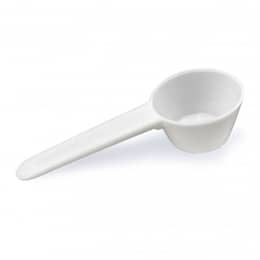
To save you the hunt, our kit for making your Bokashi & Compost activator contains 8.8 or 17.6 lb (4 or 8 kg) of wheat bran from the Gers region, 8.5 fl oz (250 ml) of EM-1, 8.5 fl oz (250 ml) of beet molasses from the Béarn region, a 0.7 fl oz (20 ml) measuring spoon, and the recipe: enough to make up to 17.6 lb (8 kg) of activator, ideally in 2.2 lb (1 kg) batches so it is always fresh. All you need to provide is the non-chlorinated water, the scale, saucepan, bowl, black bag, and airtight container.
The chlorine in tap water keeps microbes in the pipes in check. As EM manufacturers point out, it also weakens the microorganisms you want to put to work, and it can make the fermentation fail.
Tap water: let it sit for 24 hours in the open air, in a wide, uncovered container, so the chlorine evaporates. The easiest way is to set it out the night before.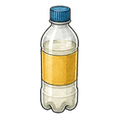 Other options: carbon-filtered water (from a filter pitcher) or still bottled spring water.
Temperature matters too: microorganisms get started best in lukewarm water, between 77 and 86 °F (25 and 30 °C). Water that is too hot can kill some of them: never pour EM-1 into hot water. If you don't have a thermometer, it should feel barely warm on the inside of your wrist.
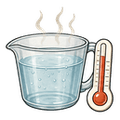 Warm the water: gently heat 17 fl oz (500 ml) of non-chlorinated water in the saucepan to 77–86 °F (25–30 °C). Never let it boil.Add the EM-1: pour 1 fl oz (30 ml) of EM-1 into the lukewarm water and stir with the spoon.Add the molasses: pour in 1 fl oz (30 ml) of molasses and stir again until it is fully dissolved.Weigh the bran: pour 2.2 lb (1 kg) of wheat bran into the bowl.
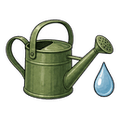 Moisten the bran with the mixture a little at a time, mixing as you go. The bran swells as it absorbs the liquid.
 Knead thoroughly by hand to spread the moisture evenly, until the bran forms balls that break apart easily.
 Bag it: put the bran into the black bag, press it down to squeeze out as much air as possible, then close the bag with a tight knot.
 Seal the bag inside the airtight container, and keep it somewhere warm and dark.
 Wait three weeks without ever opening it.
To make a liquid activated solution (EM-A) instead, see our guide Activating EM-1.
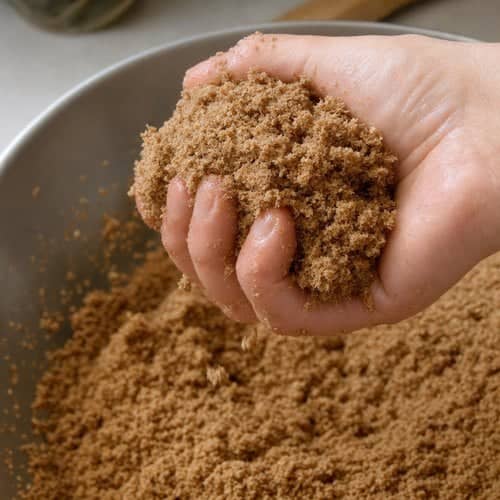 This is the key step. Squeeze a handful in your hand:
 it is just right if it forms a ball that holds together, then crumbles easily between your fingers, without a single drop dripping out;
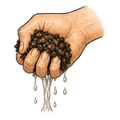 it is too wet if water beads between your fingers or the ball turns into a sticky dough: add a small handful of dry bran and knead again.
Do not add any water beyond the 17 fl oz (500 ml): overly wet bran is the main cause of green or black mold. If it seems a little dry at first, knead longer: the bran absorbs the liquid gradually.
During these three weeks, lactic acid bacteria and yeasts multiply by feeding on the molasses, without oxygen. Just like in your bokashi bucket, air is the enemy.
Do not open the bag, not even for a quick peek. The air that gets in may be enough to spoil the fermentation. Keep it warm, ideally between 68 and 86 °F (20 and 30 °C), out of the light, in a closet or cabinet, for example. In the cold, fermentation slows down; avoid freezing temperatures, and don't set it on top of a radiator either.
Some recipes settle for two weeks; we prefer three to be on the safe side, especially in a cool house.
Did you know?The white film that sometimes appears on fermented bran is the same one you see in a healthy bokashi bucket: a good sign, not a mold to worry about.
 the bran smells fermented: a sweet-and-sour smell of yeast, beer, or cider, sometimes slightly alcoholic;
 a white fuzz covers part of the surface, or there is nothing visible: both are normal.
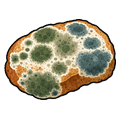 green, blue, black, or pink mold has appeared;
 the bran smells rotten, like sewage, or moldy.
Spoiled bran can't be saved: add it to your compost bin or bury it, then start over, paying close attention to the moisture, the water, and how well the bag is sealed.
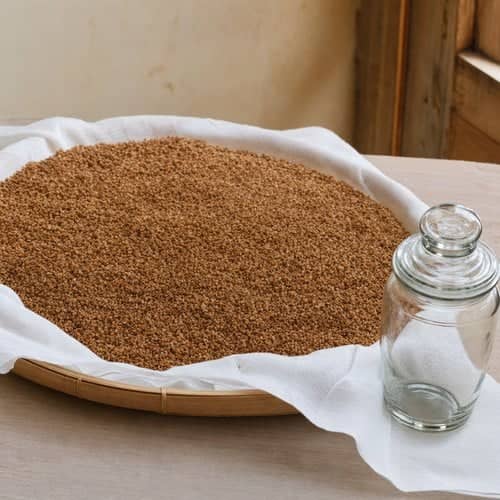 Your bran is ready. You have two options:
Use it as is, moist: keep it in an airtight container, out of the sun, in a cool, dry place, and close it tightly each time you scoop some out. Ideally, use it within the next few weeks. Dry it so it keeps for about a year: spread it in a thin layer on a tray or a clean cloth, in a dry, well-ventilated room, out of direct light. Turn it over from time to time. Allow a few days: it should be dry and crumbly, with no dampness to the touch.
Avoid the oven, heaters, or direct sun: too much heat damages the microorganisms. Once it is dry, store it in a jar or a tightly closed bucket, somewhere dry and dark. When you're ready to use it, it should still smell sour or yeasty; if it smells musty, replace it. For how much to use in the bucket, see our guide Bokashi bran: role, dosage, and storage.
Emy's tipWrite the date it was made on the jar with a marker. You'll see at a glance which batch to use first, and when to start the next one.
How much should you make? A family of four typically uses 4.4 to 13.2 lb (2 to 6 kg) of bran a year, so 2.2 lb (1 kg) lasts roughly two to six months, depending on your food scraps and how generous you are with it.
Some gardeners replace EM-1 with a homemade lactic acid bacteria serum. Here's how it works: let rice rinse water ferment in the open air for a few days, then add a small amount of it to milk, which curdles in about a week. The yellowish liquid you collect is then used just like EM-1, with molasses and bran.
This method works for many people, but it has its limits: the microorganism population is not controlled and varies from one batch to the next, it is less diverse than EM (so you sprinkle a little more bran into the bucket), and making it adds two to three weeks, with a greater risk of failure.
Does EM really make a difference? Published studies are few and far between, and some trials found no difference in plant growth between bokashi made with or without EM: we take a closer look in our guide Bokashi and effective microorganisms: what the science really says. For consistent results, we recommend EM-1, the most reliable and simplest option.
Key takeawaysOur recipe: 2.2 lb (1 kg) of wheat bran, 17 fl oz (500 ml) of non-chlorinated water at 77–86 °F (25–30 °C), 1 fl oz (30 ml) of EM-1, and 1 fl oz (30 ml) of molasses. Moist but not soggy bran, a firmly packed black bag inside an airtight container, three weeks somewhere warm without opening, then drying in the shade so it keeps for a year.
Making your own bokashi bran is simple: 17 fl oz (500 ml) of lukewarm non-chlorinated water, 1 fl oz (30 ml) of EM-1, 1 fl oz (30 ml) of molasses, and 2.2 lb (1 kg) of wheat bran, kneaded until the bran is moist but not soggy, then three weeks of fermentation in a firmly packed black bag, kept warm and unopened. A fermented smell and possibly a white film mean success; colored mold or a rotten smell mean failure. Used promptly, or dried in the shade to last a year, it replaces store-bought activator.
Scan the code or visit mouttafarm.com/guide: all our how-to guides, with links to the products mentioned.



 France
 Belgium
 Switzerland
 Germany
 Austria
 United Kingdom
 Italy
 Spain
 Holland
 Portugal
 Ireland
 Sweden
 Finland
 Denmark
 Greece
 Poland
 Rumania
 Czech Republic
