












Best Seller
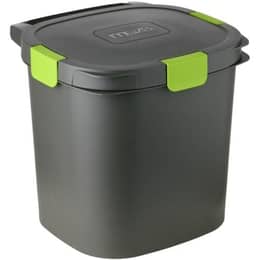
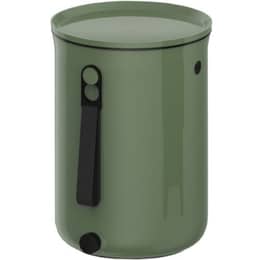
Bokashi Composter Confort
3.7-gallon (14-liter) capacity, sold individually or as a set of 2
$45.59 €40.83
Fast and odor-free, composting worms eat your food scraps and turn them into fertilizer for your plants.

From 2 to 4 trays, with an optional planter.

Up to 18 growing areas around a central worm composter.

Terracotta, with a flower pot.

From 2 to 4 trays, with a lower shelf.

Trays you add over time for easy vermicompost harvesting.

Turn your planters and flower beds into a worm composter: WORMacotta, In-Ground.
 Practical guide

From kitchen to garden, composting becomes simple, fast, and effective for everyone.
 Practical guide
 Practical guide
Live animals (worms and bait) and products to feed and care for pets and livestock.

Eisenia composting worms for your worm composter or compost bin.

Ultra-fresh worms: red worms, Dendros, and Canadian nightcrawlers from 3.5 oz (100 g) to 2.2 lb (1 kg).

Natural solutions dedicated to the well-being of horses, ponies, and donkeys.

Optimize the health and performance of your farm.

Mealworms: natural, nutritious supplements.
Beautify your home with our decorative pieces and care for your house in a natural, sustainable way.
Garden the eco-friendly way, in harmony with nature, for healthy, long-lasting plants.
EM-based products designed to enrich soil, protect plants, support animal health, and make everyday well-being and home care easier.

Contains a blend of 80 families of beneficial microorganisms.

Revitalize, purify, and improve water quality in all your applications.

Stimulate soil microbial activity and plant growth.

Clean and care for your surroundings naturally.

For the well-being and health of pets, livestock, and horses.

Enrich your body care and dietary routines with essential enzymes.
 Practical guidePractical guide

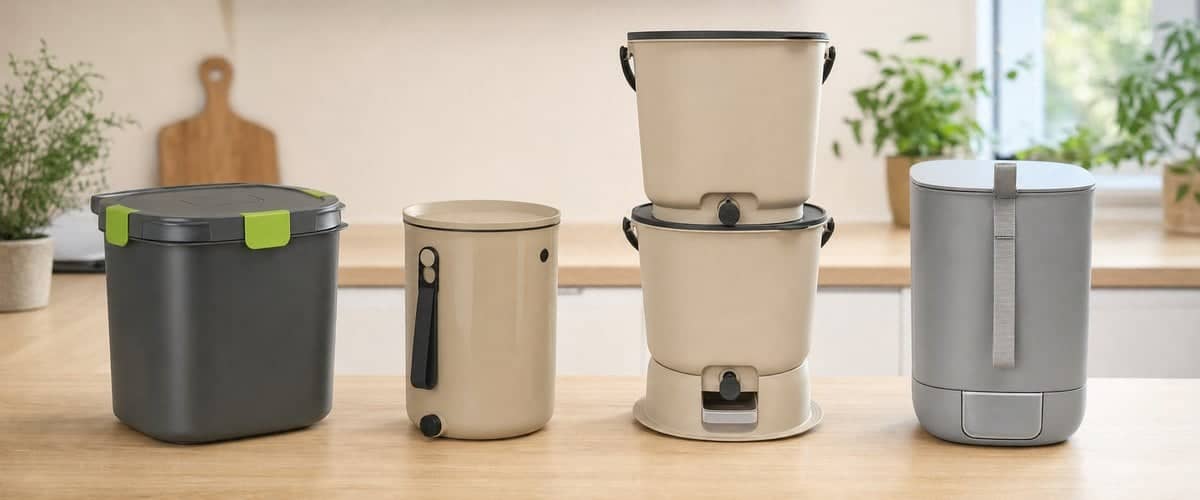
All bokashi buckets work on the same principle: an airtight container, a grid or strainer that keeps the food scraps above the liquid, and a way to drain that liquid off. Day to day, though, the difference comes down to details: capacity, how you drain it, the quality of the seal, and the compactor. A well-chosen bucket is one you'll enjoy using for years.
This guide first covers the criteria that really matter, then gives you an honest look at the four models we offer, with their strengths and their limitations.
This is the first criterion, and the one people most often get wrong. The right bucket is one you fill in roughly one to two weeks. If it's too small, it overflows within a few days and you end up juggling. If it's too large, it takes more than a month to fill: you open it dozens of times, air gets in every time, and the last layers wait a long time for their turn.
Bokashi is an airless fermentation. A lid that doesn't close properly invites bad smells and fruit flies. Check the quality of the seal and the closing system: clips, a lid with a wide gasket, or a snap-on lid.
Food scraps release a liquid that needs to be drained off regularly. There are three options: a spigot, which is handy but can loosen or clog over time; a screw-on drain plug, which is simpler, but you need to place a container underneath; or a collection drawer, the cleanest to use.
It separates the food scraps from the liquid. Without it, the bottom of the bucket sits in liquid and eventually starts to smell. A fine strainer, or one lined with a filter, also reduces the risk of a clogged spigot.
Pressing down each layer drives out the air, so it's an essential step. A compactor that covers the full width of the bucket presses more effectively and keeps your hands clean.
Measure the space you have available, under the sink for example, and allow for the height needed to slip a glass under the spigot. Also make sure the bucket is easy to clean: few nooks and crannies, and parts that come apart.
The usual guidelines are about 2.6 gallons (10 liters) for one or two people and about 4 gallons (15 liters) for three or four people. But the amount of food scraps varies enormously from one household to the next: depending on whether you cook a lot of fresh vegetables or lean toward prepared meals, the volume can double.
The simplest approach is to measure. For one week, collect your kitchen scraps in a small countertop compost pail and note how many times you empty it. Keep in mind that pressed-down scraps take up far less room than they do in the trash can.
Emy's tipBefore you buy, pour a week's worth of chopped scraps into a measuring container and press them down with the flat of your hand: you'll know how many liters your household really produces.
Whatever the capacity, one bucket isn't enough: once full, it needs to stay closed for at least two weeks. We explain why in our guide on the benefits of using two buckets.
All our buckets come with a measuring scoop and a 2.2 lb (1 kg) bag of our activator, which we make right here on the farm. Here's what sets them apart.
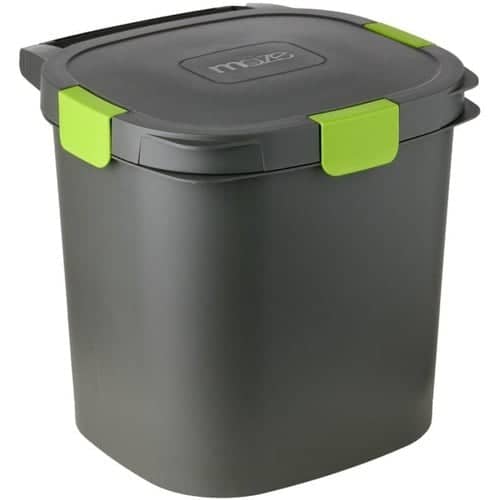 The Confort Bokashi Composter holds 3.7 gallons (14 liters), a good balance between capacity and size (about 11.4 in (29 cm) tall). Its gasketed lid locks with three latches, making it very airtight. The liquid drains through a spigot at the bottom of the bucket, beneath a grid that keeps the food scraps dry. The compactor hooks onto a holder on the back of the bucket, so it's always within reach.
Who is it for? A household of two to four people who want a simple, sturdy bucket.
Good to know: as with any bucket that has a spigot, plan to raise it slightly, on the edge of a shelf for example, so you can slip a glass underneath.
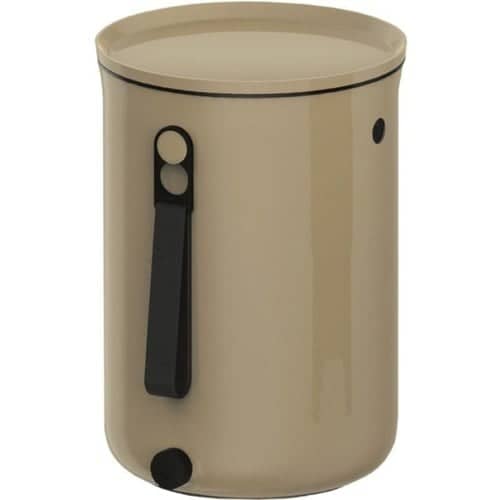 The Skaza Organko 2 Bokashi Composter is the smallest in our lineup: 2.5 gallons (9.6 liters), measuring about 9.8 in (25 cm) square and 13.4 in (34 cm) tall. Its design won a Red Dot Award, and it's made from recycled plastic. It consists of an airtight inner container that slides into an outer container, with a very handy carrying strap for taking it out to the garden.
Instead of a spigot, it has a screw-on drain plug: you unscrew it over a container and the liquid drains out. Fewer parts means less risk of leaks. Its compactor covers the full width of the bucket and folds in half to come out: just pull it by the longer part of the handle, without forcing it, and you can leave it in place on the scraps between additions.
Who is it for? A single person or a couple, a small kitchen, anyone who wants something discreet on the countertop.
Good to know: its small capacity means emptying it more often. With two buckets, rotating them is easy.
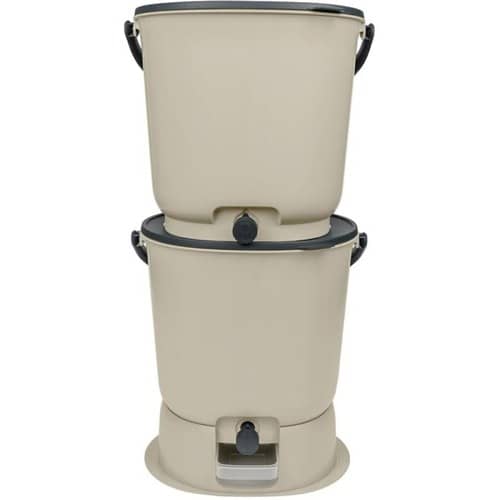 The Skaza Essential Bokashi Composter is sold as a kit of two buckets holding 4 gallons (15.3 liters) each, for a total of more than 7.9 gallons (30 liters). The buckets are made from recycled plastic sourced from packaging. Each one has its own built-in spigot and drainage strainer. A base, on which the buckets stack, includes a collection drawer that catches the liquid. The handle is wide and sturdy. According to the manufacturer, the buckets are dishwasher-safe up to 131 °F (55 °C).
Who is it for? Families, avid cooks, and anyone with a garden to feed.
Good to know: this is the bulkiest of our models (a footprint of about 13.8 × 11 in (35 × 28 cm) and 12.2 in (31 cm) tall per bucket). Measure your cabinet before ordering.
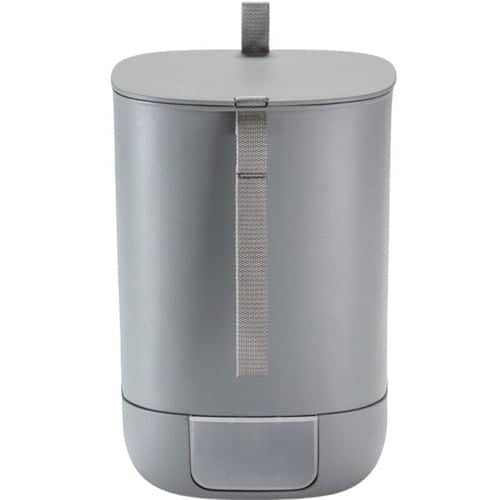 The Urbalive Bokashi Composter has a usable capacity of 2.8 gallons (10.6 liters), with a footprint of about 10.2 × 9.4 in (26 × 24 cm) and a height of 13.8 in (35 cm). What makes it special: the liquid drains into an 8.5 fl oz (0.25-liter) transparent drawer that slides under the bucket. Gently pressing the drawer lets the liquid flow, and as soon as you pull it out, an automatic valve closes. The bottom has a strainer lined with three interchangeable fabric filters, which let only the liquid through and keep the system from clogging. The lid has a very wide gasket, and the compactor spans the full width of the bucket.
Who is it for? A household of one to three people, and anyone who wants to collect the liquid cleanly, without holding a glass under a spigot.
Good to know: since the drawer is small, it needs emptying often, especially if you add a lot of fruit and vegetables.
Key takeawaysOrganko 2 and Urbalive for small households and small kitchens, Confort for a mid-sized household, Essential for families. Whichever you choose, plan on two buckets.
A well-maintained bokashi bucket lasts a long time. Parts that wear out or go missing, such as the Organko 2's plug or the Essential's strainer, are available as replacement parts, so there's no need to replace the whole bucket. Maintenance tasks, from the gasket to the spigot, are covered in detail in our guide on maintaining and draining your bokashi.
Two accessories are also genuinely useful: a small countertop compost pail for collecting the day's scraps so you open your bokashi less often, and a supply of activator stored somewhere dry. To get off to a good start with your new bucket, follow our method for starting your first bokashi step by step.
Did you know?There's no "miracle" bucket: they all work the same way. A simple bucket that's well pressed down, properly closed, and drained regularly will ferment better than a high-end model that gets opened every hour.
It's entirely possible with two nested food-grade buckets and a drill. The homemade version costs less, but the airtightness and draining aren't as convenient. If the idea appeals to you, follow our tutorial on making your own bokashi bucket. Think about the location before you choose, too: our guide on where to put your bokashi will help you make sure the model you have in mind will fit.
Choose the capacity first: a bucket you fill in one to two weeks. Then check how airtight the lid is, how the liquid is drained (spigot, plug, or drawer), and whether there's a grid and a good compactor. In our lineup, the Organko 2 and the Urbalive suit small households, the Confort mid-sized households, and the Essential families. Whatever the model, plan on two buckets so you never have to stop sorting your food scraps.
Scan the code or visit mouttafarm.com/guide: all our how-to guides, with links to the products mentioned.



 France
 Belgium
 Switzerland
 Germany
 Austria
 United Kingdom
 Italy
 Spain
 Holland
 Portugal
 Ireland
 Sweden
 Finland
 Denmark
 Greece
 Poland
 Rumania
 Czech Republic
