The Bokashi Urbalive has a usable capacity of 2.8 gallons (10.6 liters), ideal for everyday use in the kitchen. It comes as a complete kit with everything you need to get started right away and compost your food scraps with ease.
What sets this model apart is its built-in drawer for collecting the fermentation liquid, so you can easily drain off the valuable Bokashi tea without handling the scraps. Its compactor spans the full width of the bucket, pressing down the organic matter effectively and keeping out air, which is essential for good fermentation.
Bokashi isn't a traditional composter but rather a maceration process that breaks down your food scraps. It relies on EM bacteria (the activator), which are added to the Bokashi to speed up the fermentation of organic waste.
The word "bokashi" is a Japanese term meaning "fermented organic matter." It's fermented by EM (friendly bacteria), which speed up the fermentation of organic matter in the composter.
Bokashi is good for the soil: it enriches the earth, feeds your garden, and helps the planet by reducing everyday waste. Making compost with a Bokashi is very simple. With its stylish, discreet, and compact design, it makes an ideal kitchen composter.
WHAT CAN I PUT IN THE COMPOSTER?
Allowed:
Food scraps: fruits and vegetables;
Dairy products, meat, and fish bones;
Prepared foods: pizza, burgers, snacks, baked goods / cakes;
Other organic matter: coffee grounds.
Carbon-rich materials.
Not allowed:
Plastic, glass, metal, liquids, wood or wood shavings, ashes, sand, excrement.
Comes complete with:
- 1 (or 2) 2.8-gallon (10.6-liter) Bokashi Urbalive composter(s),
- 1 (or 2) grid / sieve,
- 3 (or 6) fabric filters for the sieve,
- 1 (or 2) automatic spigot(s),
- 1 (or 2) compactor(s),
- 1 (or 2) 8.5 fl oz (0.25-liter) drawer(s),
- 1 x 0.7 fl oz (20 mL) measuring scoop for the Bokashi activator,
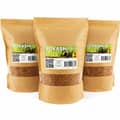
- 1 x 2.2 lb (1 kg) bag of compost activator (EM) made by Moutta Farm,
- 1 user guide.
Our high-fermentation Bokashi EM-1 activator is made by Moutta Farm!
Our ingredients are carefully selected, and we use official EM-1 from Professor Teruo Higa, the renowned inventor of bokashi, to guarantee superior quality.
We use raw materials sourced from our region: wheat bran from the Gers (32) and molasses from Béarn (64).
WHY TWO BOKASHIS?
The advantage of the two-bucket kit:
While fermentation is under way in the first composter (for 15 days), the second one is available so you can keep adding new food scraps (over the next 15 days).
We recommend using two Bokashis. Once the first one is full, it needs to stay closed and sit for 2 weeks while the food scraps ferment. In the meantime, you can start filling the second bucket, which is ready to go!

Advantages
This indoor composter has several strengths:
- A transparent drawer collects the compost tea as it drains, so liquid doesn't pool in the bucket. This improves fermentation by keeping the scraps in the bucket drier.
- When the compost tea drawer is pulled out, an automatic spigot system stops the liquid from continuing to drain.
- The lid has an extra-wide seal, making it completely airtight yet easy to open and close.
- The compactor is as wide as the bucket, so you can press down the scraps easily without getting your hands dirty.
- The bottom has a sieve and 3 interchangeable fabric filters. The filter lets only the compost tea through and keeps the spigot from clogging.
- Compact, stylish, and above all odorless, this composter is designed to blend seamlessly into your home.

How it works:
- Put your cooked and uncooked food scraps in the composter.
- Sprinkle with two tablespoons of Bokashi activator.
- Press down the scraps with the included compactor to squeeze the air out of the organic matter.
- Always keep the lid closed: the less air, the better.
- Drain off excess liquid using the spigot at the base of the composter.
When the bucket is full, empty the contents into a small hole or trench in your yard (or into your yard waste bin, a worm composter, or even your local recycling center).
At this stage, the scraps will be fermented but not yet decomposed. They need to go into the soil to physically break down into humus. Alternatively, you can add the contents of the bucket to your backyard composter. For best results, keep this organic matter covered with soil and other compostable materials.

































 USA. Calculate your shipping costs in your cart. We ship to 192 countries.





 Belgium
 Switzerland
 Germany
 United Kingdom
 Italy
 Spain
 Holland
 Portugal
 Ireland
 Sweden
 Finland
 Denmark
 Greece
 Poland
 Rumania
 Czech Republic
