












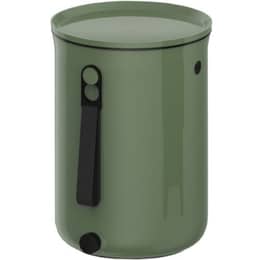
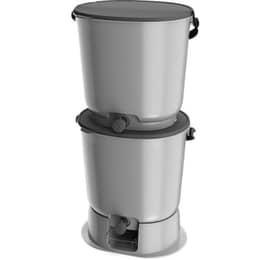
Bokashi Composter Skaza Organko 2
2.5-gallon (9.6 L) capacity, sold individually or as a set of 2
$75.35 €67.49
Fast and odor-free, composting worms eat your food scraps and turn them into fertilizer for your plants.

From 2 to 4 trays, with an optional planter.

Up to 18 growing areas around a central worm composter.

Terracotta, with a flower pot.

From 2 to 4 trays, with a lower shelf.

Trays you add over time for easy vermicompost harvesting.

Turn your planters and flower beds into a worm composter: WORMacotta, In-Ground.
 Practical guide

From kitchen to garden, composting becomes simple, fast, and effective for everyone.
 Practical guide
 Practical guide
Live animals (worms and bait) and products to feed and care for pets and livestock.

Eisenia composting worms for your worm composter or compost bin.

Ultra-fresh worms: red worms, Dendros, and Canadian nightcrawlers from 3.5 oz (100 g) to 2.2 lb (1 kg).

Natural solutions dedicated to the well-being of horses, ponies, and donkeys.

Optimize the health and performance of your farm.

Mealworms: natural, nutritious supplements.
Beautify your home with our decorative pieces and care for your house in a natural, sustainable way.
Garden the eco-friendly way, in harmony with nature, for healthy, long-lasting plants.
EM-based products designed to enrich soil, protect plants, support animal health, and make everyday well-being and home care easier.

Contains a blend of 80 families of beneficial microorganisms.

Revitalize, purify, and improve water quality in all your applications.

Stimulate soil microbial activity and plant growth.

Clean and care for your surroundings naturally.

For the well-being and health of pets, livestock, and horses.

Enrich your body care and dietary routines with essential enzymes.
 Practical guidePractical guide

Your bucket has fermented for two weeks, it smells sour, and a white film covers the surface: congratulations, the first stage was a success. But what you have on your hands isn't compost yet. It's a pre-compost, acidic and stabilized, that now needs to meet the life in the soil to become earth.
Burying it in the garden is the simplest and most effective way to put it to use. You still need to do it in the right place, at the right depth, and give the soil time to do its work. Here's the method, the timing, and the mistakes to avoid.
In the bucket, lactic acid bacteria have acidified the scraps without really breaking them down: the peels are softened but still recognizable. Once in the ground, everything changes. Oxygen returns, and bacteria, fungi, and earthworms take over. The pH rises, the material breaks apart, and within a few weeks your food scraps turn into soil.
This transformation has a practical consequence: for the first few days, the burial area is an acidic and very nutrient-rich environment. In a trial on spinach, soil into which a large dose of bokashi had just been mixed contained around 288 mg of ammonium per kilogram, compared with about 5 in the control soil. Six weeks later, this level had dropped back to around 14 mg/kg. Nothing to worry about for the soil, but it's a good reason to keep young roots away from fresh bokashi.
Did you know?Earthworms steer clear of bokashi for the first few days because of its acidity. After that, they happily move in: this is often when you find lots of worms in the burial area.
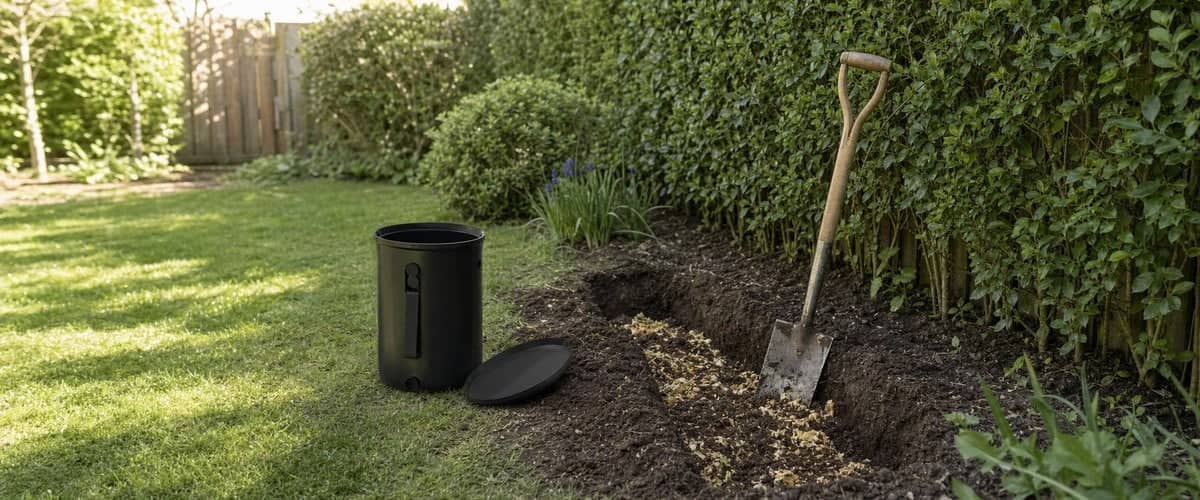
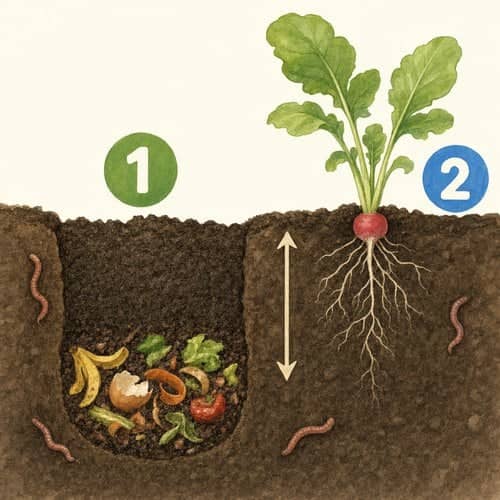 You don't need a vegetable garden: a corner of the yard, the foot of a hedge, or the space between shrubs all work very well. Recommendations range from 4–12 in (10–30 cm) depending on the source. We recommend digging a trench or holes 8–12 in (20–30 cm) deep. That's deep enough that animals (dogs, foxes, birds) won't be tempted to dig it up, and shallow enough to stay in the most biologically active layer of soil.
We prefer a trench: the bokashi spreads out in a thinner layer, touches more soil, and breaks down faster. A 4-gallon (15-liter) bucket fits comfortably in a trench about one spade wide and 3.3 ft (1 m) long. If you only have small open spaces, several holes are better than one big one.
If animals in your neighborhood are very persistent, dig deeper and cover the area with fine wire mesh while it breaks down. We cover these situations in detail in the guide Problems after burying. On the diagram: the bokashi mixed with soil at the bottom of the trench, 8–12 in (20–30 cm) deep (1), and established plants, kept about 12 in (30 cm) away (2).
This is the step that makes the biggest difference. A compact clump of bokashi dropped at the bottom of a hole stays acidic and wet longer, and can smell bad. Mixed with soil, it breaks down much more quickly.
 Dig the trench and set the soil aside.
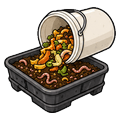 Empty the bucket into the bottom and spread the contents in a layer a few inches thick.
 Roughly chop it up with the spade, mixing it with about 2 to 3 times its volume of soil.
 Fill in with the rest of the soil, so nothing is visible anymore.
 Water lightly if the soil is dry, then cover with dead leaves or mulch.
Emy's tipPush a small stake into the ground wherever you bury a bucket, with the date written on it. You'll know when you can plant there, and you won't bury the next bucket in the same spot.
Fresh bokashi is acidic and high in salts and ammonium. In direct contact with roots, it can damage them. Keep it about 12 in (30 cm) away from established plants. The roots will find their own way to the nutrients once the area has turned into soil.
Reliable sources agree on one point: you don't sow or plant right away. Our guidelines:
 at least 2 weeks in warm, living soil, in late spring or summer;
 3 to 4 weeks is even better, and it's the waiting time we recommend by default;
 longer in cold, heavy, or compacted soil: allow up to 6 to 8 weeks in early spring or late fall.
How can you tell when it's ready? Scratch the surface a little: the soil should no longer smell sour, and the scraps should be almost unrecognizable. A few hard bits (fruit pits, bones, thick stems) may still be lying around: they'll disappear over the following weeks and won't get in the way of planting. If the sour smell lingers beyond two weeks, it's often because the bokashi was too concentrated or not mixed in well enough.
Key takeaways8–12 in (20–30 cm) deep, 2 to 3 volumes of soil for 1 volume of bokashi, 12 in (30 cm) from roots, and at least 2 weeks before planting (3 to 4 is better, longer in cold soil).
In the vegetable garden, the ideal is to bury bokashi in an empty bed a few weeks before planting it. Set up a rotation: each bucket goes into the next bed, and you plant where you buried a month earlier. In practice:
 in spring, bury in the beds that will get heavy feeders (squash, tomatoes, cabbage) in May or June;
 in summer, use the beds freed up after harvest (potatoes, peas);
 in fall, bury in the beds that will stay bare all winter.
If the ground is frozen, don't force it: a fermented bucket keeps for several months with the lid closed, even in the cold. You'll find our tips in the guide Bokashi in winter, in summer, and on vacation.
For trees and shrubs, dig holes 10–12 in (25–30 cm) deep just beyond the drip line, where the fine roots that absorb water and nutrients are found. Mix the bokashi with the soil you dug out, fill in, and water lightly. Choose a new spot each time, working your way around the tree.
In an established flower bed or hedge, dig small trenches between the rows or between the clumps, keeping the right distance from the roots. For perennials, a few small, well-spread additions are better than a whole bucket in one spot.
 Spread bokashi on the surface or use it as mulch. Exposed to the air, it doesn't dry properly, smells, and attracts flies and animals. Kitchen bokashi always gets buried. Not to be confused with EM Bokashi mulch for soil, a different, dry product designed to be spread.
 Put everything in a single hole, season after season. The area becomes too concentrated and takes a long time to break down.
 Plant the same day in the burial area.
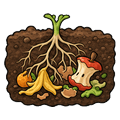 Bury it at the base of a plant hoping to feed it directly.
 Forget to rinse the bucket with clean water before filling it again.
No yard, or no room to dig? There are other options, from a large tub of soil on the balcony to a composter: see our guides No garden? What to do with your bokashi and Bokashi and garden compost.
Fermented bokashi is a pre-compost: it's the soil that turns it into earth. Bury it 8–12 in (20–30 cm) deep, preferably in a trench, well mixed with 2 or 3 times its volume of soil and about 12 in (30 cm) from roots. Wait at least two weeks before planting, ideally three to four, longer if the soil is cold. In the vegetable garden, set up a bed rotation; around trees, dig beyond the drip line. And never leave it on the surface.
Scan the code or visit mouttafarm.com/guide: all our how-to guides, with links to the products mentioned.



 France
 Belgium
 Switzerland
 Germany
 Austria
 United Kingdom
 Italy
 Spain
 Holland
 Portugal
 Ireland
 Sweden
 Finland
 Denmark
 Greece
 Poland
 Rumania
 Czech Republic
