












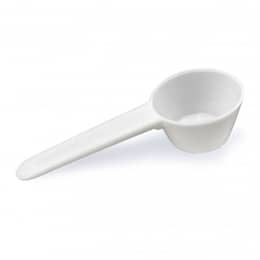
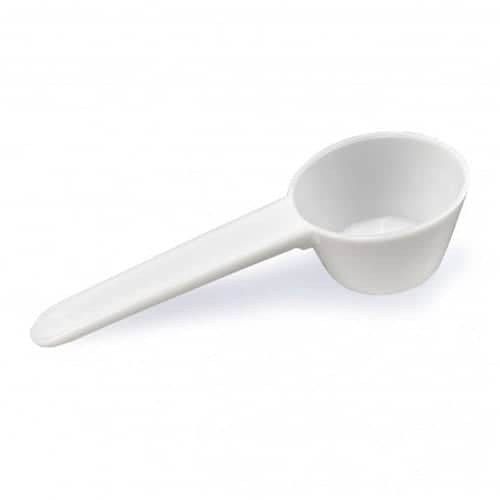
20 ml measuring spoon
Measure amounts precisely
$2.70 €2.42
Fast and odor-free, composting worms eat your food scraps and turn them into fertilizer for your plants.

From 2 to 4 trays, with an optional planter.

Up to 18 growing areas around a central worm composter.

Terracotta, with a flower pot.

From 2 to 4 trays, with a lower shelf.

Trays you add over time for easy vermicompost harvesting.

Turn your planters and flower beds into a worm composter: WORMacotta, In-Ground.
 Practical guide

From kitchen to garden, composting becomes simple, fast, and effective for everyone.
 Practical guide
 Practical guide
Live animals (worms and bait) and products to feed and care for pets and livestock.

Eisenia composting worms for your worm composter or compost bin.

Ultra-fresh worms: red worms, Dendros, and Canadian nightcrawlers from 3.5 oz (100 g) to 2.2 lb (1 kg).

Natural solutions dedicated to the well-being of horses, ponies, and donkeys.

Optimize the health and performance of your farm.

Mealworms: natural, nutritious supplements.
Beautify your home with our decorative pieces and care for your house in a natural, sustainable way.
Garden the eco-friendly way, in harmony with nature, for healthy, long-lasting plants.
EM-based products designed to enrich soil, protect plants, support animal health, and make everyday well-being and home care easier.

Contains a blend of 80 families of beneficial microorganisms.

Revitalize, purify, and improve water quality in all your applications.

Stimulate soil microbial activity and plant growth.

Clean and care for your surroundings naturally.

For the well-being and health of pets, livestock, and horses.

Enrich your body care and dietary routines with essential enzymes.
 Practical guidePractical guide

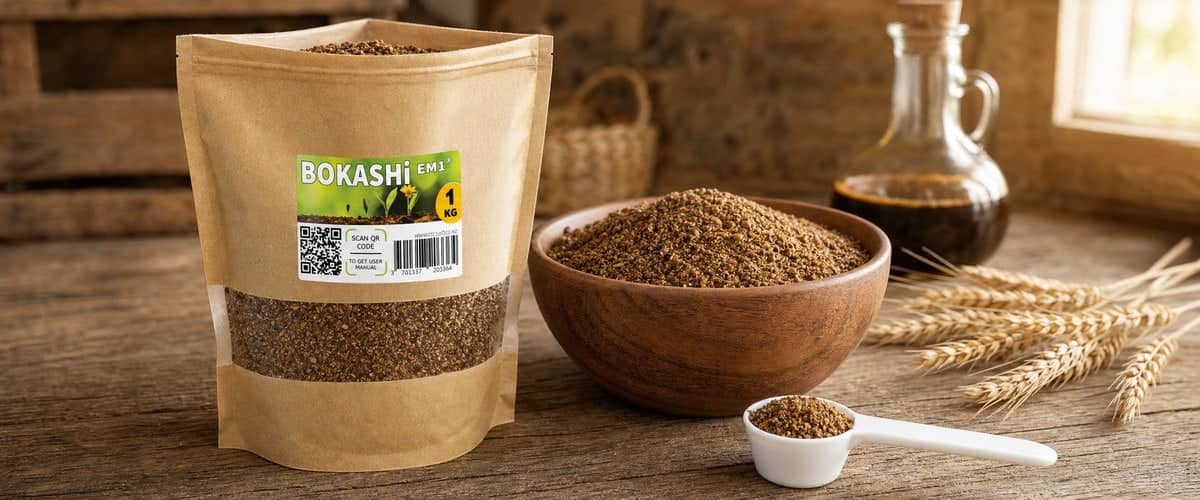
In a bokashi system, the bucket is the container, but the bran does the work. This little brown mixture, with its yeasty smell, provides the microorganisms that make your food scraps ferment instead of rot. Without it, there's no reliable fermentation.
What's in it? Why is it essential? How much should you use, and how can you tell whether it's still good? Here's everything you need to know about the activator, so you use enough without wasting it.
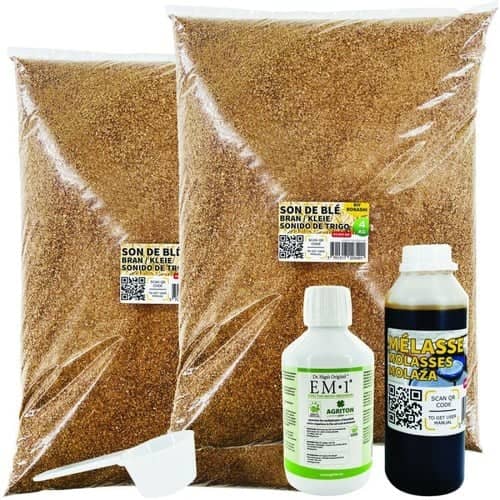 Bokashi bran, also called activator, starter, or "bokashi grains," is a dry carrier loaded with fermentation microorganisms. Most often, it's made from:
 wheat bran, the outer layer of the grain, which serves as the carrier: it's light and absorbent, and it offers a large surface area for the microorganisms. Some manufacturers also use rice bran, spelt hulls, or sawdust;
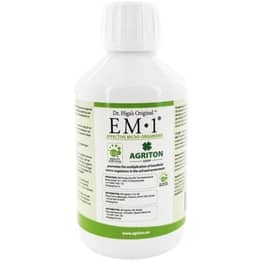
 effective microorganisms (EM), a blend dominated by lactic acid bacteria, which manufacturers combine with yeasts and photosynthetic bacteria;
 molasses, a syrup made from sugar beets or sugarcane, which feeds the microorganisms as they get going;
 non-chlorinated water.
The damp mixture is packed down away from the air and left to ferment for several weeks, like a small bokashi. The microorganisms multiply, and the bran is then often dried so it keeps. Our Bokashi EM Compost Activator is made this way, right here on the farm, then lightly dried: it keeps for two years, and its production date is printed on the bag. To learn exactly what EM are and how the different products in the range compare, see our guide EM-1, EM-A, Microferm: choosing the right EM product.
Did you know?Once dried, the bran stops fermenting: its microorganisms go into a kind of dormancy. The moisture in your food scraps wakes them up when you sprinkle the bran into the bucket. That's why well-dried bran keeps for months, while bran left damp changes and spoils more quickly.
Your food scraps already carry thousands of microbes, including some lactic acid bacteria. But they also carry putrefying bacteria, especially on meat, fish, and leftovers that are a bit past their prime. In a sealed bucket, it's a race: whichever microbes take hold first set the tone.
The bran tips the balance in the right direction, in three ways:
 it heavily inoculates each layer with lactic acid bacteria, which acidify the environment from the very first days;it provides a little easy-to-use food, thanks to the molasses and the bran;
 it absorbs some of the moisture at the surface, where contact with the air is greatest.
Without an activator, a sealed bucket of food scraps may smell like rotten eggs or a sewer instead of pickles. There are homemade alternatives, based on whey for example, but their results are less consistent, so you need to use more.
Instructions and guides give different doses: one 20 ml spoonful per addition for some, two tablespoons for others, or one to two tablespoons per quart (about 1 liter) of food scraps. All these recommendations are in the same ballpark. We recommend:
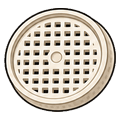 at the bottom of the empty bucket: one dose of about 4 teaspoons (20 ml) on the grid;
 on each 1.2–2 in (3–5 cm) layer of food scraps: a dose of 3–4 teaspoons (15–20 ml), or about one heaping tablespoon or a small handful, spread over the whole surface;
 on the final layer, when the bucket is full: a double dose.
Our 20 ml Measuring Spoon takes the guesswork out of it. The full method is described in our guide Starting your first bokashi bucket.
 Meat, fish, cheese, eggs: these protein-rich leftovers are the most delicate. Be much more generous on these layers. Our guide What food scraps can go in a bokashi explains the precautions to take with them.Very wet scraps: melon, watermelon, squeezed citrus, salad, leftover cooked vegetables.
 In winter, when the room is cool: the microorganisms work more slowly.
 At the first sign of trouble: an odor turning unpleasant, colored patches of mold. A good dose of bran followed by careful packing down will often set things right. Our guide Mold in bokashi will help you tell good from bad.
 Too much bran doesn't harm fermentation: it's simply wasted, and it adds a little dry matter to the bucket. When in doubt, it's better to use a little too much than too little, without burying each layer under a thick crust.
As a rough guide, plan on 4.4–13 lb (2–6 kg) of bran a year for a family of four: a 2.2 lb (1 kg) bag therefore lasts roughly two to six months, and closer to six months for a two-person household. With a very generous hand, or lots of meat, fish, and wet leftovers, it may last only a month.
Key takeawaysThe right dose: about 4 teaspoons (20 ml) of bran per 1.2–2 in (3–5 cm) layer of food scraps, more for meat, fish, wet scraps, and in winter. When in doubt, a little more rather than a little less.
You can recognize a good activator by its smell first. It smells like yeast, bread, or beer, or has a sweet-and-sour note, sometimes slightly alcoholic. It's dry or barely damp, brown in color, and crumbles easily. A few filaments or a light white bloom are nothing to worry about: they're a sign of fermentation.
Replace your bran if it shows any of these signs:
 it smells moldy, musty, or rotten;
 it doesn't smell like anything at all: the microorganisms are probably too weak;
 it has green, blue, or black mold;
 it has become damp and sticky, or has formed compact clumps.
Questionable bran shouldn't go into the bucket, where it could trigger a bad fermentation. You can, however, scatter it on your backyard composter.
 In an airtight container: its original bag tightly closed, a box with a lid, or a jar.
 Somewhere dry: moisture is its main enemy, because it restarts fermentation inside the bag.
 Away from light and heat: a cool cabinet rather than the windowsill or the top of the oven.
 Not for too long: dried and well stored, bran keeps for one to two years, depending on the manufacturer. Ours keeps for two years from the production date printed on the bag; for homemade bran, plan on about a year.
Emy's tipAlways scoop out the bran with a completely dry spoon and close the bag again right away. A wet spoon or a bag left open by the sink is all it takes for moisture to get into the whole package.
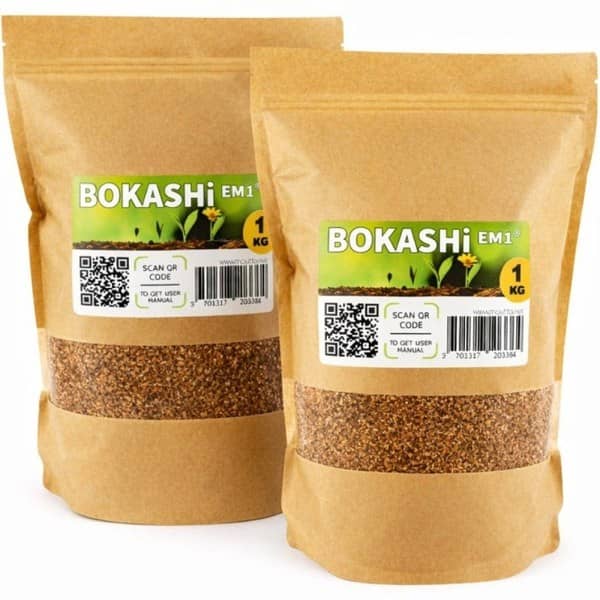
Buying a ready-to-use activator is the simplest option when you're starting out: the fermentation is already under control, and the bran is dry and consistent. That's what we recommend for your first buckets.
Making your own bran becomes worthwhile once you use bokashi regularly, or with other people. You need wheat bran, EM-1, molasses, non-chlorinated water, and three weeks of fermentation without opening, followed by drying. Our Kit for making your own Bokashi & Compost activator brings all the ingredients together, and our complete step-by-step recipe is in our guide Making your own bokashi activator.
Finally, if you're wondering what microorganisms really contribute beyond getting fermentation started, our guide Bokashi and EM: what the science says lays out the facts without exaggeration.
Bokashi bran is wheat bran fermented with effective microorganisms and molasses, usually dried so it keeps. It's essential because it inoculates each layer with lactic acid bacteria and gives fermentation the head start it needs over putrefaction. Use about 4 teaspoons (20 ml) per 1.2–2 in (3–5 cm) layer, more for meat, fish, wet scraps, and in winter. Good bran smells yeasty or sweet-and-sour; if it smells moldy or like nothing at all, replace it. Keep it dry, cool, away from light, and tightly closed: ours keeps for up to two years (production date on the bag), and homemade bran for about a year.
Scan the code or visit mouttafarm.com/guide: all our how-to guides, with links to the products mentioned.



 France
 Belgium
 Switzerland
 Germany
 Austria
 United Kingdom
 Italy
 Spain
 Holland
 Portugal
 Ireland
 Sweden
 Finland
 Denmark
 Greece
 Poland
 Rumania
 Czech Republic
