












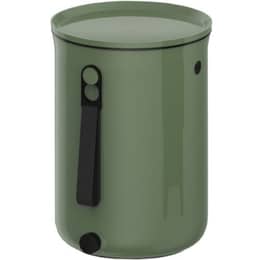
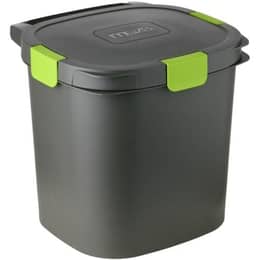
Bokashi Composter Skaza Organko 2
2.5-gallon (9.6 L) capacity, sold individually or as a set of 2
$75.35 €67.49
Fast and odor-free, composting worms eat your food scraps and turn them into fertilizer for your plants.

From 2 to 4 trays, with an optional planter.

Up to 18 growing areas around a central worm composter.

Terracotta, with a flower pot.

From 2 to 4 trays, with a lower shelf.

Trays you add over time for easy vermicompost harvesting.

Turn your planters and flower beds into a worm composter: WORMacotta, In-Ground.
 Practical guide

From kitchen to garden, composting becomes simple, fast, and effective for everyone.
 Practical guide
 Practical guide
Live animals (worms and bait) and products to feed and care for pets and livestock.

Eisenia composting worms for your worm composter or compost bin.

Ultra-fresh worms: red worms, Dendros, and Canadian nightcrawlers from 3.5 oz (100 g) to 2.2 lb (1 kg).

Natural solutions dedicated to the well-being of horses, ponies, and donkeys.

Optimize the health and performance of your farm.

Mealworms: natural, nutritious supplements.
Beautify your home with our decorative pieces and care for your house in a natural, sustainable way.
Garden the eco-friendly way, in harmony with nature, for healthy, long-lasting plants.
EM-based products designed to enrich soil, protect plants, support animal health, and make everyday well-being and home care easier.

Contains a blend of 80 families of beneficial microorganisms.

Revitalize, purify, and improve water quality in all your applications.

Stimulate soil microbial activity and plant growth.

Clean and care for your surroundings naturally.

For the well-being and health of pets, livestock, and horses.

Enrich your body care and dietary routines with essential enzymes.
 Practical guidePractical guide

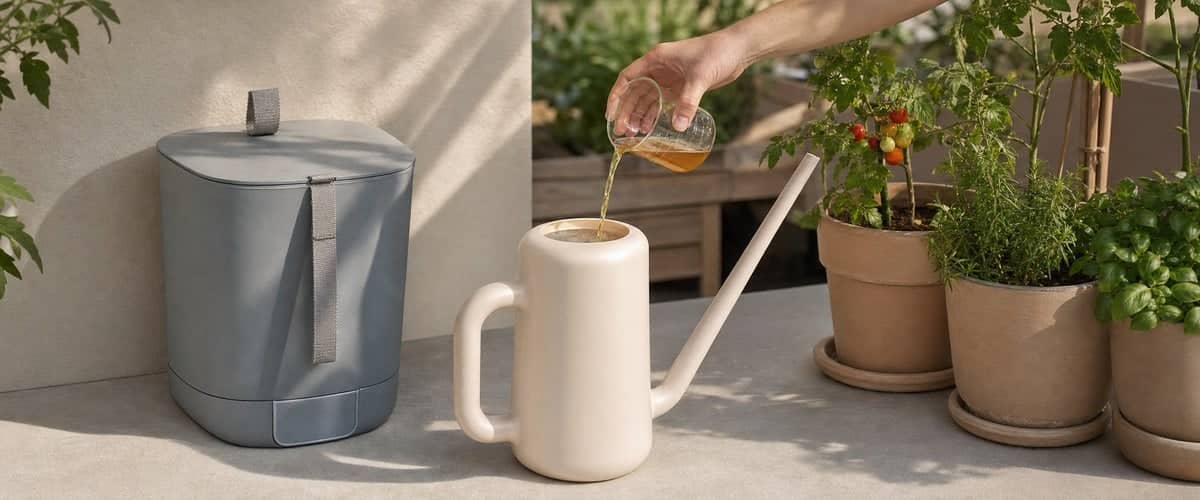
At the bottom of your bucket, an amber liquid builds up day by day: this is bokashi juice, also known as “bokashi tea.” It's sometimes credited with every virtue under the sun. The reality is more nuanced: well diluted and poured at the base of plants, it makes a handy little nutritional supplement; undiluted, it's too acidic and too concentrated for them.
This guide explains what it really contains, the dilution to stick to, the right way to use it, and what not to expect from it.
The juice is the water released by food scraps as they ferment, pressed down under their own weight. How much you get depends mainly on what you put in the bucket: fruits and vegetables release a lot, bread and cooked leftovers much less. It often appears after a few days, sometimes not until the second week, and it's normal to get very little in winter.
Several analyses tell us what it contains:
 It's very acidic: its pH ranges from 3.5 to 4.9 depending on the measurements, an acidity comparable to that of orange juice.
 It's low in nitrogen: around 130 to 300 mg per liter, almost entirely in the form of ammonium.
 It's rich in potassium and phosphorus: roughly 2,400 to 4,300 mg of potassium per liter and 500 to 1,000 mg of phosphorus in the samples analyzed.
 It can be salty: juice from cooked meal leftovers contained far more sodium and chlorides than juice from peels.
 It's alive: it mainly contains lactic acid bacteria, the same ones that fermented the bucket.
Did you know?In an analysis of juice from four different kitchens, the juice from a household that mostly added peels was the richest in potassium, phosphorus, and calcium, and among the least salty. So the most useful juice for plants comes from peels, not from meal leftovers.
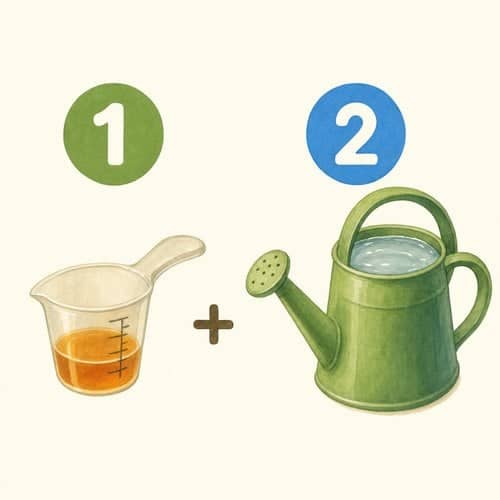 The basic rule, found in our instructions as well as those of most manufacturers, is a dilution of 1:100, in other words 1.3 fl oz of juice per gallon of water (10 ml per liter). For a 2.6-gallon (10-liter) watering can, that comes to 3.4 fl oz (100 ml), or a small glass. This is a minimum: some sources recommend 1:200 or even more if you water more than once a week or if your plants are sensitive.
Diluting more carries no risk. Diluting less, on the other hand, exposes the roots to an acidic, salty liquid. When in doubt, use less juice, never more.
As for frequency, watering with juice once a week to once every two weeks is plenty. The rest of the time, use plain water. In the diagram: a dose of 10 ml of juice (1) per liter of water (2).
Emy's tipKeep a dosing syringe or a small measuring cup by the watering can, set aside just for the juice. You'll measure accurately in seconds, without ever pouring “by eye.”
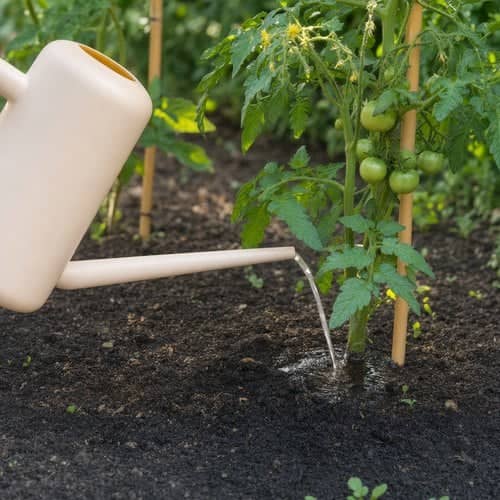 Always pour the diluted juice onto the soil, at the base of the plants, on soil that's already slightly moist. Some manufacturers allow spraying it on the foliage early in the morning, but leaves are much more sensitive than roots, and this acidic mixture can mark them. Our instructions advise against it, and we stand by that advice: soil only.
Diluted juice works well for vegetable garden plants, flower beds, shrubs, and houseplants.
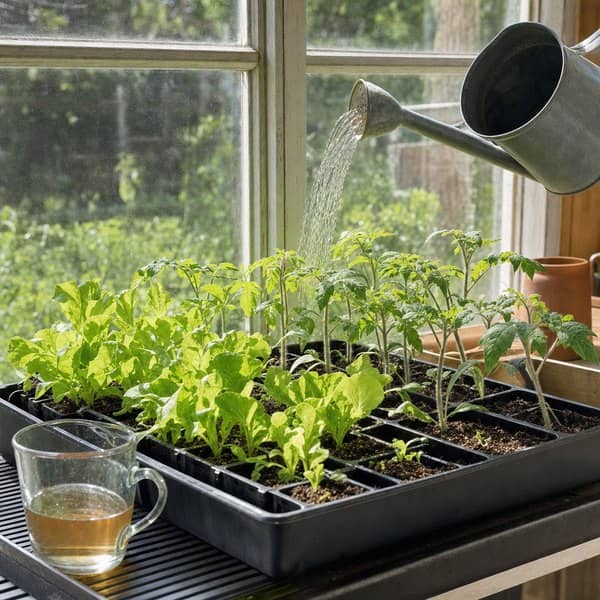
For seeds, seedlings, and cuttings, dilute between 1:500 and 1:1000, which is about ¾ to 1½ teaspoons per gallon of water (1 to 2 ml per liter). One teaspoon (5 ml) in a 1.3-gallon (5-liter) watering can gives 1:1000; in 0.66 gallon (2.5 liters), about 1:500.
A published trial on tomato plants used exactly these dilutions: seeds soaked for half an hour in juice diluted at 1:500, then watered weekly at 1:1000. According to the authors, stem diameter was about 13% greater than in plants watered with plain water. The treated plants were also slightly taller, but this difference was not statistically significant, and the trial involved only a few plants. It's encouraging, nothing more. To learn more about seedlings and microorganisms, see the EM guide article Seedlings, young plants, and repotting with EM.
The juice is a living liquid that changes quickly once it leaves the bucket. We recommend using it the same day or the day after draining, and diluting only the amount you need. If you have to keep it for a few days, store it in a well-filled, tightly closed bottle in the fridge or somewhere cool and dark. Some bucket manufacturers claim it keeps for up to a month under these conditions, but we prefer to err on the side of caution. A distinctly bad smell or colored mold is a sign that it should be thrown out.
If your spigot gives almost nothing, that's not a problem: the bucket works perfectly well with little juice. We explain draining and how often to do it in the article Looking after your bokashi. A model with a spigot, such as the Comfort Bokashi Composter, makes collecting the juice easier.
Many instructions, including ours, suggest pouring the undiluted juice down the sink, shower, or toilet. It's a good way to use it when you have no use for it in the garden: rather than throwing it away, pour it down a drain, followed by a little water.
However, we can't promise that it unclogs pipes or maintains a septic tank: no study has shown this, and biological septic tank additives in general have no proven long-term effect. The subject is covered in the EM guide article Septic tanks, drains, and composting toilets. Just remember that it's no substitute for a drain snake or having the tank pumped.
Bokashi juice is not a complete fertilizer. Because it's low in nitrogen, it can't feed a plant on its own: in a pot trial, plants fed only with diluted juice grew noticeably less than plants given a conventional fertilizer. It mainly provides potassium, some phosphorus, and soluble organic matter. Think of it as a supplement, alongside living soil, compost, or vermicompost.
Nor is it compost tea: the liquid from a worm composter, which is less acidic, is diluted differently, as explained in our article Harvesting vermicompost and worm tea. Don't mix up the two recipes.
Finally, if your bucket gets a lot of salty meal leftovers, its juice will be salty too. In that case, it's better to save it for the drains rather than for potted plants, where salt builds up more easily. We also discuss this in the article What food scraps can go in a bokashi?
Key takeawaysNever undiluted, always at the base: at least 1:100 for established plants, 1:500 to 1:1000 for seedlings and young plants, used within 24 to 48 hours.
Bokashi juice is an acidic liquid, low in nitrogen but rich in potassium, that gives plants a small boost when used properly. Dilute it at least 1:100 (1.3 fl oz per gallon, or 10 ml per liter) for established plants and 1:500 or 1:1000 for seedlings, pour it onto the soil rather than the leaves, and use it within two days. Any leftover juice can go down the drain, just don't expect miracles. And to truly feed your plants, rely first on buried bokashi and living soil.
Scan the code or visit mouttafarm.com/guide: all our how-to guides, with links to the products mentioned.



 France
 Belgium
 Switzerland
 Germany
 Austria
 United Kingdom
 Italy
 Spain
 Holland
 Portugal
 Ireland
 Sweden
 Finland
 Denmark
 Greece
 Poland
 Rumania
 Czech Republic
