












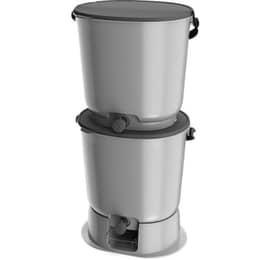
Skaza Essential Bokashi Composter
4-gallon (15.3-liter) capacity, set of 2 buckets
$71.65 €64.17
Fast and odor-free, composting worms eat your food scraps and turn them into fertilizer for your plants.

From 2 to 4 trays, with an optional planter.

Up to 18 growing areas around a central worm composter.

Terracotta, with a flower pot.

From 2 to 4 trays, with a lower shelf.

Trays you add over time for easy vermicompost harvesting.

Turn your planters and flower beds into a worm composter: WORMacotta, In-Ground.
 Practical guide

From kitchen to garden, composting becomes simple, fast, and effective for everyone.
 Practical guide
 Practical guide
Live animals (worms and bait) and products to feed and care for pets and livestock.

Eisenia composting worms for your worm composter or compost bin.

Ultra-fresh worms: red worms, Dendros, and Canadian nightcrawlers from 3.5 oz (100 g) to 2.2 lb (1 kg).

Natural solutions dedicated to the well-being of horses, ponies, and donkeys.

Optimize the health and performance of your farm.

Mealworms: natural, nutritious supplements.
Beautify your home with our decorative pieces and care for your house in a natural, sustainable way.
Garden the eco-friendly way, in harmony with nature, for healthy, long-lasting plants.
EM-based products designed to enrich soil, protect plants, support animal health, and make everyday well-being and home care easier.

Contains a blend of 80 families of beneficial microorganisms.

Revitalize, purify, and improve water quality in all your applications.

Stimulate soil microbial activity and plant growth.

Clean and care for your surroundings naturally.

For the well-being and health of pets, livestock, and horses.

Enrich your body care and dietary routines with essential enzymes.
 Practical guidePractical guide

Bokashi works year-round, but not in quite the same way in January as in July. Cold slows the microorganisms down, while heat speeds everything up, including juice production and the appetite of fruit flies. And when it's time to go on vacation, many people wonder whether they can leave their bucket on its own.
The good news: with a few simple adjustments, bokashi handles the seasons and your time away with no trouble at all. Here's how.
The lactic acid bacteria and yeasts that ferment your food scraps work best at room temperature, around 64–77 °F (18–25 °C). The cooler it gets, the more they slow down: below about 50 °F (10 °C), fermentation is noticeably slower, and at around 41 °F (5 °C), it has almost stopped. The cold doesn't undo the work already done: it simply puts it on hold, and fermentation picks up again when the temperature rises.
On the other hand, a bucket kept somewhere warm ferments faster, produces more juice, and gives off a stronger smell when you open it. What you should avoid above all is direct sunlight, which drives the temperature of a plastic bucket well above that of the room. To pick the right spot, see our guide on where to put your bokashi.
Did you know?Cold doesn't harm bokashi that has already fermented. Once the two-week resting period is over, the bucket can even freeze without any damage: it will wait patiently for the thaw.
 Bring the bucket indoors if it usually lives on a balcony or in a garage. A bucket that's still being filled needs a room at a moderate temperature to get off to a good start. Outdoors, repeated freezing and thawing can also crack the lid or the spigot.
 Be a little more generous with the activator, especially with meat, fish, and moist scraps: a good start matters more when it's cool.
 Cut things smaller. Small pieces ferment faster and pack down better.
 Press down, but never stir. Some winter advice suggests mixing the contents of the bucket: that's a mistake. Stirring lets air in, while bokashi needs to be kept away from it.
Expect less juice, too: that's normal in cold weather. Keep draining it regularly all the same.
In a cool room, extend the resting time of the full bucket by one to two weeks. Three or four weeks instead of two is no problem at all: a well-sealed bucket doesn't mind waiting. Timing guidelines are covered in detail in our guide on fermentation time and the signs that bokashi is ready.
Emy's tipSet the bucket on a board or a piece of thick cardboard rather than on a cold tile floor: it will hold on to the warmth of the room better.
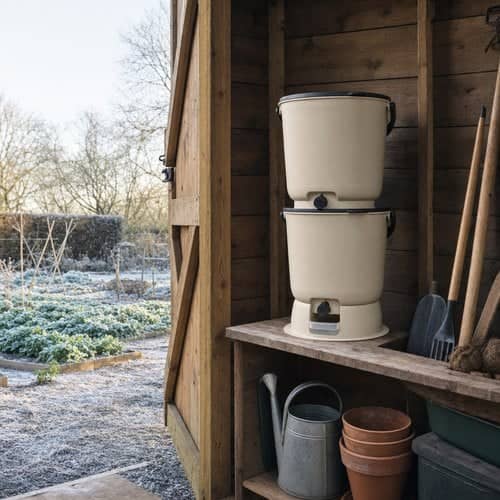 In most regions of France, bokashi can be buried almost all winter long, on a day without frost. Cold soil simply breaks it down more slowly: allow more time before planting. But in the mountains, or during a harsh winter, the ground can stay hard for several weeks. You then have several options:
In spring, bury your stock as soon as the soil can be worked, following our guide to burying bokashi in the garden. If you have a lot stored up, a third bucket or a storage container makes winter much easier: we explain this in our guide on the two-bucket rotation.
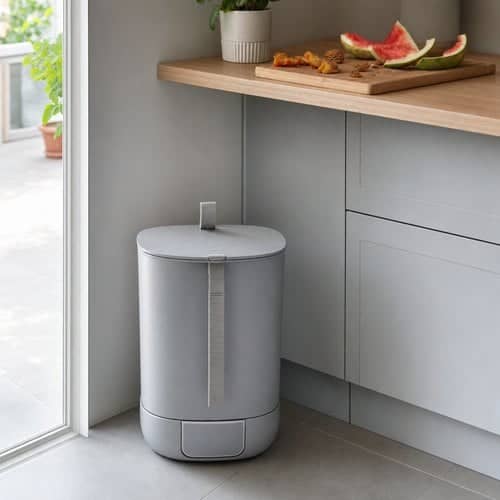 Heat speeds up fermentation, which is actually good news. But it does call for a little more attention.
 Drain more often. Summer fruits and vegetables are full of water, so the bucket produces more juice. Drain every other day, or even daily during a heat wave.
 Keep the bucket in the shade. Bring it inside if your balcony gets direct sun, and keep it away from sliding glass doors and large windows.
 Keep fruit flies away. They don't come from a properly closed bokashi: they're drawn to scraps left out in the open and to drips of juice. Empty your kitchen compost pail every day, sprinkle activator right after each addition, and wipe the rim of the lid and the spigot.
 Stick to the two-week rest. Even though fermentation goes faster in hot weather, this waiting period ensures a reliable result.
If the lid bulges slightly from the pressure of fermentation gases, or if an unusual smell appears, our guide bad smells, too much juice, fruit flies will help you figure out what's going on.
This is one of bokashi's great advantages: it gets along just fine without you. Unlike a worm composter, there's no one to feed. Before you leave:
 Empty your kitchen compost pail into the bokashi: nothing should be left out in the open.Sprinkle a good layer of activator on top, press down, and close the lid tightly.Drain the juice down to the last drop and make sure the spigot or plug is properly closed.Put the bucket somewhere cool and shady. A closed-up house in midsummer can get very hot: a pantry or basement is better than the kitchen.
The bucket will simply keep fermenting while you're away. When you get back, drain it: you may find a bit more juice than usual. If it was full when you left, it will even be ready to empty. If you'll be gone for more than a month and the bucket is full of juicy fruits and vegetables, ask a neighbor to stop by and drain it once.
Also keep your supply of activator tightly closed, dry, and away from heat. For when you return, keeping a spare bag of our Bokashi EM Compost Activator on hand helps you avoid unpleasant surprises. And if you also have worms, their needs are different: see our guide caring for your worm composter while you're on vacation.
Key takeawaysBefore you leave: kitchen compost pail emptied, layer of activator, lid tightly closed, juice drained, bucket somewhere cool. A closed bokashi can be left alone for several weeks with no trouble.
The seasons fit naturally into the two-bucket rotation:
 In spring and summer, the garden is ready to receive bokashi: this is the time to bury it regularly and to use up the stock built up over the winter.
 In the fall, take advantage of the beds opening up in the vegetable garden to bury it before the first frosts.
 In winter, let fermented buckets sit a little longer, and store the contents if the ground is frozen.
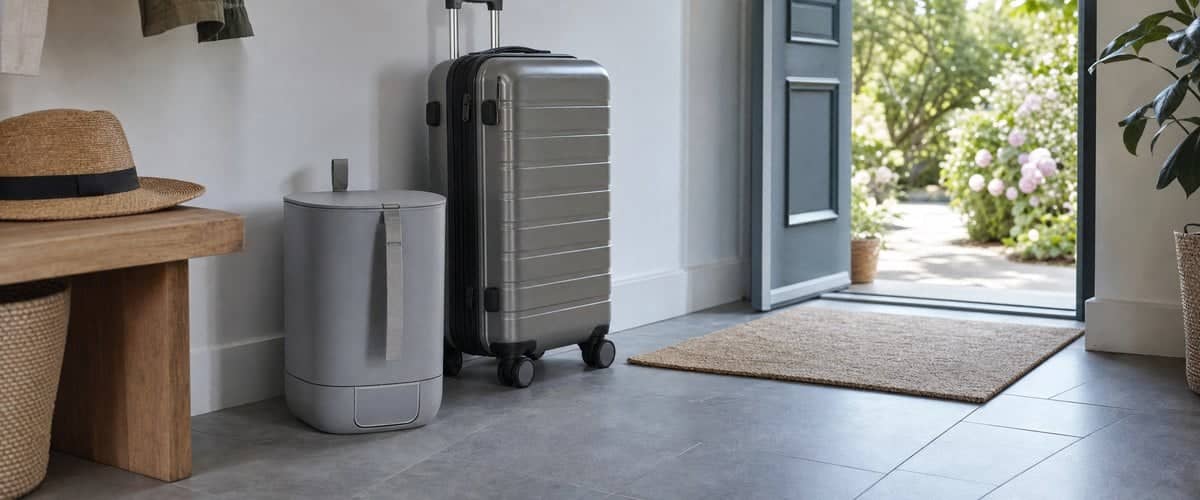
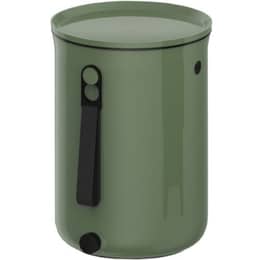
A portable bucket also makes these trips back and forth easier: the Skaza Organko 2 Bokashi Composter, with its strap, is easy to carry out to the garden or the shed.
In winter, bring the bucket indoors, cut things smaller, be a little more generous with the activator, and extend the resting time by one to two weeks, without ever stirring. If the ground is frozen, store the fermented bokashi, well sealed and drained, until the thaw. In summer, drain more often, keep the bucket in the shade, and never leave scraps out in the open, to avoid fruit flies. Before a vacation, empty the kitchen compost pail, add a layer of activator, drain, close, and put the bucket somewhere cool: it will wait for you with no problem.
Scan the code or visit mouttafarm.com/guide: all our how-to guides, with links to the products mentioned.




 France
 Belgium
 Switzerland
 Germany
 Austria
 United Kingdom
 Italy
 Spain
 Holland
 Portugal
 Ireland
 Sweden
 Finland
 Denmark
 Greece
 Poland
 Rumania
 Czech Republic
