












Best Seller
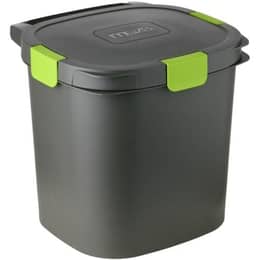
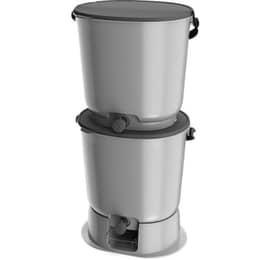
Bokashi Composter Confort
3.7-gallon (14-liter) capacity, sold individually or as a set of 2
$45.59 €40.83
Fast and odor-free, composting worms eat your food scraps and turn them into fertilizer for your plants.

From 2 to 4 trays, with an optional planter.

Up to 18 growing areas around a central worm composter.

Terracotta, with a flower pot.

From 2 to 4 trays, with a lower shelf.

Trays you add over time for easy vermicompost harvesting.

Turn your planters and flower beds into a worm composter: WORMacotta, In-Ground.
 Practical guide

From kitchen to garden, composting becomes simple, fast, and effective for everyone.
 Practical guide
 Practical guide
Live animals (worms and bait) and products to feed and care for pets and livestock.

Eisenia composting worms for your worm composter or compost bin.

Ultra-fresh worms: red worms, Dendros, and Canadian nightcrawlers from 3.5 oz (100 g) to 2.2 lb (1 kg).

Natural solutions dedicated to the well-being of horses, ponies, and donkeys.

Optimize the health and performance of your farm.

Mealworms: natural, nutritious supplements.
Beautify your home with our decorative pieces and care for your house in a natural, sustainable way.
Garden the eco-friendly way, in harmony with nature, for healthy, long-lasting plants.
EM-based products designed to enrich soil, protect plants, support animal health, and make everyday well-being and home care easier.

Contains a blend of 80 families of beneficial microorganisms.

Revitalize, purify, and improve water quality in all your applications.

Stimulate soil microbial activity and plant growth.

Clean and care for your surroundings naturally.

For the well-being and health of pets, livestock, and horses.

Enrich your body care and dietary routines with essential enzymes.
 Practical guidePractical guide

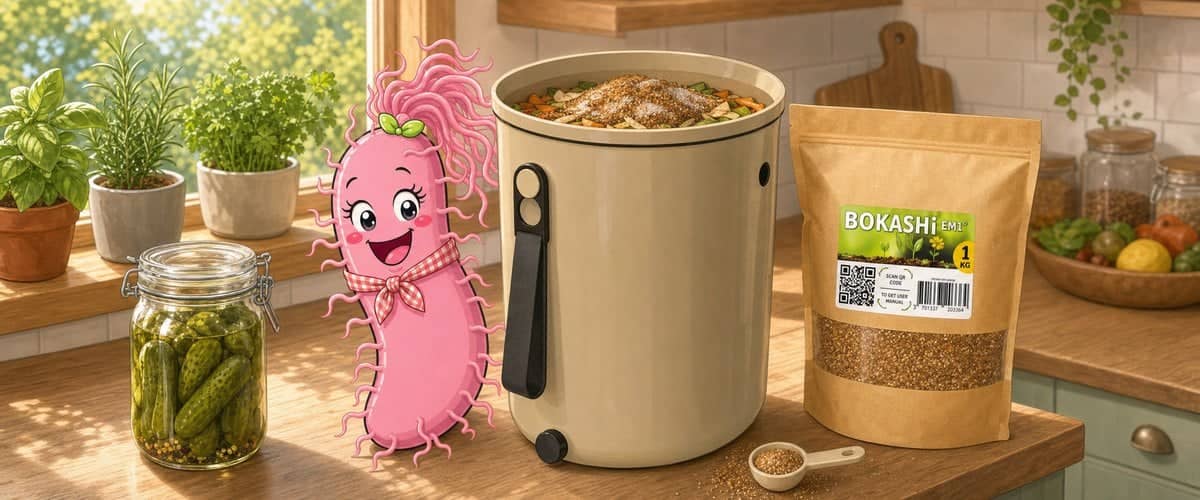
A sealed bucket under the sink, a few handfuls of bran boosted with EM-1 sprinkled over the peels, and leftovers that ferment instead of rotting: that's bokashi. The method intrigues people because it takes scraps that backyard compost piles and worms turn their noses up at, and because it fits in a kitchen. Understanding what goes on inside the bucket helps you avoid most beginner mistakes.
The word bokashi is often translated as "fermented organic matter." It refers to the method, to the fermented material you end up with, and, by extension, to the bran used to start the fermentation.
In practice, kitchen bokashi relies on three things: an airtight bucket fitted with a grate and a spigot to drain off the liquid; your food scraps, pressed down layer by layer; and an activator, meaning cereal bran fermented with microorganisms. We cover the activator in detail in our guide to bokashi bran.
Did you know?In Japanese, the verb bokasu means "to blur" or "to soften," the way you would blend a color gradient. Japanese gardeners use the word bokashi for a fertilizer made of rice bran and oilseed meal mixed with soil and then fermented: this "softens" the strength of these materials, making them gentler on roots.
Conventional compost is decomposition in the presence of air. Bacteria, fungi, and small critters consume the material while breathing oxygen; the pile heats up, loses water and carbon dioxide, and gradually turns into humus.
Bokashi follows an entirely different logic: preservation. In the sealed, tightly packed bucket, there's hardly any air left. The lactic acid bacteria introduced by the bran convert some of the sugars in the scraps into lactic acid. The environment becomes acidic, and that acidity holds back the microbes responsible for putrefaction. It's exactly what happens when you make pickles, sauerkraut, or the silage farmers feed their livestock in winter.
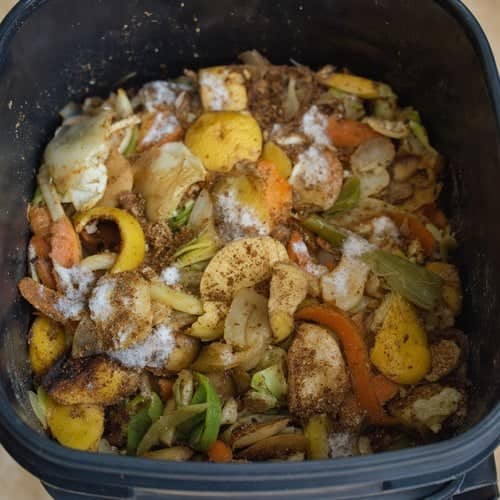
The result: your scraps aren't digested, they're preserved. They look more or less the same, take on a sour smell of vinegar or pickles, and are sometimes covered with a thin white film, which is a good sign.
Another difference from compost: a bokashi bucket barely warms up at all. Lactic fermentation releases very little energy compared with decomposition in air, and most of the material, and therefore most of the nutrients, stays in the bucket.
 Bokashi activators are generally made with effective microorganisms, or EM. According to manufacturers, these blends mainly combine lactic acid bacteria, yeasts, and photosynthetic bacteria. You'll find their history and composition in our guide What are effective microorganisms.
In the bucket itself, lactic acid bacteria call the shots. The few published analyses of household buckets show that they make up the vast majority of the microbial population, both in the starter bran and in the bucket at full fermentation. Yeasts and other groups are far less prominent, and their exact role in bokashi is still poorly understood.
Their work shows up in the pH, meaning the level of acidity. The liquid drained from the spigot usually measures between about 3.5 and 5, an acidity comparable to orange juice or yogurt. That's why the contents of the bucket never go directly at the base of plants, and why the liquid is always heavily diluted.
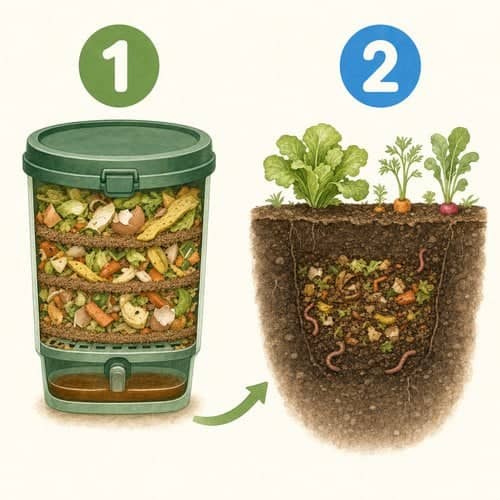 You fill the bucket day by day, sprinkling each layer with bran and pressing it down firmly. Once the bucket is full, you leave it closed for at least two weeks in a room at a moderate temperature, draining off the liquid from time to time. Since this phase ties up the bucket, most people use two: one being filled while the other ferments. You'll find detailed instructions in our guide Starting your first bokashi bucket. In the diagram: fermentation in the bucket (1), then transformation in the soil (2).
What comes out of the bucket is an acidic pre-compost, not compost. It needs to go into the soil: bury it 8–12 in (20–30 cm) deep, well mixed with the soil, away from roots, and wait at least two weeks before planting. You can also mix it into a backyard composter or a large container of soil, or feed it in small amounts to worms, adding a few extra crushed eggshells to offset its acidity. In the soil, microbial life consumes the lactic acid, the acidity drops, and the scraps break down. Depending on the season and soil type, allow roughly two weeks to two months for them to disappear.
Key takeawaysBokashi happens in two stages: a few weeks of fermentation in a sealed bucket, then transformation in the soil. Without that second stage, there's no compost.
Fermenting organic matter before returning it to the soil is an old practice. It's often said to have roots in rural Korea and Japan, where organic matter was fermented to make a gentler fertilizer. These origins, however, are poorly documented.
The modern version, the kitchen bucket, is linked to Professor Teruo Higa, who taught horticulture in Okinawa, Japan. In the early 1980s, he developed effective microorganisms, a blend of fermentation microorganisms he proposed for agriculture. EM-inoculated bran, sprinkled over food scraps, then spread around the world, notably reaching Europe starting in the 1990s.
 It takes almost all food scraps, raw or cooked, including meat, fish, cheese, and citrus. The full list is in our guide What to put in a bokashi bucket.
 It fits in a kitchen: a 2.6–5.3 gallon (10–20 liter) bucket, with no contact with the soil.
 It preserves the material: since the bucket doesn't heat up and stays closed, relatively little material is lost as gas during fermentation.
 It takes little effort: chop, sprinkle, press down, close, drain the liquid. Nothing needs turning, and above all, you never stir.
 The smell stays faint with the lid closed. When you open it, it smells sour, like pickles, sometimes a little like beer or cider.
 It isn't finished compost: after two weeks, you have a pre-compost that still needs to go through the soil, a composter, or worms.
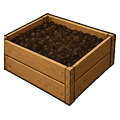 You need an outlet: a yard, a container of soil, a composter, or a friend or family member who wants it.
 It uses activator continuously: you'll need to buy more or make your own.
 It doesn't take yard waste: grass clippings, dead leaves, and branches are still a job for the composter.
 It takes a little discipline: a bucket that's poorly sealed, too wet, or not sprinkled enough can rot instead of fermenting.
Emy's tipKeep a small lidded container on the countertop during the day, and empty it into the bokashi bucket just once, in the evening. The less you open the bucket, the less air gets in, and the better the fermentation.
Bokashi is a particularly good fit if:
It's less of a fit if you have nowhere to return the pre-compost to the soil. In that case, a worm bin, which produces a ready-to-use soil amendment, will often be simpler: our guide explains how a worm composter works. To compare the methods point by point, read our guide Bokashi, compost, or vermicompost.
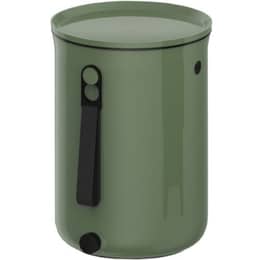
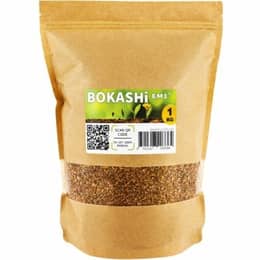
To get started, all you need is an airtight bucket with a spigot, such as the Composteur à Bokashi Confort or the Skaza Organko 2 Bokashi Composter, plus our Bokashi EM Compost Activator, made on the farm. Finally, our guide Bokashi and EM: what the science says reviews the research.
Bokashi is the lactic fermentation of food scraps, carried out in an airtight bucket using bran loaded with microorganisms. In about two weeks, the scraps turn acidic and are preserved rather than rotting, without heating up and with a faint, sour smell. This pre-compost then needs to go back into the soil, a composter, or a worm bin, where it finishes breaking down within a few weeks. Bokashi takes almost all food scraps in very little space, as long as you have an outlet and a supply of activator.
Scan the code or visit mouttafarm.com/guide: all our how-to guides, with links to the products mentioned.



 France
 Belgium
 Switzerland
 Germany
 Austria
 United Kingdom
 Italy
 Spain
 Holland
 Portugal
 Ireland
 Sweden
 Finland
 Denmark
 Greece
 Poland
 Rumania
 Czech Republic
