











Best Seller
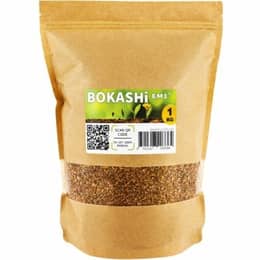
Bokashi EM compost activator | 1 kg bag
Sold individually or in sets of 2 or 3 bags
$8.02 €7.18
Fast and odor-free, composting worms eat your food scraps and turn them into fertilizer for your plants.

From 2 to 4 trays, with an optional planter.

Up to 18 growing areas around a central worm composter.

Terracotta, with a flower pot.

From 2 to 4 trays, with a lower shelf.

Trays you add over time for easy vermicompost harvesting.

Turn your planters and flower beds into a worm composter: WORMacotta, In-Ground.
 Practical guide

From kitchen to garden, composting becomes simple, fast, and effective for everyone.
 Practical guide
 Practical guide
Live animals (worms and bait) and products to feed and care for pets and livestock.

Eisenia composting worms for your worm composter or compost bin.

Ultra-fresh worms: red worms, Dendros, and Canadian nightcrawlers from 3.5 oz (100 g) to 2.2 lb (1 kg).

Natural solutions dedicated to the well-being of horses, ponies, and donkeys.

Optimize the health and performance of your farm.

Mealworms: natural, nutritious supplements.
Beautify your home with our decorative pieces and care for your house in a natural, sustainable way.
Garden the eco-friendly way, in harmony with nature, for healthy, long-lasting plants.
EM-based products designed to enrich soil, protect plants, support animal health, and make everyday well-being and home care easier.

Contains a blend of 80 families of beneficial microorganisms.

Revitalize, purify, and improve water quality in all your applications.

Stimulate soil microbial activity and plant growth.

Clean and care for your surroundings naturally.

For the well-being and health of pets, livestock, and horses.

Enrich your body care and dietary routines with essential enzymes.
 Practical guidePractical guide

A bokashi needs very little maintenance, but it does need some: draining the liquid regularly. That one habit makes all the difference between a bin with a pleasant pickle smell and a bin that turns into a swamp. Add to that a quick cleaning between cycles and an occasional check of the seal and the spigot.
Here's when and how to drain depending on your model, what to make of a bin that produces no liquid, and how to clean and prepare the bin for the next cycle.
As food scraps ferment, they release a liquid that drips down below the grate. If you let it build up, it eventually rises to the scraps at the bottom. Those scraps then sit in the liquid, and lactic fermentation may give way to rotting: unpleasant odors, mold, slimy contents.
Excess moisture is in fact the most common cause of smelly bins. Draining keeps the scraps "dry" above their liquid, so fermentation goes smoothly.
Key takeawaysThe liquid should never touch the food scraps. Regular draining keeps the bottom of the bin dry and the fermentation on track.
Reliable sources agree: every two to three days, and at least twice a week. Adjust based on what you observe:
 more often if you add lots of fresh fruits and vegetables, which release a lot of liquid, and in summer;
 less often with drier leftovers (bread, rice, pasta, paper towels), and in winter, when the cold reduces liquid production.
Keep draining during the two-week resting period once the bin is full. You don't need to open the lid: the spigot, plug, or drawer is all you need.
The collected liquid is best used within 24 to 48 hours, always diluted, at the base of your plants. All the dilution guidelines are in our guide on bokashi liquid: dilution, uses, and limits.
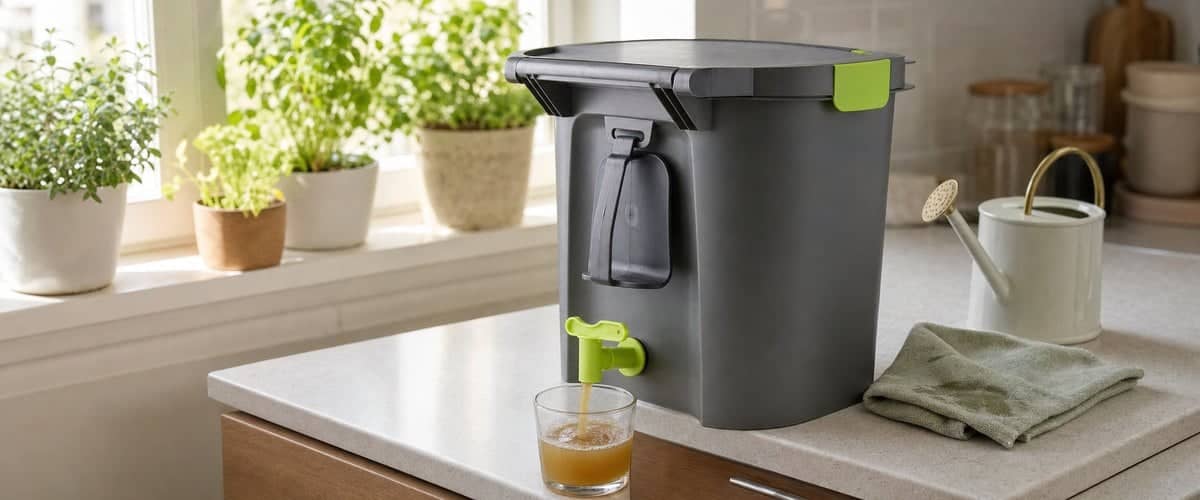
Place a glass or small jar under the spigot, open it, let it run until the last drop, then close it tightly. A spigot left slightly open lets air in and liquid out. On the Essential, the bin sitting on its base drains directly into the collection drawer.
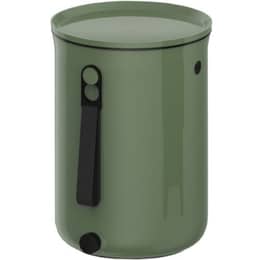
Set the bin at the edge of the countertop or sink, put a container underneath, unscrew the plug, and let it drain. Screw it back in all the way. If the plug gets damaged or lost, it's available as a replacement part: the Organko 2 plug.
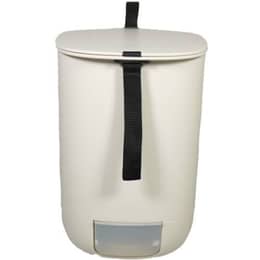
Gently pressing the clear drawer makes the liquid flow; when you remove it, the automatic spigot closes by itself. The drawer only holds about 8.5 fl oz (0.25 liters), so empty it often.
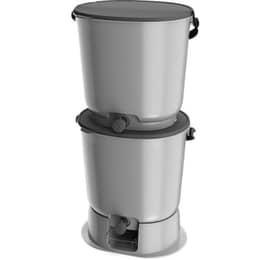
Lift the upper, perforated bucket without opening the lid, empty the lower bucket, then put everything back. If you can't drain, absorbent materials at the bottom (newspaper, torn egg carton) will soak up some of the liquid.
Emy's tipAfter each draining, wipe the spigot or the rim of the plug with a damp cloth: a single forgotten drop of liquid is enough to attract fruit flies.
Yes, very often. A new bin can take one to two weeks, or even longer, before producing its first drops. The amount depends mainly on what you put in: lots of liquid with fruits, vegetables, and peels, very little with bread, starchy foods, or cooked leftovers. There's less in winter, too.
As long as the smell stays sour and pleasant, a bin that produces little liquid isn't a problem. If, on the other hand, you see condensation under the lid, that's a sign the contents are too wet: drain more often and add something dry, such as a little activator or a piece of egg carton.
 The bin is empty, and its contents have gone to the garden or the compost pile. Before filling it again:
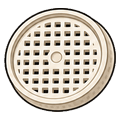 Scrape off any residue stuck to the bottom and the grate, and add it to the emptied contents.
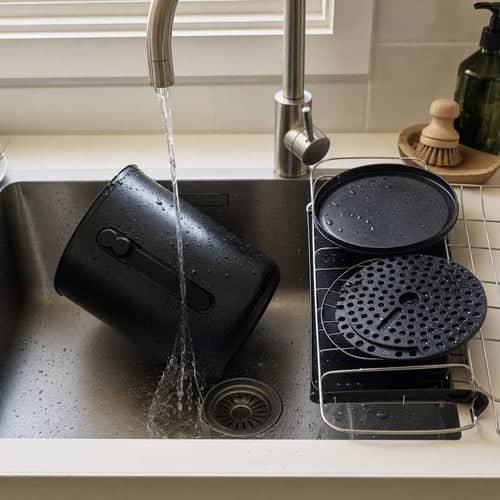
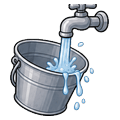 Rinse the bin, the grate or strainer, and the compactor in hot water, using a brush. Take out the grate to clean underneath.
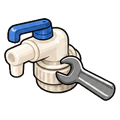 Clean the spigot or plug: run water through it to flush out any deposits that could clog it. On the Urbalive, rinse the fabric filters too.
 Leave the bin open to dry, ideally outdoors. A few hours outside, in the shade or gentle sunshine, is enough to get rid of the smell.
There's no need to disinfect: the bin will host a new fermentation anyway. Our instructions recommend rinsing with water, without detergent or soap, and that's what we advise for everyday use. If a more thorough cleaning is needed, a little mild dish soap is fine, as long as you rinse thoroughly: product residue could disrupt the microorganisms of the next cycle. Avoid bleach and scented products entirely. According to the manufacturer, Skaza bins, such as the Essential, are dishwasher-safe up to 131 °F (55 °C), or on an eco cycle.
Did you know?A properly used bokashi bin stays clean: the acidic environment created by lactic acid bacteria holds back rotting. A simple rinse is almost always enough.
 The seal and the rim of the lid: a crumb or bit of residue on the seal is enough to let air in. Wipe them from time to time, and whenever scraps have spilled over.The spigot: over time or during shipping, it can work loose and leak where it joins the bin. To tighten it, hold the nut on the inside and turn the spigot by its body. Test it now and then with a little water, with the spigot closed.The strainer and the grate: check that they aren't cracked. For the Essential, a replacement strainer is sold separately.
These checks take a minute at each change of cycle and prevent most odor and leak problems.
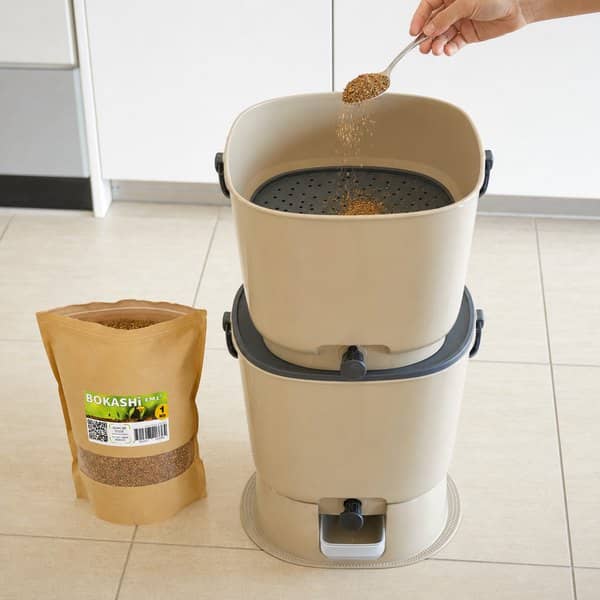
Once the bin is dry and reassembled, sprinkle a little activator on the grate before the first layer of food scraps: this gets fermentation going right from the bottom of the bin. Check that the spigot or plug is properly closed, then get back into your usual routine: a layer of scraps, activator, press down, lid.
If, despite good maintenance, your bin smells bad or gets covered in colored mold, see our guides on bad odors, too much liquid, fruit flies and mold in bokashi. And if your bin is showing signs of wear, our guide to choosing a bokashi composter presents our different models.
Drain the liquid every two to three days, more often with fruits and vegetables or in summer, including during the full bin's resting period. A bin that produces little liquid is nothing to worry about if the smell stays sour; condensation under the lid, on the other hand, signals excess moisture. Between cycles, scrape, rinse with hot water, clean the spigot, and leave to dry, without bleach or scented products. A quick check of the seal and spigot each cycle, and your bin will serve you well for years to come.
Scan the code or visit mouttafarm.com/guide: all our how-to guides, with links to the products mentioned.



 France
 Belgium
 Switzerland
 Germany
 Austria
 United Kingdom
 Italy
 Spain
 Holland
 Portugal
 Ireland
 Sweden
 Finland
 Denmark
 Greece
 Poland
 Rumania
 Czech Republic
