











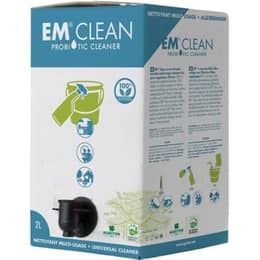
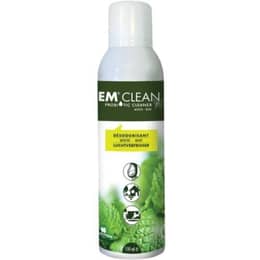
EM Clean, multi-purpose EM cleaner | Classic - 2 L Bag-in-box
For home, outdoors, animals... from 0.5 to 66 gal (2 to 250 L)
$18.51 €16.58
Fast and odor-free, composting worms eat your food scraps and turn them into fertilizer for your plants.

From 2 to 4 trays, with an optional planter.

Up to 18 growing areas around a central worm composter.

Terracotta, with a flower pot.

From 2 to 4 trays, with a lower shelf.

Trays you add over time for easy vermicompost harvesting.

Turn your planters and flower beds into a worm composter: WORMacotta, In-Ground.
 Practical guide

From kitchen to garden, composting becomes simple, fast, and effective for everyone.
 Practical guide
 Practical guide
Live animals (worms and bait) and products to feed and care for pets and livestock.

Eisenia composting worms for your worm composter or compost bin.

Ultra-fresh worms: red worms, Dendros, and Canadian nightcrawlers from 3.5 oz (100 g) to 2.2 lb (1 kg).

Natural solutions dedicated to the well-being of horses, ponies, and donkeys.

Optimize the health and performance of your farm.

Mealworms: natural, nutritious supplements.
Beautify your home with our decorative pieces and care for your house in a natural, sustainable way.
Garden the eco-friendly way, in harmony with nature, for healthy, long-lasting plants.
EM-based products designed to enrich soil, protect plants, support animal health, and make everyday well-being and home care easier.

Contains a blend of 80 families of beneficial microorganisms.

Revitalize, purify, and improve water quality in all your applications.

Stimulate soil microbial activity and plant growth.

Clean and care for your surroundings naturally.

For the well-being and health of pets, livestock, and horses.

Enrich your body care and dietary routines with essential enzymes.
 Practical guidePractical guide


“A capful of EM in the toilet once a month and your septic tank will run like clockwork.” You often come across advice like this, on forums and on some product labels. The reality is more nuanced. A well-designed tank needs no additive at all, and no product can replace pumping it.
EM can still be of some use in household drains and dry toilets, especially against odors. This page sorts out what you can reasonably expect from them and what you shouldn't ask of them.
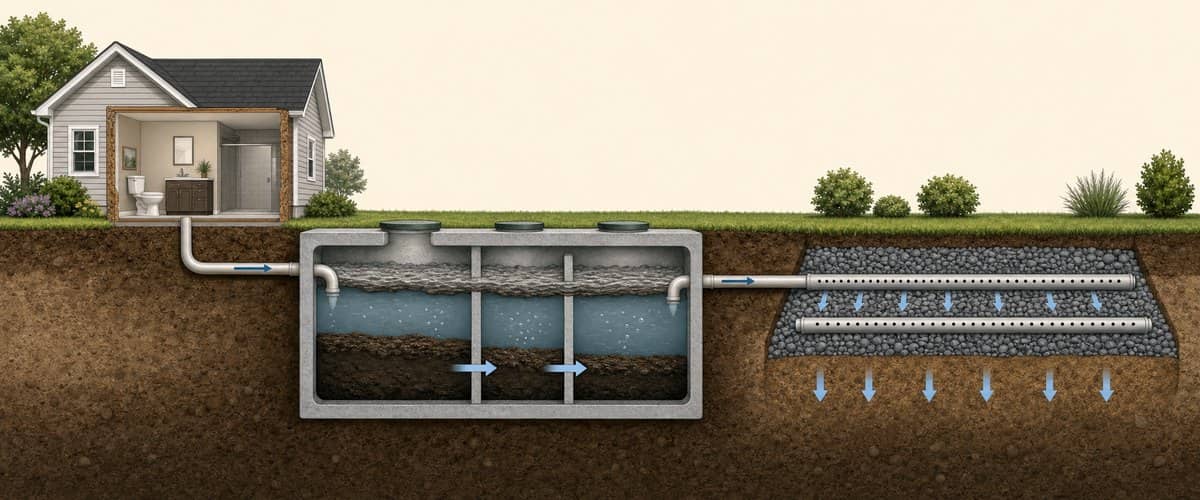
The septic tank, which in France is now called an “all-waters tank,” receives all the wastewater from the house. Inside the tank, without air, the contents separate into three layers:
The bacteria naturally present in wastewater break down part of the sludge and produce gases, which escape through a vent pipe above the roof. But some of the matter doesn't break down, so sludge inevitably builds up. That's why pumping is mandatory once the sludge reaches 50% of the tank's working volume, on average every four years depending on the size of the tank and the number of people in the household.
Did you know?The wastewater of a single person carries billions of microorganisms every day. The tank is never short of them: it seeds itself, starting in the first few days of use and again after every pumping.
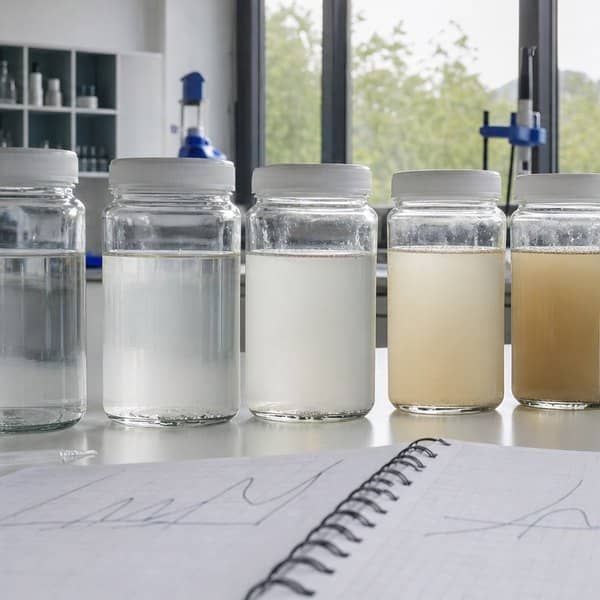
The market for septic tank “activators” is long-established and thriving. Yet independent trials of these products, whether based on bacteria, enzymes, or yeasts, have shown no lasting benefit to the way a tank works. In a long series of trials on pit latrines, none of the twenty additives tested in the lab significantly sped up the breakdown of sludge, and in the field, treated pits filled up no more slowly than those that received water alone. The main reasons are well known:
In all fairness, most of these studies looked at other commercial additives. However, an Australian trial in the early 2000s did test EM, in a wastewater treatment plant and in several septic tanks: it found no clear benefit either on sludge volume or on the suspended solids discharged by the tanks. No independent trial shows that EM delays the need for pumping. Our page What science says about EM puts these results in the context of current knowledge.
Key takeawaysA correctly sized, well-ventilated tank that is pumped on time needs no additive. No product, EM included, replaces pumping.
Pouring the leftovers of your EM Clean dilutions down the sink, shower, or toilet, as the manufacturer suggests, is harmless to a septic tank and may help limit odors in the traps. The quantities are tiny and highly diluted. An independent review of microbial cleaners actually found these products more useful for maintaining traps and drains than for everyday cleaning. Dilutions are explained on our page Natural cleaning with EM Clean.
If you have an aerobic treatment unit or another compact system, read its owner's manual. Some manufacturers rule out products that are too acidic or too alkaline. Since concentrated EM is acidic, only pour in dilutions, never an undiluted bottle.
Emy's tipNever pour cooking grease down the sink. Let it solidify in the pan, wipe it out with a paper towel, and toss that in the trash can: it's the single most effective thing you can do to protect your pipes and your tank.
 Flush nothing but toilet paper: wipes, feminine hygiene products, cotton swabs, medications, and chemicals (solvents, paints, oils) are all off-limits.
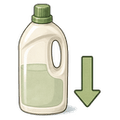 Use harsh household products sparingly: bleach, drain cleaners, descalers. Occasional use is fine; heavy daily use is not.
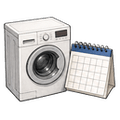 Spread out your laundry over the week rather than running load after load on the same day.
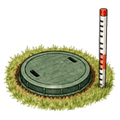 Have the sludge level checked and keep your pumping receipts. In France, the system is inspected periodically by your town's public onsite sanitation service.
In a bucket-style dry toilet, each use is covered with a good handful of sawdust, wood shavings, or dry shredded material. It's these carbon-rich materials that absorb moisture and limit odors. Properly managed, a dry toilet smells very little. If it smells strongly, it's almost always because there isn't enough dry material, the bucket is too full, or urine is pooling.
Urine is in fact the main source of odor: mixed with feces, it quickly turns into ammonia. Urine-diverting toilets, which collect urine separately, smell noticeably less.
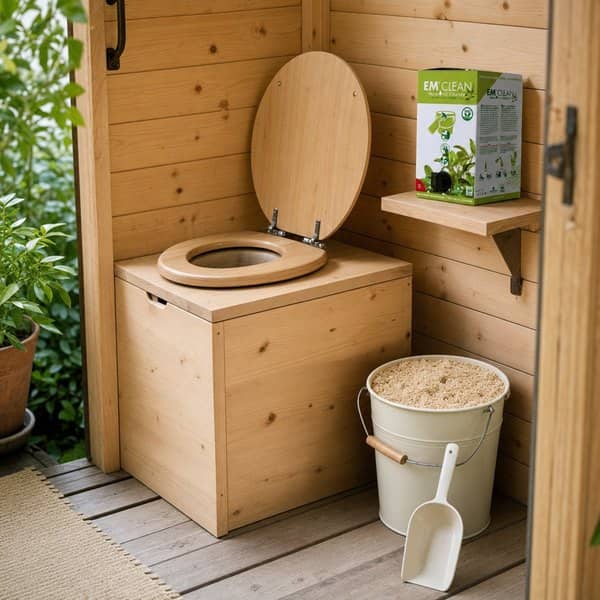
A light spray of EM in the bucket, on the sawdust, or some EM Clean deodorizer on the seat and around the bucket, can help limit odors, as long as you also use enough dry material. For cleaning the bucket and bowl, a dilution of EM Clean all-purpose cleaner works well.
You should, however, be aware of what research has shown on lactic fermentation toilets, where the aim is to ferment the waste in a sealed bucket, a bit like bokashi:
These systems remain experimental and take real know-how. The principle of fermentation, and what makes it succeed, is explained on our page How EM works.
Whatever the system, the contents of a dry toilet must be composted separately, for a long time, and under good conditions before any use. Neither sawdust, nor EM, nor fermentation makes it directly usable in the vegetable garden. If you already make bokashi in the kitchen, keep the two systems strictly separate: the bokashi bucket in our bokashi guide is for food scraps only.
A septic tank works on its own, thanks to the bacteria brought in every day by wastewater: additives, biological or otherwise, have shown no lasting benefit, and nothing replaces pumping at 50% sludge. Pouring your leftover EM Clean dilutions down the drains is risk-free and may limit trap odors, but a smell near the tank signals a problem that needs checking. In dry toilets, dry material and urine separation do most of the work; EM is only a complement, and fermentation only works with a source of sugar.
Scan the code or visit mouttafarm.com/guide: all our how-to guides, with links to the products mentioned.



 France
 Belgium
 Switzerland
 Germany
 Austria
 United Kingdom
 Italy
 Spain
 Holland
 Portugal
 Ireland
 Sweden
 Finland
 Denmark
 Greece
 Poland
 Rumania
 Czech Republic
