












Vulkamin, volcanic granules for soil | 2 kg Box
Stimulates microbial activity, 4.4 to 1,760 lb (2 to 800 kg)
$10.65 €9.54
Fast and odor-free, composting worms eat your food scraps and turn them into fertilizer for your plants.

From 2 to 4 trays, with an optional planter.

Up to 18 growing areas around a central worm composter.

Terracotta, with a flower pot.

From 2 to 4 trays, with a lower shelf.

Trays you add over time for easy vermicompost harvesting.

Turn your planters and flower beds into a worm composter: WORMacotta, In-Ground.
 Practical guide

From kitchen to garden, composting becomes simple, fast, and effective for everyone.
 Practical guide
 Practical guide
Live animals (worms and bait) and products to feed and care for pets and livestock.

Eisenia composting worms for your worm composter or compost bin.

Ultra-fresh worms: red worms, Dendros, and Canadian nightcrawlers from 3.5 oz (100 g) to 2.2 lb (1 kg).

Natural solutions dedicated to the well-being of horses, ponies, and donkeys.

Optimize the health and performance of your farm.

Mealworms: natural, nutritious supplements.
Beautify your home with our decorative pieces and care for your house in a natural, sustainable way.
Garden the eco-friendly way, in harmony with nature, for healthy, long-lasting plants.
EM-based products designed to enrich soil, protect plants, support animal health, and make everyday well-being and home care easier.

Contains a blend of 80 families of beneficial microorganisms.

Revitalize, purify, and improve water quality in all your applications.

Stimulate soil microbial activity and plant growth.

Clean and care for your surroundings naturally.

For the well-being and health of pets, livestock, and horses.

Enrich your body care and dietary routines with essential enzymes.
 Practical guidePractical guide

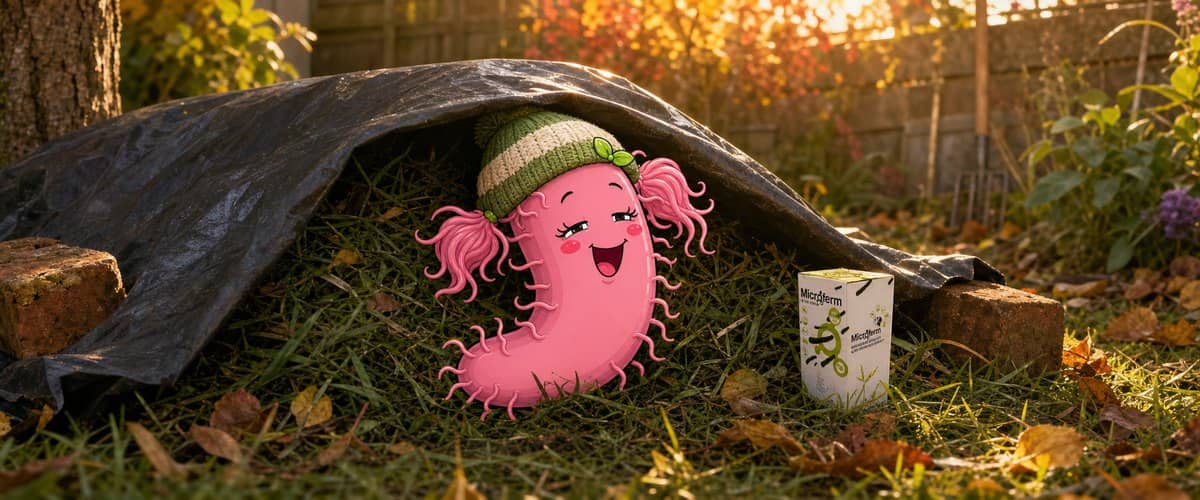
In the yard, effective microorganisms are mainly used for two things: supporting your compost, and fermenting large quantities of green material, starting with grass clippings. These are two very different uses. The first happens with air, the second without it, and the techniques are not at all the same.
Do you really need an activator to make good compost? We gave an honest answer in our guide Compost activator: useful or not? Here, we get down to the practical side: how to use EM if you choose to, how much to use, and how to turn your grass clippings into fermented organic matter.
Traditional compost is an aerobic process: bacteria, fungi, and then worms and other small creatures break down the material in the presence of air. The pile heats up, settles, and within a few months becomes stable humus.
Fermentation, as in bokashi or silage, works the other way, without air. Lactic acid bacteria convert sugars into acids, the environment becomes acidic, and the material is preserved almost intact. The result is a pre-compost, which will finish breaking down in the soil or in a compost bin.
EM are first and foremost ferments, rich in lactic acid bacteria. In a well-aerated compost pile, they don't change the nature of the process: they simply add to the microorganisms already present. That's why independent composting trials show a modest gain at best. One trial carried out in a tropical climate on rice straw and goat manure recorded a slightly faster rise in temperature and more advanced decomposition after 90 days with EM, but it had no control receiving molasses alone, so it's hard to say how much of the effect comes from the microorganisms. Independent assessments consider the effect of EM in composting plausible, provided that moisture, air, and temperature are well managed.
Key takeawaysGood compost comes from the right mix, air, and moisture; EM can support it. Good fermentation comes from keeping air out by packing the material down and covering it airtight; here, EM play a central role.
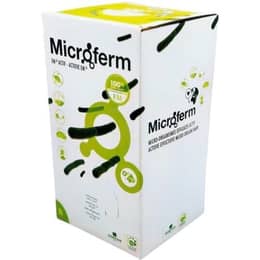
The manufacturer of EM-A Microferm Active Solution recommends about 0.8 quart of product per cubic yard of material (1 liter per m³), diluted in twice its volume of non-chlorinated water and applied layer by layer. Other instructions go up to 1.6 quarts per cubic yard (2 liters per m³). For a 106-gallon (400-liter) backyard compost bin, that comes to about 17 fl oz (0.5 liter) of product over the whole filling: each time you add material, a couple of tablespoons, 0.7–1 fl oz (20–30 ml), diluted in 17 fl oz (0.5 liter) of water is all you need.
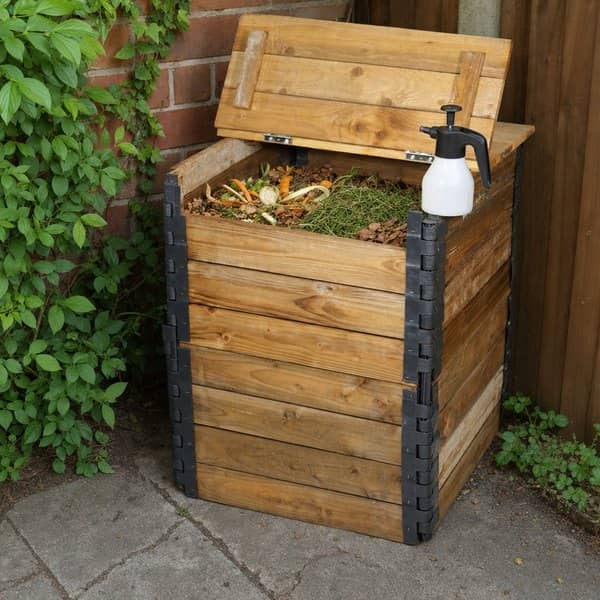
You can also sprinkle a handful of Bokashi EM Compost Activator over your food scraps, especially when starting a new bin. And if you have some slightly old homemade EM-A left over, the compost pile is where it will be most useful: our guide Storing your EM explains how to tell whether it's still good.
If you empty a bucket of kitchen bokashi into your compost bin, spread it out and mix it with browns rather than dumping it in as one clump. The method is explained in detail in our guide Bokashi and garden compost.
In spring, grass clippings pile up in such quantities that a compost bin can't take them all. Dumped in a thick layer, they mat down and rot. Fermentation offers another option: a kind of "garden bokashi," similar to the silage farmers make.
Emy's tipBuild the pile on a tarp laid on the ground, fold it over the top, then stomp the whole thing down before weighting it with boards or soil. The less air left inside, the cleaner the fermentation.
Well-fermented grass smells sour, like silage, and keeps its structure as it turns brown. The edges, which often ferment less well, can go into your next pile or the compost bin. Like any bokashi, it's an acidic pre-compost, not finished compost: mix it into the top layer of soil or add it to your compost, and wait at least two weeks before sowing or planting in that spot. Don't spread it in a thick layer around the base of plants.
There are two limitations to keep in mind. Don't use clippings from a lawn treated with weed killer. And there's no evidence that fermentation destroys weed seeds: it's the heat of a well-managed compost pile that takes care of that. To cut down the volume of clippings at the source, also consider mowing without bagging, covered in our guide A natural lawn with EM.
Did you know?The rancid butter smell of overly wet grass comes from butyric acid, produced by bacteria other than lactic acid bacteria. Farmers know it well: that's exactly why they let grass wilt before making silage.
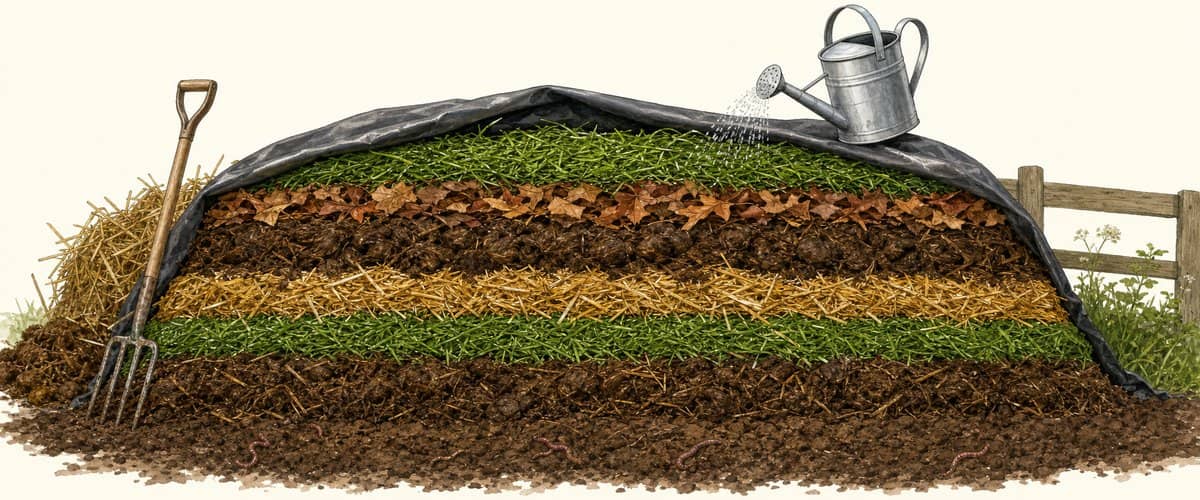
For horse, sheep, or poultry manure mixed with straw, and for large volumes of yard waste, the manufacturer suggests a layered method with no turning:
Be cautious about the claims: in a trial carried out in Norway on liquid cow manure, fermentation was more intense with EM, but the nitrogen and dry matter content of the manure was no different from that of the control.
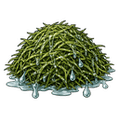 Waterlogged material: it rots instead of fermenting.
 A poorly sealed pile, or one opened "just to check": air lets mold and rot take hold again.
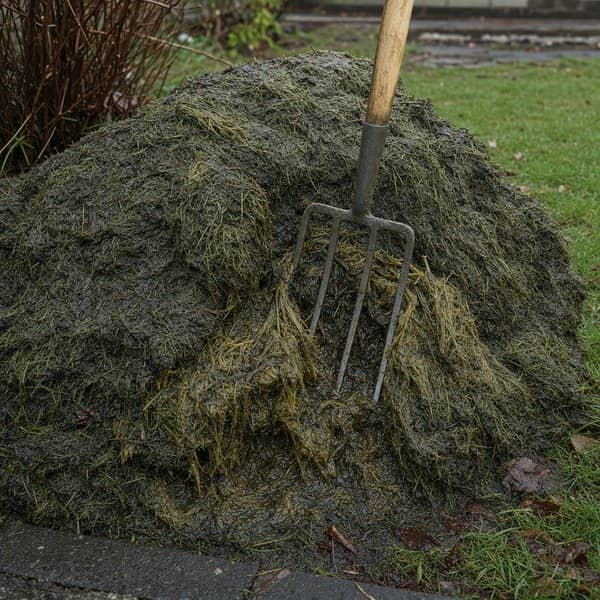
 Grass clippings alone dumped in a thick layer in the compost bin: without dry material or a controlled fermentation, they turn into a slimy mass.
 Quicklime or hydrated lime: it's caustic and destroys the very microorganisms you're trying to encourage.
 Chlorinated water for diluting EM.
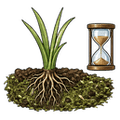 Using it too soon: freshly fermented material placed in contact with roots or seedlings can harm them.
These methods complement each other more than they compete. Traditional compost is still the simplest solution for yard waste and produces stable humus. EM fermentation is useful for handling large volumes of green material all at once, and kitchen bokashi accepts leftovers that compost struggles to break down. Vermicomposting, for its part, is a great fit for apartments. To compare these options for your situation, see our guide Compost, vermicompost, bokashi, or EM: which method to choose.
In a compost bin, EM are used at about 0.8 quart per cubic yard of material (1 liter per m³), diluted and applied layer by layer, and they never replace the right mix, air, and moisture; their effect on how fast compost breaks down remains modest. Where they really shine is fermentation: grass clippings left to dry off, moistened with a 5% solution, with shell limestone added if you like, firmly packed down, and covered airtight for 6 to 10 weeks, produce an acidic pre-compost to mix into the soil or the compost, with a two-week wait before sowing. The same approach applies to manure built up in lasagna layers, with no promise of a nitrogen gain.
Scan the code or visit mouttafarm.com/guide: all our how-to guides, with links to the products mentioned.



 France
 Belgium
 Switzerland
 Germany
 Austria
 United Kingdom
 Italy
 Spain
 Holland
 Portugal
 Ireland
 Sweden
 Finland
 Denmark
 Greece
 Poland
 Rumania
 Czech Republic
