











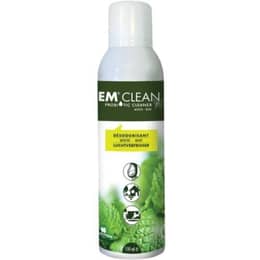
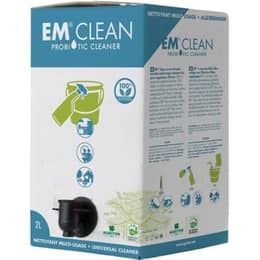
EM Clean, EM deodorizer | Mint
Naturally neutralizes bad odors
$14.43 €12.92
Fast and odor-free, composting worms eat your food scraps and turn them into fertilizer for your plants.

From 2 to 4 trays, with an optional planter.

Up to 18 growing areas around a central worm composter.

Terracotta, with a flower pot.

From 2 to 4 trays, with a lower shelf.

Trays you add over time for easy vermicompost harvesting.

Turn your planters and flower beds into a worm composter: WORMacotta, In-Ground.
 Practical guide

From kitchen to garden, composting becomes simple, fast, and effective for everyone.
 Practical guide
 Practical guide
Live animals (worms and bait) and products to feed and care for pets and livestock.

Eisenia composting worms for your worm composter or compost bin.

Ultra-fresh worms: red worms, Dendros, and Canadian nightcrawlers from 3.5 oz (100 g) to 2.2 lb (1 kg).

Natural solutions dedicated to the well-being of horses, ponies, and donkeys.

Optimize the health and performance of your farm.

Mealworms: natural, nutritious supplements.
Beautify your home with our decorative pieces and care for your house in a natural, sustainable way.
Garden the eco-friendly way, in harmony with nature, for healthy, long-lasting plants.
EM-based products designed to enrich soil, protect plants, support animal health, and make everyday well-being and home care easier.

Contains a blend of 80 families of beneficial microorganisms.

Revitalize, purify, and improve water quality in all your applications.

Stimulate soil microbial activity and plant growth.

Clean and care for your surroundings naturally.

For the well-being and health of pets, livestock, and horses.

Enrich your body care and dietary routines with essential enzymes.
 Practical guidePractical guide

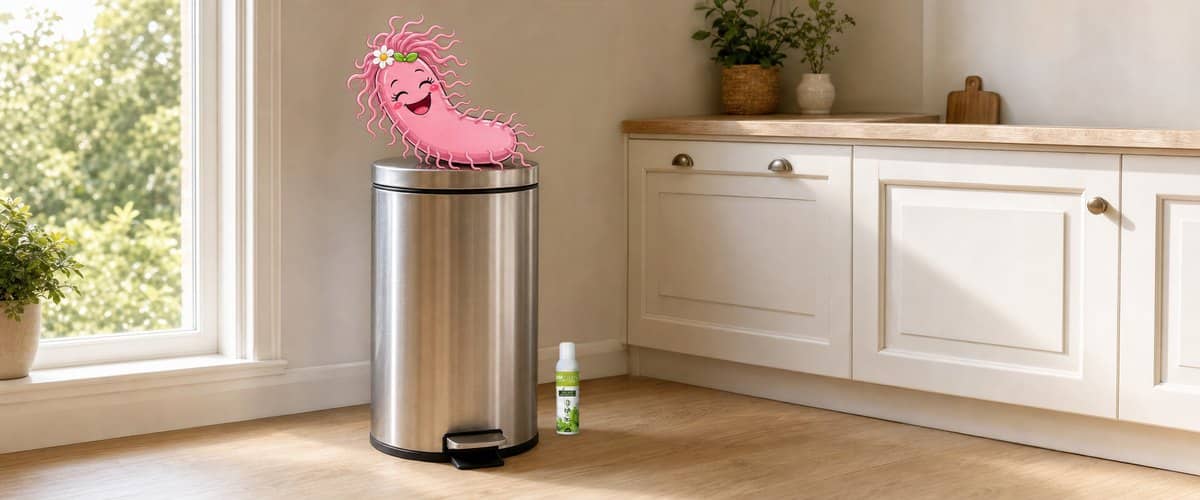
A kitchen trash can in the height of summer, a drain that smells, a musty fridge, the cat's litter box: household odors almost always have the same origin, organic remains that are breaking down badly. Effective microorganisms are often used to reduce them, by steering this breakdown toward fermentation rather than rotting.
They can be helpful, provided you know how they work, where they're useful, and where they're no use at all. This guide takes you room by room, with the steps that really matter.
When organic matter rots, meaning it breaks down without air and without control, microorganisms produce several families of very smelly molecules:
 ammonia and amines: the sharp smell of urine, dirty litter, fish;
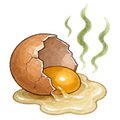 sulfur compounds (hydrogen sulfide, mercaptans): rotten eggs, cabbage, sewer;
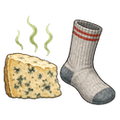 volatile fatty acids: the smell of rancid food, strong cheese, sweat.
EM are based on a simple principle: lactic acid bacteria and yeasts that ferment residues and produce acids. By making the environment acidic, they slow down rotting. Acidity has a well-known effect on ammonia and amines: in acidic conditions, these molecules turn into salts that no longer evaporate. That's why acidifying manure slurry is a recognized technique for reducing ammonia emissions.
With sulfur odors, however, acidity doesn't help; quite the opposite: hydrogen sulfide escapes more easily from an acidic environment. According to the manufacturer, certain bacteria in EM consume these sulfur compounds, but this hasn't been independently verified in household use.
Did you know?The human nose detects hydrogen sulfide, the smell of rotten eggs, at extremely low concentrations. Just a tiny amount of rotting waste is enough to make a whole room stink, which is why finding the source matters so much.
When you're dealing with an odor, there are four ways to act, and they're not equally effective:
EM are in a category of their own. They act on the organic residues themselves, changing the way they break down. So they're a maintenance and prevention measure rather than an instant deodorizer. To work, they need to be in contact with the material and need a little moisture: sprayed into thin air or onto a dry, clean surface, they do very little.
Key takeawaysA persistent odor almost always means there's a source to track down. EM help keep whatever is fermenting or breaking down under control, but they don't replace cleaning or airing out.
If most of the smell comes from peels and leftovers, the longest-lasting solution is to keep them out of the trash. A bokashi bucket ferments them in a sealed container, with no rotting smell: our bokashi guide explains everything. A composter or worm composter that smells bad has specific causes: see our guide to diagnosing compost problems or the one on worm bin odors.
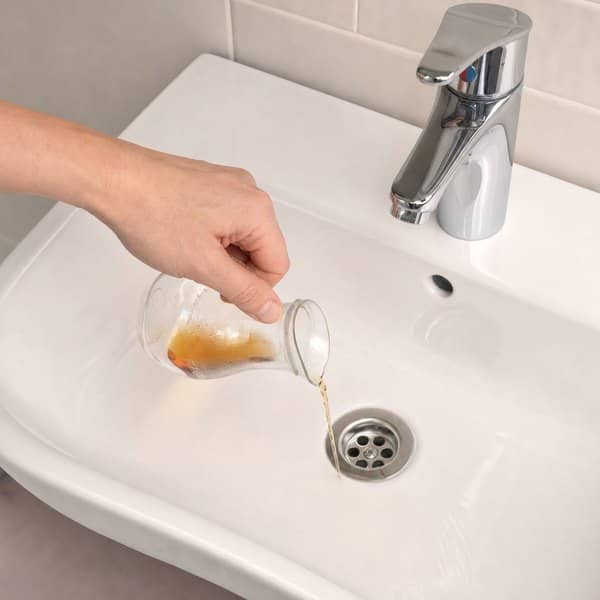
A sewer smell coming up from a sink or shower often has a mechanical cause, which you should check first:
Once the trap is clean, regularly pour the leftovers of your cleaning dilutions, or a little diluted EM Clean, down the drain as the manufacturer recommends, preferably in the evening so it stays in place overnight. This is a sensible maintenance use. For septic tanks, clogs, and composting toilets, everything is explained in our guide Septic tanks, drains, and composting toilets.
A smelly fridge is almost always caused by forgotten food or a spill. Empty it, throw out anything questionable, wash the shelves and walls with hot water and dish soap, then rinse and dry. Also clean the small drain hole at the back, which often gets clogged. For lingering odors, a small dish of activated charcoal or baking soda does the trick. We don't recommend spraying EM inside the fridge, on surfaces that come into contact with food.
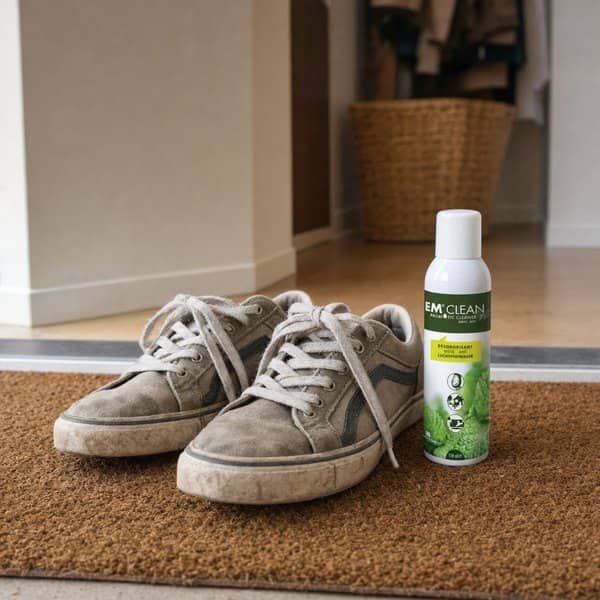
Fabrics hold on to sweat and musty smells. EM Clean deodorizer is ready to use: spray it directly onto the fabric, without soaking it, and let it air-dry. For shoes, alternate between two pairs so they dry out completely between wears. For a rug or couch, vacuum first, then follow the dilutions in our guide Natural cleaning with EM Clean.
Emy's tipTake the insoles out of your shoes every evening and let them air-dry. A dry insole hardly smells at all: it's moisture that feeds the microorganisms responsible for the odor.
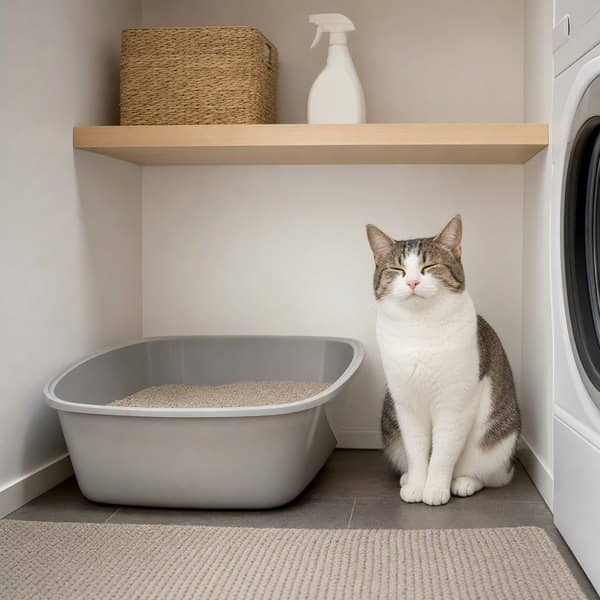
Litter box odor comes mainly from urine: within a few hours, bacteria turn urea into ammonia. So changing the litter often is still the first step. On top of that, the manufacturer of Microferm recommends regularly spraying the litter, litter box, doghouse, rabbit hutch, or chicken coop with a solution of 1.3 fl oz per gallon of water (10 ml per liter). Microferm EM-A Activated Solution contains no fragrance, which makes it the simplest choice around animals.
A few precautions:
Advice specific to dogs, cats, and small animals is gathered in our guide EM for dogs, cats, and small animals.
There are only a few studies on EM and odors, and their results vary. Above all, they show that what matters is lactic acidification. In lab trials on very smelly organic waste, EM added on their own didn't lower the pH or reduce odors; they only worked when combined with a source of sugar, such as molasses, and ordinary lactic acid starter cultures did at least as well. On hog farms, a trial with another commercial microbial additive found no difference in odor or ammonia between treated and untreated barns.
Our take: for minor everyday odors linked to organic residues, EM are a practical, gentle aid, alongside good hygiene. They won't get rid of an odor if its source is still there.
Household odors come from rotting organic remains: ammonia, sulfur compounds, fatty acids. Removing the source, drying, and airing out remain the essential steps. By encouraging acidic fermentation, EM mainly help with urine- and ammonia-type odors, in trash cans, clean drains, fabrics, and litter boxes, provided they're in contact with the residues. For the fridge, stick with washing and activated charcoal; around animals, use a fragrance-free product. And if an odor persists despite everything, look for the cause: a dry trap, a blocked vent, or a health problem in your pet.
Scan the code or visit mouttafarm.com/guide: all our how-to guides, with links to the products mentioned.



 France
 Belgium
 Switzerland
 Germany
 Austria
 United Kingdom
 Italy
 Spain
 Holland
 Portugal
 Ireland
 Sweden
 Finland
 Denmark
 Greece
 Poland
 Rumania
 Czech Republic
