












Best Seller
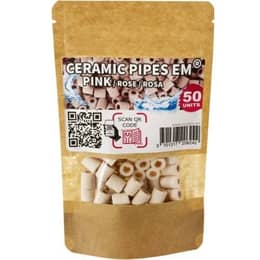
Pink EM ceramic beads | 50 beads
Removes chlorine and unwanted residues from water
$9.21 €8.25
Fast and odor-free, composting worms eat your food scraps and turn them into fertilizer for your plants.

From 2 to 4 trays, with an optional planter.

Up to 18 growing areas around a central worm composter.

Terracotta, with a flower pot.

From 2 to 4 trays, with a lower shelf.

Trays you add over time for easy vermicompost harvesting.

Turn your planters and flower beds into a worm composter: WORMacotta, In-Ground.
 Practical guide

From kitchen to garden, composting becomes simple, fast, and effective for everyone.
 Practical guide
 Practical guide
Live animals (worms and bait) and products to feed and care for pets and livestock.

Eisenia composting worms for your worm composter or compost bin.

Ultra-fresh worms: red worms, Dendros, and Canadian nightcrawlers from 3.5 oz (100 g) to 2.2 lb (1 kg).

Natural solutions dedicated to the well-being of horses, ponies, and donkeys.

Optimize the health and performance of your farm.

Mealworms: natural, nutritious supplements.
Beautify your home with our decorative pieces and care for your house in a natural, sustainable way.
Garden the eco-friendly way, in harmony with nature, for healthy, long-lasting plants.
EM-based products designed to enrich soil, protect plants, support animal health, and make everyday well-being and home care easier.

Contains a blend of 80 families of beneficial microorganisms.

Revitalize, purify, and improve water quality in all your applications.

Stimulate soil microbial activity and plant growth.

Clean and care for your surroundings naturally.

For the well-being and health of pets, livestock, and horses.

Enrich your body care and dietary routines with essential enzymes.
 Practical guidePractical guide


You open the stall or chicken coop door in the morning and a sharp smell hits you: that's ammonia. It's not just unpleasant. It irritates the airways and eyes, both the animals' and yours, and it's a sign of bedding that is breaking down faster than it is drying out.
Effective microorganisms (EM) are often suggested as a way to improve the air in stables, barns, and chicken coops. They can have a place there, provided you use them at the right dose and alongside good hygiene, never instead of it. Here's how to go about it, and what is really known about their effect.
Mammal urine contains urea, and poultry droppings contain uric acid. On contact with the bedding, very common bacteria turn these compounds into ammonia, a gas that escapes into the air. The warmer, wetter, and more trampled the bedding, the faster the reaction.
This gas irritates the nose, throat, and eyes. Repeated exposure weakens the airways, which matters a great deal for horses, as they are very sensitive to the air quality in their stall. In broiler chicken farming, European regulations actually set a limit of 20 ppm of ammonia, measured at the animals' head height. If the smell stings your eyes, the concentration is already too high.
Did you know?The air is most heavily loaded with ammonia right at bedding level. A horse lying down, a foal, a pony, or a hen therefore breathes air that is considerably more irritating than what you smell standing in the aisle.
No product can make up for soaked bedding. Before thinking about EM, check these points:
 Remove manure and wet spots every day, and replace the bedding completely at regular intervals.
 Choose absorbent bedding. In a comparative trial presented in 2019, wood pellets and shavings produced less ammonia than straw, which absorbs less urine. The EM manufacturer, for its part, recommends straw-type bedding, which ferments better than wood: it's up to you to find the right balance for your animals.
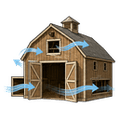 Ventilate: a building that breathes, without drafts on the animals, clears out ammonia and moisture.
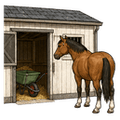 Move the animals out while mucking out: this is when ammonia and dust are at their highest.
 Keep an eye on the diet: excess protein ends up in the urine as nitrogen. Talk to your vet if the smell stays strong despite good upkeep.
Key takeawaysEM come after mucking out, absorption, and ventilation, not before. They support well-kept bedding; they won't rescue neglected bedding.
The idea is to introduce lactic acid bacteria and yeasts into the bedding to steer decomposition toward acidic fermentation rather than putrefaction. The manufacturer suggests two dosage levels with EM-A Microferm, the ready-to-dilute solution.
Dilute Microferm to 1%: 1.3 fl oz per gallon of water (10 ml per liter), so 3.4 fl oz (100 ml) for a 2.6-gallon (10-liter) sprayer. Spray the bedding regularly. The manufacturer doesn't set a precise frequency: once or twice a week is a good starting point, to be adjusted according to the smell.
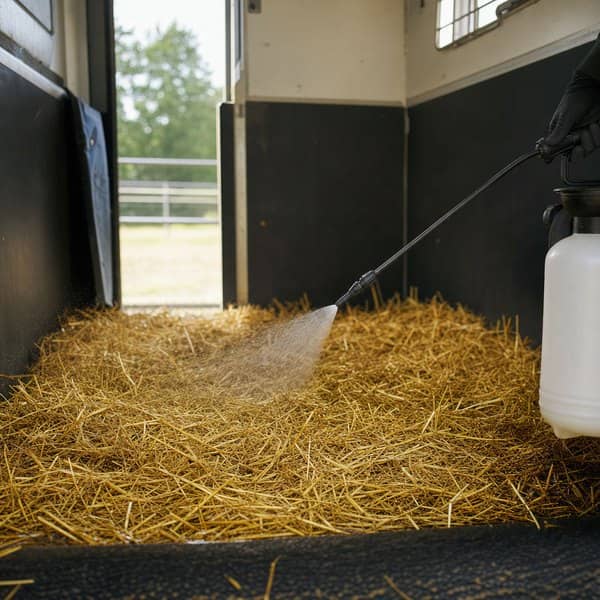
Prepare a 5% solution (1.3 gallons (5 liters) of Microferm per 26.4 gallons (100 liters) of water, or 6.4 fl oz per gallon (50 ml per liter)). Spray about 1.6 quarts (1.5 liters) of this solution per 97 sq ft (9 m²) stall, or 2.1 quarts (2 liters) for 129 sq ft (12 m²), two to three times a week. When completely replacing the bedding, the manufacturer recommends working in layers: spray the floor, spread the bedding, then spray again.
At these volumes, making your own EM-A works out much cheaper: an activation tank such as our EM Activator, from 16 to 58 gallons (60 to 220 liters), turns about 1 quart (1 liter) of EM-1 into 5.3 gallons (20 liters) of active solution. It's used at the same dilutions, within 1 to 2 months of preparation. You'll find the method in our guide activating EM-1 step by step.
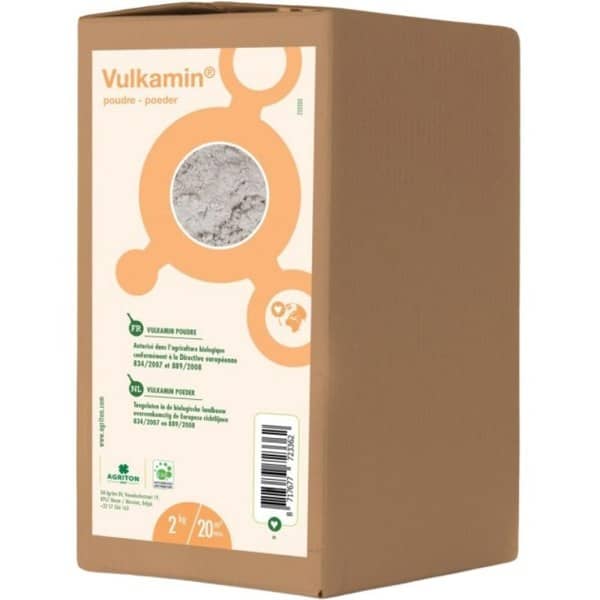
The manufacturer often combines EM with Vulkamin powder, a ground volcanic rock that absorbs moisture. Guidelines given for a horse stall: a layer of about 0.8 oz per sq ft (250 g per m²) when laying the bedding, then two applications a week, of about 1.1–1.7 lb (500–750 g) for a 97 sq ft (9 m²) stall and 1.7–2.2 lb (750 g–1 kg) for 129 sq ft (12 m²), concentrated on wet areas. The instructions for cattle on deep bedding go up to 0.8 oz per sq ft (250 g per m²) per day. Wear gloves and a dust mask when spreading it.
Emy's tipSpray while the animals are outside, in large droplets rather than a fine mist, and let the bedding soak it up for about ten minutes before bringing them back in. Poultry in particular have airways that are very sensitive to anything floating in the air.
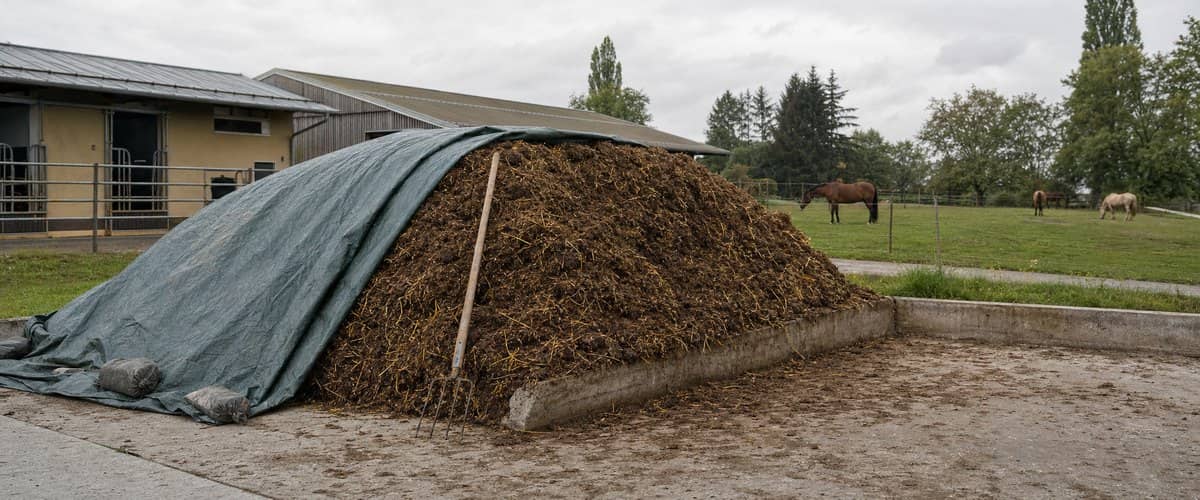
The treated bedding continues its journey on the manure pile. The manufacturer suggests fermenting it without air: about 2.1 quarts (2 liters) of Microferm diluted in about 2.6 gallons (10 liters) of water per 1.3 cubic yards (1 m³) of fresh manure, compacted and covered airtight for 8 to 10 weeks. We explain this method in detail in our guide speeding up your compost with EM.
For liquid manure (slurry), there is a specific program combining Pro-Mest Total and Microferm: 2.1 quarts (2 liters) of Pro-Mest Total diluted in water per 26,400 gallons (100 m³) of slurry at the start, then 5.3 gallons (20 liters) of Microferm per 26,400 gallons (100 m³) one to two weeks later depending on the instructions, and for maintenance about 1 quart (1 liter) of Pro-Mest Total per week for 50 livestock units. Follow the product instructions, which vary according to the type of pit.
Results do exist, but they are still few and inconsistent. Here are the most telling:
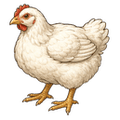 Broiler chickens, Poland (2026). Bedding with added zeolite, then sprayed weekly with EM, produced about 54% less ammonia, drier bedding, and fewer foot lesions. But the zeolite (an absorbent rock) and the EM were used together: it's impossible to tell which was responsible for what.
 Broiler chickens, East Africa. A trial measured less ammonia in the bedding, but EM were also given in the drinking water, which muddies the interpretation.
 Laying hens. A favorable effect on ammonia was reported, in a publication that had not been peer-reviewed.
 Hog slurry, Spain. A preliminary trial measured 59% less ammonia in spring, but no difference in fall. The authors believe the dose was probably too low.
 Manure, Norway. Fermentation with EM was more pronounced, with no difference in the nitrogen or dry matter of the manure.
In short, a reduction in ammonia is plausible, notably thanks to the acidification of the bedding, but it isn't guaranteed and depends heavily on conditions. We have found no independent study on the use of Microferm in a horse stall: the doses above are the manufacturer's. For an overview of the evidence, see our guide what science says about EM.
 Don't put EM in the drinking water or in the feed without your vet's advice. Spray products are not feed. For the diet, there are EM-fermented feeds designed for horses and livestock.
 Don't spray on a wound, in the eyes, or in the nostrils.
 Don't expect EM to solve a health problem. An animal that is coughing, has runny eyes, or is having trouble breathing must be seen by a vet.
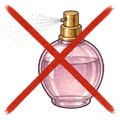 Don't rely on a fragrance to mask ammonia: if the smell comes back quickly, it's the bedding or the ventilation that needs a closer look.
Ammonia in stables, barns, and chicken coops comes from urine and droppings breaking down in damp bedding. The first response is still daily mucking out, absorbent bedding, and good ventilation. EM come next: Microferm diluted to 1% for routine maintenance, or a 5% solution sprayed two to three times a week on the straw in a stall, possibly with rock dust on damp areas. Studies show a possible reduction in ammonia, with no guarantee. Use non-chlorinated water, don't combine EM with lime or a disinfectant, keep them out of the drinking water, and leave any health questions to your vet.
Scan the code or visit mouttafarm.com/guide: all our how-to guides, with links to the products mentioned.



 France
 Belgium
 Switzerland
 Germany
 Austria
 United Kingdom
 Italy
 Spain
 Holland
 Portugal
 Ireland
 Sweden
 Finland
 Denmark
 Greece
 Poland
 Rumania
 Czech Republic
