












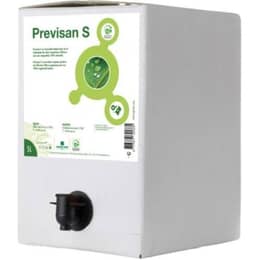
EM Previsan S, EM leaf film | 5 L Bag-in-box
Natural film with microorganisms for leaves, from 5 to 250 L
$81.10 €72.64
Fast and odor-free, composting worms eat your food scraps and turn them into fertilizer for your plants.

From 2 to 4 trays, with an optional planter.

Up to 18 growing areas around a central worm composter.

Terracotta, with a flower pot.

From 2 to 4 trays, with a lower shelf.

Trays you add over time for easy vermicompost harvesting.

Turn your planters and flower beds into a worm composter: WORMacotta, In-Ground.
 Practical guide

From kitchen to garden, composting becomes simple, fast, and effective for everyone.
 Practical guide
 Practical guide
Live animals (worms and bait) and products to feed and care for pets and livestock.

Eisenia composting worms for your worm composter or compost bin.

Ultra-fresh worms: red worms, Dendros, and Canadian nightcrawlers from 3.5 oz (100 g) to 2.2 lb (1 kg).

Natural solutions dedicated to the well-being of horses, ponies, and donkeys.

Optimize the health and performance of your farm.

Mealworms: natural, nutritious supplements.
Beautify your home with our decorative pieces and care for your house in a natural, sustainable way.
Garden the eco-friendly way, in harmony with nature, for healthy, long-lasting plants.
EM-based products designed to enrich soil, protect plants, support animal health, and make everyday well-being and home care easier.

Contains a blend of 80 families of beneficial microorganisms.

Revitalize, purify, and improve water quality in all your applications.

Stimulate soil microbial activity and plant growth.

Clean and care for your surroundings naturally.

For the well-being and health of pets, livestock, and horses.

Enrich your body care and dietary routines with essential enzymes.
 Practical guidePractical guide

Spraying microorganisms on the leaves rather than on the soil is an idea that appeals to many gardeners. Leaves naturally host a multitude of bacteria and yeasts, and some EM products are designed to be applied directly to foliage. That's the case with EM Previsan S, a ready-to-dilute preparation that we carry.
This guide explains how to use it properly, when, at what dose, and above all, what you can honestly expect from it. A foliar EM spray is not a treatment: it replaces neither good growing practices nor an authorized product once a disease has taken hold.
The surface of a leaf is a living environment. Billions of microorganisms settle there, feed on the sugars and dust deposited on it, then disappear with the sun, wind, and rain. The idea behind an EM-based foliar spray is to bring lactic acid bacteria and yeasts from fermentation to this very spot.
It's worth knowing that a leaf is a tough place for a microorganism. The sun's ultraviolet rays are the main factor limiting their survival, followed by heat and drying out. That's why the timing of the spray matters as much as the dose: a living product sprayed in the full midday sun loses much of its value within a few hours.
Did you know?On a leaf, it's not the rain but the sun that does the most damage to microorganisms: ultraviolet light damages their genetic material. Spraying early in the morning or in overcast weather gives them a much better chance.
EM Previsan S is a liquid preparation based on effective microorganisms, combined with a plant-based binder. This binder helps the solution stay on the leaves, including waxy or glossy foliage such as boxwood, bay laurel, or rhododendron, where water tends to bead up and run off.
EM Previsan S is a preparation of microorganisms with a plant-based binder that forms a natural film on the leaves. It is not a pesticide or plant protection product. In France, as throughout the European Union, a product intended to protect plants against diseases, fungi, or pests must be granted marketing authorization before it can be sold for that use. So we do not present EM Previsan S as a treatment, and you should not rely on it to cure a diseased plant. The legal framework is explained in our guide EM and regulations.
The research points the same way. Independent trials of EM give highly variable results depending on the plants and conditions, and several find no measurable effect. Work published in 2015, combining a review of studies with greenhouse trials, even noted something unexpected: corn plants treated with EM were about 50% more appealing to a caterpillar than untreated plants, and responded less to its attacks. This doesn't prove that EM weaken plants, but it's a reminder not to credit them with unproven benefits. Our guide What science says about EM gives the full picture.
Key takeawaysEM Previsan S is used as regular foliage care, alongside a well-managed garden. It is neither a remedy nor an insurance policy against disease.
Always refer to the label on your container: it has the final word. As a guide, the manufacturer recommends a dilution of 1.1 quarts (1 liter) of EM Previsan S per 26.4 gallons (100 liters) of water, i.e., 1%. Its professional guidelines, around 1.1 quarts (1 liter) of product per 2.5 acres (1 hectare) in 26–40 gallons (100–150 liters) of water, work out to the same concentration. For a home garden, that means:
The program the manufacturer suggests for professionals runs from April to September, with 8 to 10 applications per season, roughly one every two to three weeks, and up to one a week during very wet spells. In a home garden, one application every two to three weeks during the growing season is considered a reasonable pace to start with.
One rule comes up with every EM manufacturer: it's better to increase the number of applications than the dose. A more concentrated solution is not more effective, and an overly strong acidic preparation can mark young leaves.
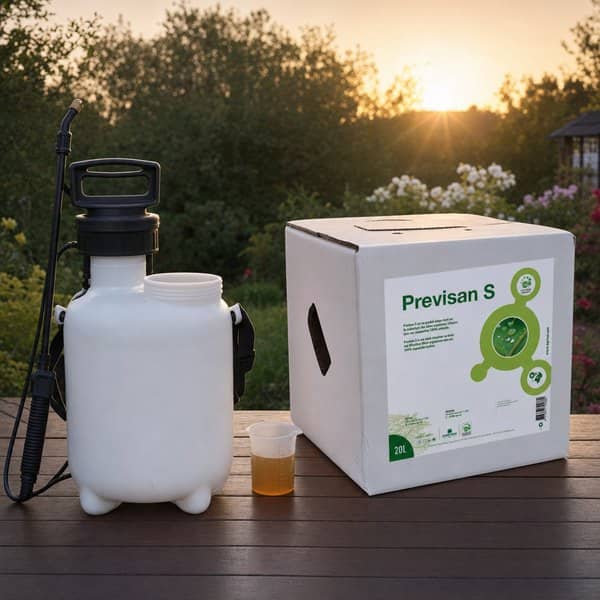
Emy's tipKeep one sprayer just for microorganisms and label it with a marker. A sprayer that has held a weed killer or fungicide retains residues, even after rinsing, which can damage your plants or destroy the microorganisms in the solution.


No product of any kind can make up for a plant that is poorly placed or weakened. The proven measures are simple, free, and far more effective than any spray:
If you notice spots, a powdery coating, yellowing leaves, or a colony of pests, EM Previsan S is not the answer. Work through these steps in order:
Once the plant has recovered, resume your EM sprays using thoroughly rinsed equipment.
EM Previsan S is a foliar spray based on effective microorganisms, with a binder that helps it stay on the leaves. Dilute it to around 1% in non-chlorinated water, following the label, and spray both sides of the foliage with a fine mist, early in the morning or in overcast weather, increasing the number of applications rather than the dose. Use it as a form of care, alongside proven practices: good varieties, crop rotation, airflow, watering at the base, and a living soil. It is not a pesticide: if a disease breaks out, identify it and turn to a product authorized for home garden use.
Scan the code or visit mouttafarm.com/guide: all our how-to guides, with links to the products mentioned.



 France
 Belgium
 Switzerland
 Germany
 Austria
 United Kingdom
 Italy
 Spain
 Holland
 Portugal
 Ireland
 Sweden
 Finland
 Denmark
 Greece
 Poland
 Rumania
 Czech Republic
