












Vulkamin, volcanic granules for soil | 2 kg Box
Stimulates microbial activity, 4.4 to 1,760 lb (2 to 800 kg)
$10.65 €9.54
Fast and odor-free, composting worms eat your food scraps and turn them into fertilizer for your plants.

From 2 to 4 trays, with an optional planter.

Up to 18 growing areas around a central worm composter.

Terracotta, with a flower pot.

From 2 to 4 trays, with a lower shelf.

Trays you add over time for easy vermicompost harvesting.

Turn your planters and flower beds into a worm composter: WORMacotta, In-Ground.
 Practical guide

From kitchen to garden, composting becomes simple, fast, and effective for everyone.
 Practical guide
 Practical guide
Live animals (worms and bait) and products to feed and care for pets and livestock.

Eisenia composting worms for your worm composter or compost bin.

Ultra-fresh worms: red worms, Dendros, and Canadian nightcrawlers from 3.5 oz (100 g) to 2.2 lb (1 kg).

Natural solutions dedicated to the well-being of horses, ponies, and donkeys.

Optimize the health and performance of your farm.

Mealworms: natural, nutritious supplements.
Beautify your home with our decorative pieces and care for your house in a natural, sustainable way.
Garden the eco-friendly way, in harmony with nature, for healthy, long-lasting plants.
EM-based products designed to enrich soil, protect plants, support animal health, and make everyday well-being and home care easier.

Contains a blend of 80 families of beneficial microorganisms.

Revitalize, purify, and improve water quality in all your applications.

Stimulate soil microbial activity and plant growth.

Clean and care for your surroundings naturally.

For the well-being and health of pets, livestock, and horses.

Enrich your body care and dietary routines with essential enzymes.
 Practical guidePractical guide

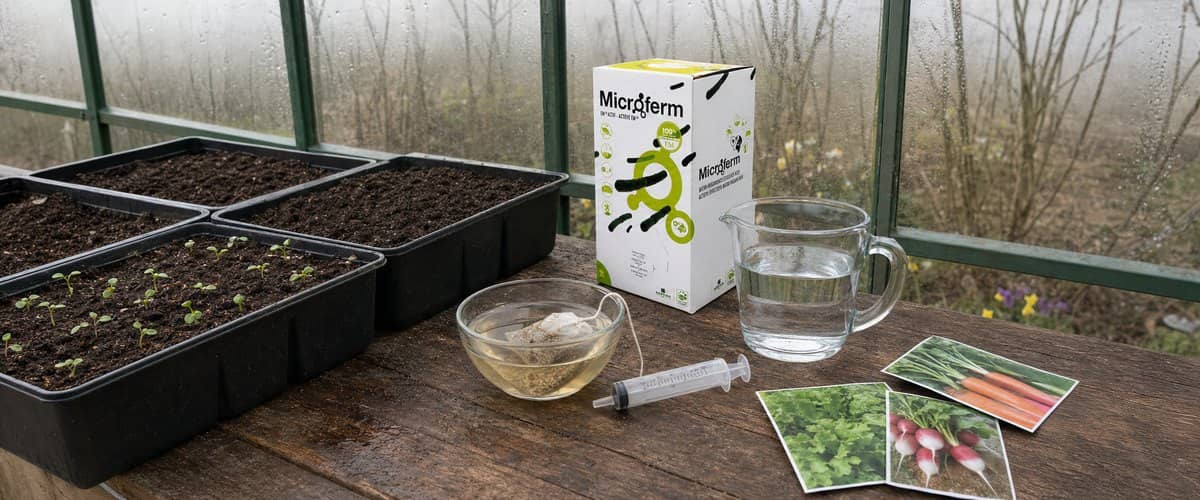
A good start often leads to a good harvest. Vigorous seedlings and stocky, well-rooted young plants handle transplanting, drought, and cold snaps better. Many gardeners add effective microorganisms when starting seeds: by soaking the seeds, moistening the potting mix, or watering the young plants.
These steps are simple, but they call for weaker dilutions than in the vegetable garden, because young roots are fragile. Here are the doses, the right sequence, and what the few published trials actually show.
Before thinking about EM, let's go over what really makes seed starting a success: plenty of light, the right temperature for each species, a light, clean potting mix, and regular watering without overdoing it. A seedling that lacks light gets leggy and weak, no matter what you give it. Waterlogged potting mix rots the roots.
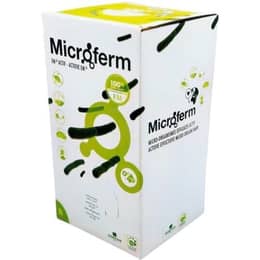
EM complement these good conditions. They are always used diluted in unchlorinated water: rainwater, or tap water left to stand for 24 hours. You can use EM-A Microferm Active Solution, ready to dilute, or an EM-A you make yourself from EM-1 Mother Solution, following our guide Activating EM-1: making your own EM-A step by step.
The best-documented soak is at 1 in 500, i.e., about 1.5 teaspoons of EM-A per gallon of water (2 ml per liter; a small dosing syringe is very handy for measuring), for 30 minutes before sowing. This is the protocol used in the published trials on celery and tomato, and the dilution one distributor recommends for sprouts and seedlings.
For very fine seeds (carrot, lettuce, strawberry), soaking is impractical: simply moisten the potting mix with the solution, as explained below.
What can you expect? The results are mixed. In trials on corn, sorghum, and sunflower, treating seeds with EM did not change the germination rate under favorable conditions, but it gave better results under stress, especially cold. Other lab tests on sunflower report better germination and longer roots. In other words: a possible small boost, especially when conditions aren't ideal, but nothing that will make up for seed that's too old or a sowing that's too cold.
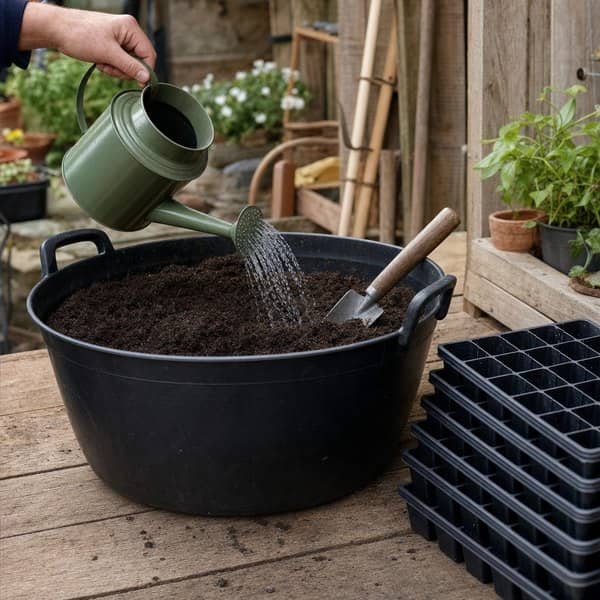
The day before sowing, moisten your potting mix with the same 1 in 500 solution. Mix well, so it feels damp to the touch without being soggy: a tightly squeezed handful should not drip. Then fill your pots or seed trays.
A few rules for the growing medium:
Emy's tipAlways sow a few control pots, watered with plain water, alongside the ones getting EM, and label them. It's the only way to see, under your own conditions, whether there's a difference.
Once the seedlings have come up, water them with EM once a week, and with plain water the rest of the time:
 From emergence to the first true leaves: 1 in 1,000, i.e., about 3/4 teaspoon per gallon (1 ml per liter).
 From the first true leaves to transplanting: 1 in 500, i.e., about 1.5 teaspoons per gallon (2 ml per liter).
Ideally, water from below, letting the pots soak in a saucer for a few minutes, then pour off the excess. Don't spray the seedlings' leaves, and never increase the dose: stronger doesn't mean more effective, and EM-A is acidic.
EM are no substitute for precautions against damping-off, the collapse of seedlings at soil level: clean containers and potting mix, moderate watering, good air circulation, and enough light remain the only real defenses.
Key takeawaysThe younger the plant, the more you dilute: 1 in 500 for seeds and potting mix, 1 in 1,000 for seedlings, and 1 in 100 only for well-established plants in the garden.
Two greenhouse trials conducted in Estonia on transplants are often cited. They are interesting, but they should be read with their limitations in mind.
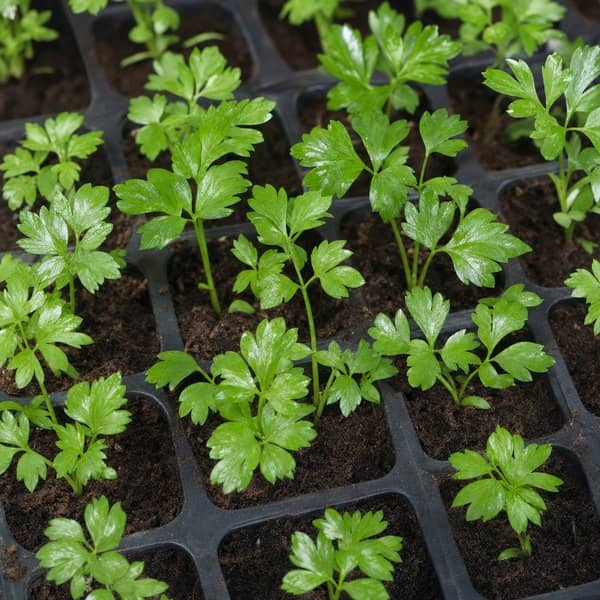
The seeds were soaked for 30 minutes in a 1 in 500 EM solution, sown in peat treated the same way, then watered weekly. Result: noticeably stockier plants (about a third shorter), with thicker stems and higher levels of nitrogen, phosphorus, potassium, and calcium. But this was a single trial, over a single season, with no measurement of the harvest, and the three treatments were combined: there's no way to know which one made the difference.
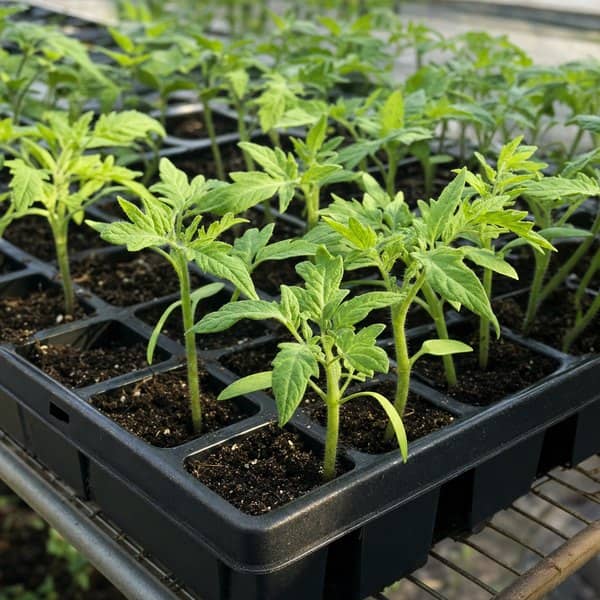
Here, diluted bokashi juice was tested: seeds soaked at 1 in 500, then watered weekly at 1 in 1,000. Only stem diameter was significantly greater, by about 13%. The plants seemed slightly taller, but the difference was not significant, with a very small number of plants. Bokashi juice has its own rules of use, detailed in our guide Bokashi juice: dilution, uses, and limitations.
Beyond these two trials, reviews count a majority of positive studies on vegetable growth, but that's a simple tally that doesn't weigh the quality of the trials. Field trials in temperate climates, on the other hand, show no clear effect on yields, as we explain in our guide What science says about effective microorganisms.
Did you know?A smaller plant isn't necessarily a failed plant. For transplanting, gardeners actually look for stocky plants with thick stems, which establish better than tall, spindly ones.
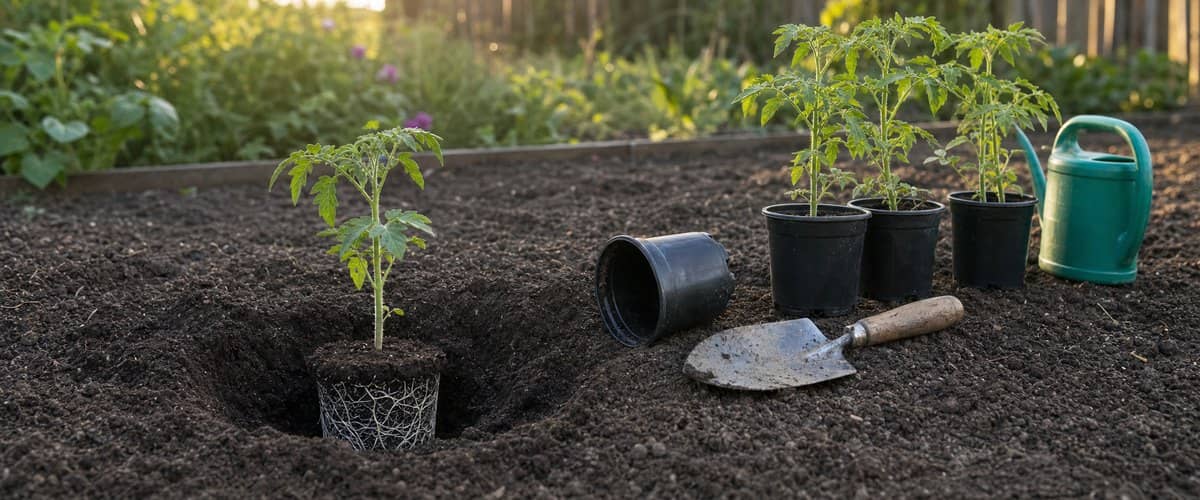
Water the plants with a 1 in 500 solution the day before, so the root ball holds together, then again right after transplanting, so the soil settles well around the roots.
Water the planting hole and the root ball with the same solution. For larger plantings (shrubs, fruit trees, large container plants), you can mix a little bokashi mulch into the soil in the hole, at the rate given in our guide Using EM in the vegetable garden, working it in well so no clumps are left touching the roots.
Moisten the new potting mix at 1 in 500, repot, then water with the same solution. For well-established plants, whether houseplants or patio and balcony plants, the manufacturer of Microferm recommends regular watering at 1 in 100; in pots, where the roots have nowhere to escape, we suggest starting more diluted, at 1 in 500, then moving up to 1 in 100 if the plant is doing well. Always empty any water left standing in the saucer.
For seed starting, soak the seeds for 30 minutes in a 1 in 500 EM solution, moisten the potting mix the day before with the same dilution, then water the young plants once a week at 1 in 1,000, then 1 in 500 until transplanting, always with unchlorinated water. When transplanting and repotting, stay at 1 in 500; the 1 in 100 dilution is for well-established plants only. Published trials show stockier plants with thicker stems, but they are few and small in scale: EM complement light, warmth, good potting mix, and careful watering, but never replace them.
Scan the code or visit mouttafarm.com/guide: all our how-to guides, with links to the products mentioned.



 France
 Belgium
 Switzerland
 Germany
 Austria
 United Kingdom
 Italy
 Spain
 Holland
 Portugal
 Ireland
 Sweden
 Finland
 Denmark
 Greece
 Poland
 Rumania
 Czech Republic
