












Preorder
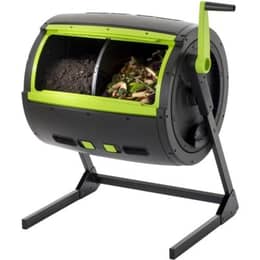
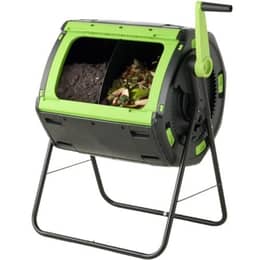
245L Maze Rotating Composter with Dual Chambers
Effortless outdoor composting
$231.67 €207.50
Fast and odor-free, composting worms eat your food scraps and turn them into fertilizer for your plants.

From 2 to 4 trays, with an optional planter.

Up to 18 growing areas around a central worm composter.

Terracotta, with a flower pot.

From 2 to 4 trays, with a lower shelf.

Trays you add over time for easy vermicompost harvesting.

Turn your planters and flower beds into a worm composter: WORMacotta, In-Ground.
 Practical guide

From kitchen to garden, composting becomes simple, fast, and effective for everyone.
 Practical guide
 Practical guide
Live animals (worms and bait) and products to feed and care for pets and livestock.

Eisenia composting worms for your worm composter or compost bin.

Ultra-fresh worms: red worms, Dendros, and Canadian nightcrawlers from 3.5 oz (100 g) to 2.2 lb (1 kg).

Natural solutions dedicated to the well-being of horses, ponies, and donkeys.

Optimize the health and performance of your farm.

Mealworms: natural, nutritious supplements.
Beautify your home with our decorative pieces and care for your house in a natural, sustainable way.
Garden the eco-friendly way, in harmony with nature, for healthy, long-lasting plants.
EM-based products designed to enrich soil, protect plants, support animal health, and make everyday well-being and home care easier.

Contains a blend of 80 families of beneficial microorganisms.

Revitalize, purify, and improve water quality in all your applications.

Stimulate soil microbial activity and plant growth.

Clean and care for your surroundings naturally.

For the well-being and health of pets, livestock, and horses.

Enrich your body care and dietary routines with essential enzymes.
 Practical guidePractical guide

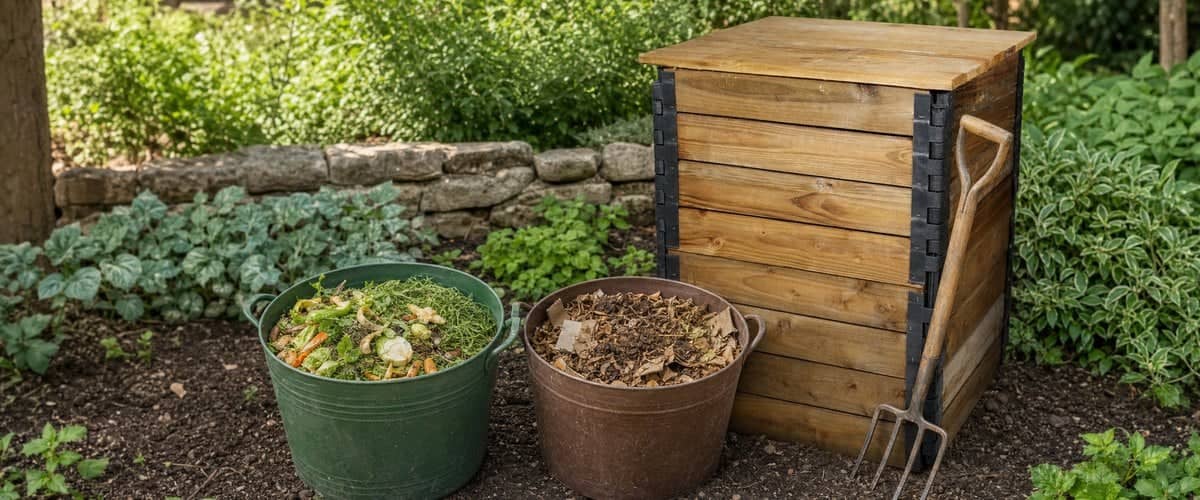
One compost pile smells pleasantly like the forest floor, another reeks like a sewer: the difference very often comes down to a single adjustment, the balance between "greens" and "browns." It's the most important step in composting, and it's much simpler than it looks.
In this guide, we explain what green and brown mean, what the famous carbon/nitrogen ratio is, and above all the practical rule to follow day to day, with no scale or calculator.
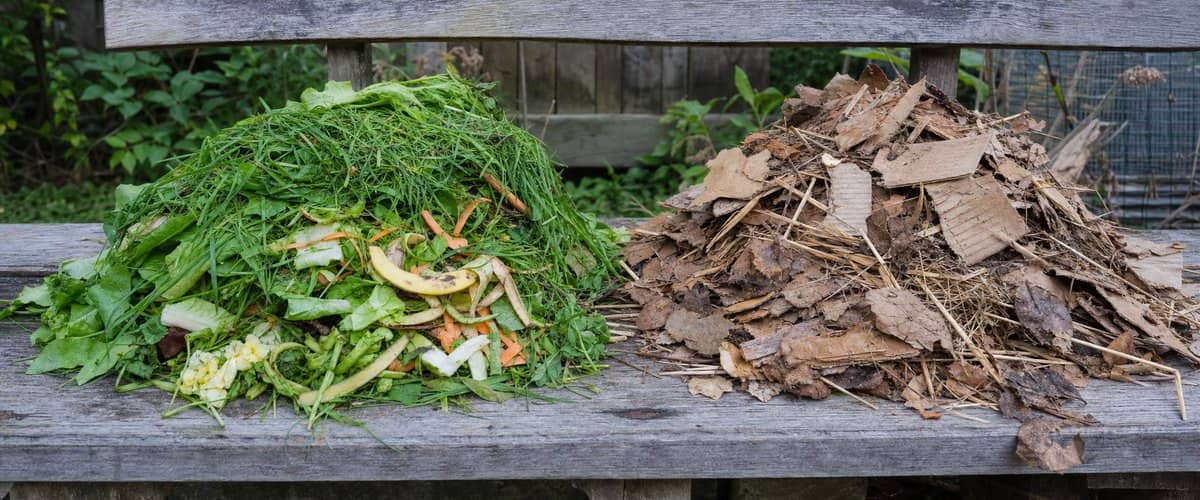
The microorganisms that break down your waste need two main elements: carbon, which gives them energy, and nitrogen, which allows them to multiply. Waste falls roughly into two families, depending on what it provides.
These are fresh, soft, moist materials: peels, fruit and vegetable scraps, coffee grounds, grass clippings, young shoots, spent flowers. They break down quickly. On their own, they pack down, lack air, release liquid, and end up rotting.
These are dry, hard, fibrous materials: dead leaves, straw, small shredded branches, untreated sawdust, brown cardboard, paper. They break down slowly. On their own, they stay dry and almost nothing happens.
Color is only a guide: grass clippings dried in the sun become more "brown," and coffee grounds, although brown, behave like a green. The right test is simple: is it fresh and moist, or dry and fibrous?
The C/N ratio compares the amount of carbon and the amount of nitrogen in a material. The higher it is, the more "brown" the material. The ideal mix is generally put at around 30 to 1: roughly thirty parts carbon to one part nitrogen.
Here are some approximate values for common materials. They are ranges, since the same waste varies depending on how fresh it is and where it comes from.
You can see right away why peels on their own rot (not enough carbon) and why a pile of sawdust just sits there (not enough nitrogen). By mixing the two families, you naturally get closer to the right range.
Did you know?The C/N ratio is a tool for understanding, not for measuring. Nobody weighs their peels before tossing them, and C/N is calculated by weight, while practical advice talks about buckets by volume. Just remember the order of magnitude: you need a lot more "brown" than you might think.
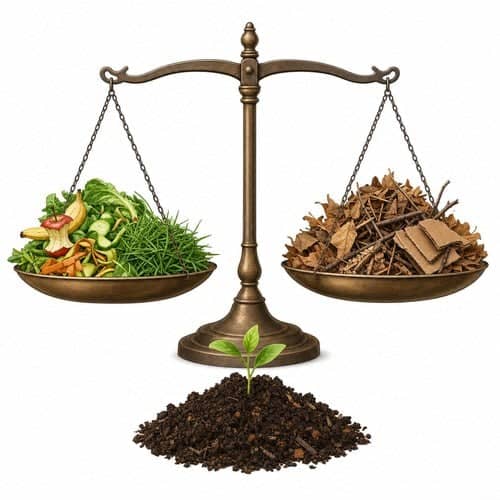 For everyday composting, aim for a mix of about 50% moist waste and 50% dry waste. Put very simply: one bucket of dry material for every bucket of moist waste. This is the rule we recommend to get started.
Some advice leans even further toward brown: some sources recommend two to three volumes of brown for every volume of green, especially to deter rodents, while others suggest 25–50% green material. These differences aren't contradictory: very wet food scraps need more brown than slightly dry grass clippings.
Our take: start with "bucket for bucket," then adjust by watching your compost. If it smells bad or turns slimy, add brown. If it stays dry and nothing happens, add green and a little water. The squeeze test will quickly tell you whether the moisture level is right.
Willy's tipKeep a bag or trash can of dry material right next to the composter: dead leaves, wood chips, torn cardboard. That way, every time you empty your kitchen compost pail, the right move is within easy reach, with nothing to go looking for.
Green and brown aren't the whole story. In practice, you need to get three mixes right at the same time.
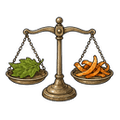 Carbon and nitrogen: this is the green/brown balance described above.
 Moist and dry: moist waste on its own suffocates the pile, dry waste on its own stalls it. The right mix stays as moist as a wrung-out sponge.
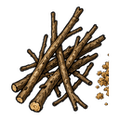 Coarse and fine: coarse pieces (wood chips, small branches) create air pockets; fine materials (grass clippings, sawdust, peels) pack down easily. Too much coarse material and the compost dries out; too much fine material and it clogs up.
The simplest approach is to lightly mix each new addition into the layer already there, rather than piling up thick layers of a single type of waste. Alternating layers work on paper, but they're hard to keep up in real life.
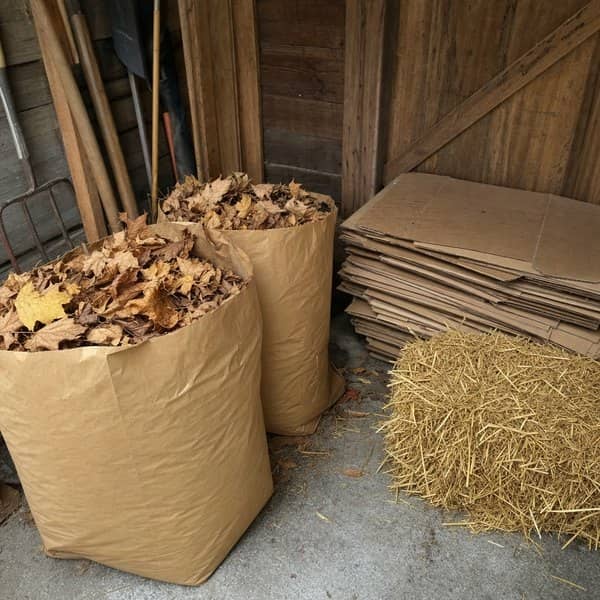
In summer, or in a small yard, brown material is often what runs short. A few ideas:
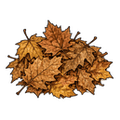 Fall leaves: store several bags somewhere dry and they'll last you all year.
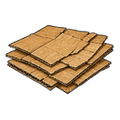 Brown cardboard: egg cartons, paper towel and toilet paper tubes, shipping boxes with no tape or glossy ink, torn into pieces.
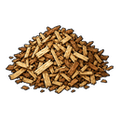 Wood chips from your hedge trimmings, or the free mulch some towns and cities offer: check with your local recycling center.
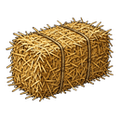 Straw, and sawdust or shavings from untreated wood (never treated wood or particleboard).
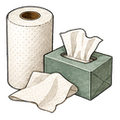 Paper towels and tissues.
In an apartment or in a worm composter, cardboard plays exactly the same role, acting as a sponge and a regulator: we explain this in our guide What can you feed earthworms?
Your compost tells you what it needs. Here are the most common signs and how to fix them:
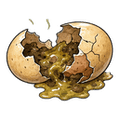 Rotten egg smell, slimy and compacted material: too much green and not enough air. Add coarse brown material and mix.
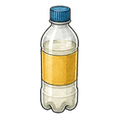 Ammonia smell: too much nitrogen, often after mowing a large lawn. Work in leaves or cardboard.
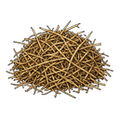 Dry, fibrous material, nothing happening: too much brown and not enough water. Add peels or fresh grass clippings, and water lightly.
 Very slow decomposition with no smell: often too much carbon, or simply the winter cold.
A tool like the Brass'Compost compost aerator helps work dry material into the heart of the mix without having to turn the whole pile. For a more complete troubleshooting of odors and stalled compost, see our guide Compost that smells bad or isn't breaking down.
Greens provide nitrogen and moisture, browns provide carbon and structure. Experts aim for a C/N ratio of about 30 to 1, but in the backyard, one rule is enough: one bucket of dry material for every bucket of food scraps, mixing large and small pieces. Always keep a stockpile of browns near the composter, then adjust by smell and feel.
Scan the code or visit mouttafarm.com/guide: all our how-to guides, with links to the products mentioned.



 France
 Belgium
 Switzerland
 Germany
 Austria
 United Kingdom
 Italy
 Spain
 Holland
 Portugal
 Ireland
 Sweden
 Finland
 Denmark
 Greece
 Poland
 Rumania
 Czech Republic
