












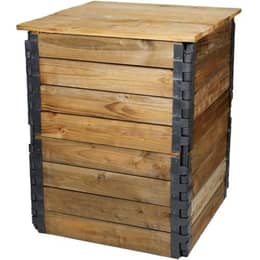
Compostys wooden composter | 305 liters
PEFC-certified spruce wood
$129.32 €115.83
Fast and odor-free, composting worms eat your food scraps and turn them into fertilizer for your plants.

From 2 to 4 trays, with an optional planter.

Up to 18 growing areas around a central worm composter.

Terracotta, with a flower pot.

From 2 to 4 trays, with a lower shelf.

Trays you add over time for easy vermicompost harvesting.

Turn your planters and flower beds into a worm composter: WORMacotta, In-Ground.
 Practical guide

From kitchen to garden, composting becomes simple, fast, and effective for everyone.
 Practical guide
 Practical guide
Live animals (worms and bait) and products to feed and care for pets and livestock.

Eisenia composting worms for your worm composter or compost bin.

Ultra-fresh worms: red worms, Dendros, and Canadian nightcrawlers from 3.5 oz (100 g) to 2.2 lb (1 kg).

Natural solutions dedicated to the well-being of horses, ponies, and donkeys.

Optimize the health and performance of your farm.

Mealworms: natural, nutritious supplements.
Beautify your home with our decorative pieces and care for your house in a natural, sustainable way.
Garden the eco-friendly way, in harmony with nature, for healthy, long-lasting plants.
EM-based products designed to enrich soil, protect plants, support animal health, and make everyday well-being and home care easier.

Contains a blend of 80 families of beneficial microorganisms.

Revitalize, purify, and improve water quality in all your applications.

Stimulate soil microbial activity and plant growth.

Clean and care for your surroundings naturally.

For the well-being and health of pets, livestock, and horses.

Enrich your body care and dietary routines with essential enzymes.
 Practical guidePractical guide

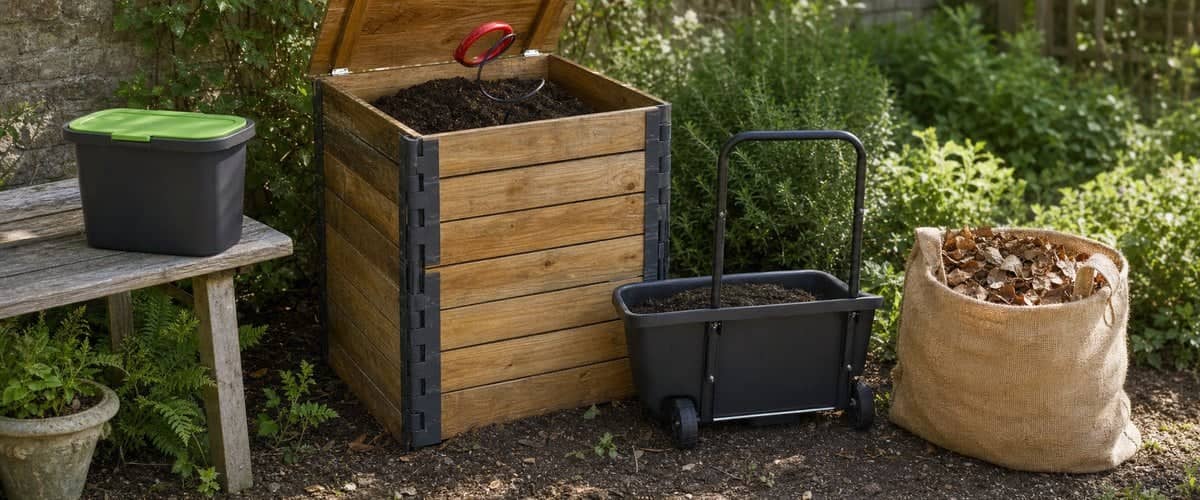
53, 106, 159 gallons (200, 400, 600 liters) or more: when you're buying a composter, the question of size always comes up. Too small, and it overflows by the first spring. Too big, and it takes up space for no reason and fills so slowly that it struggles to get going.
The good news is that a few simple guidelines are all you need to choose. In this guide, we'll help you estimate what your household produces, choose the right size for your yard, and then pick the few accessories that make composting truly practical day to day.
It's estimated that each person produces about 154 lb (70 kg) a year of kitchen and household waste that could be composted. Once broken down, this yields roughly 17.6 lb (8 kg) of compost. The difference is no surprise: most of this waste is water, and much of the organic matter is consumed by microorganisms. Composting also reduces the volume of organic waste by about two-thirds.
Unfortunately, not all of those 154 lb (70 kg) end up in the compost. According to an analysis of household trash carried out in 2017, about 220 lb (100 kg) of waste per person per year that could have been composted or collected as organic waste was still ending up in the regular trash. So there's plenty of room for improvement.
A yard changes everything. Yard waste (grass clippings, leaves, prunings) often takes up far more volume than kitchen scraps: to give you an idea of scale, the French produce about 353 lb (160 kg) of yard waste per person per year. And this waste comes in waves: a single spring mowing can fill a bin in one go, and so can fallen leaves in the fall.
Before buying a giant composter, remember that some of this waste can be put to good use in other ways: leave grass clippings on the lawn, and mulch your beds with leaves or wood chips. We explain these solutions in detail in our guide on yard waste. Whatever's left goes into the composter, and that's what you should size it for.
There's no official standard, but the commonly suggested guidelines are fairly similar. For example, a 53-gallon (200-liter) composter is considered enough for the kitchen scraps alone of a four-person household, a 106-gallon (400-liter) bin works for kitchen and yard waste when the yard is under 4,300 sq ft (400 m²), and beyond that, a 159-gallon (600-liter) bin or two 106-gallon (400-liter) bins are a better choice. Other, similar guidelines put this threshold at 5,400 sq ft (500 m²) of yard.
Based on these guidelines, here's our advice:
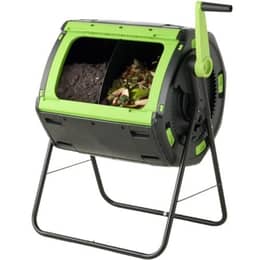
 Kitchen scraps only, 1 to 4 people: 40–79 gallons (150–300 liters). A tumbler such as our Maze 180L dual-chamber compost tumbler works well on a patio or in a courtyard, and the 65-gallon (245-liter) model suits a larger household.
 Kitchen and small yard (under 4,300 to 5,400 sq ft, or 400 to 500 m²): about 79–106 gallons (300–400 liters), for example a wooden bin such as our Compostys wooden composter.
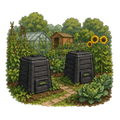 Kitchen and large yard: 159 gallons (600 liters) or more, ideally split between two bins, one for fresh additions and the other for curing.
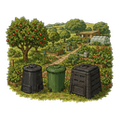 Very large yard, vegetable garden, orchard: a two- or three-bin system, plus an open pile for leaves and prunings if needed.
As an upper limit, a 35–53 cu ft (1–1.5 m³) composter can process 2,200–4,400 lb (1–2 metric tons) of waste a year, and above 264 gallons (1,000 liters), it's better to set up two bins. The differences between these systems are explained in our guides Compost pile or compost bin and Compost tumblers.
Key takeawaysKitchen scraps only: a small bin or a tumbler is enough. With a yard, plan on 79–106 gallons (300–400 liters) for a small lot, and switch to two bins as soon as the yard gets bigger. Two medium bins are better than one very large one.
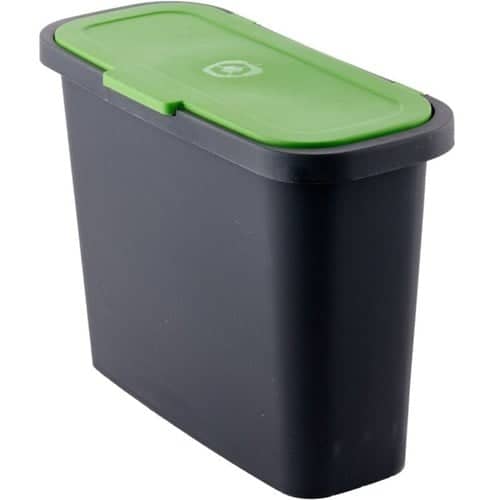 This is the most useful accessory, and often the one people forget. Without it, you end up tossing your peels in the trash can out of convenience. A small lidded pail, kept on the countertop or under the sink, collects the day's scraps before the trip to the composter.
For most households, 1.6–2.4 gallons (6–9 liters) is the sweet spot: big enough to last two or three days, small enough to be emptied before the scraps start to ferment. Choose a model with a tight-fitting lid that's easy to wash. We carry several in this size range: the Urbalive 6L compost bin, the Kaylis 7L, and the Maze 9L.
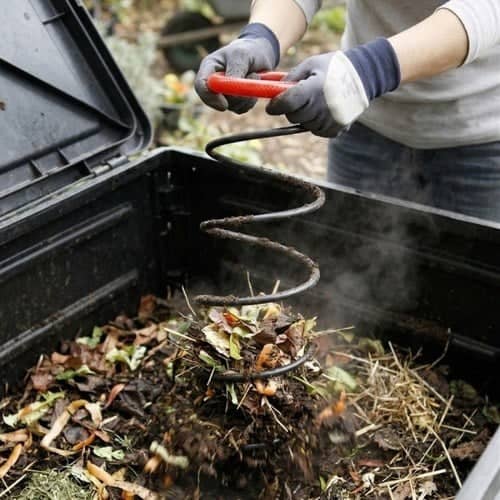 We recommend mixing your compost at least once a month with an aerator or a corkscrew-shaped tool. In a closed bin, where there isn't enough room for a pitchfork, this is the tool that makes all the difference: push it into the compost, twist it, and pull it back up, lifting the material as you go. Our Brass'Compost works on this principle. The ideal frequency for your setup is explained in detail in our guide Moisture and aeration.
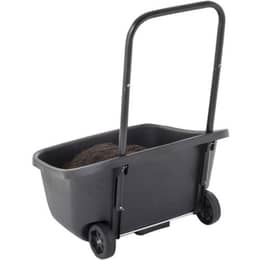
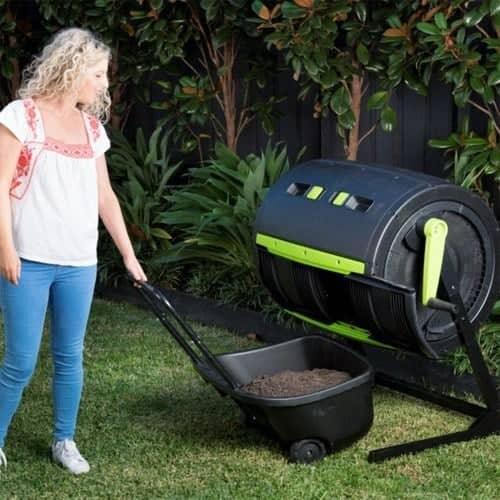 At harvest time, you need to move the compost from the bin to the vegetable garden or flower beds. A wheelbarrow will do the job, but a low cart is more practical for harvesting right at the base of the composter and moving the compost without spilling it everywhere. That's exactly what the 14.5-gallon (55-liter) compost collection cart in our catalog is designed for.
The last "accessory," and by no means the least: a supply of brown material. To balance out kitchen scraps, you need roughly as much dry material as wet material. So keep a stock of leaves and twigs next to the composter.
Set aside a spot for it right from the start: a few large bags of fallen leaves gathered in the fall, a small bin of wood chips, or a box of torn brown paper.
Willy's tipBefore buying, count how many times you empty your kitchen pail over one or two weeks. This will give you a concrete idea of how much kitchen volume to plan for, keeping in mind that scraps settle and lose a lot of volume as they break down.
A household produces about 154 lb (70 kg) of compostable waste per person per year, plus yard waste, which is often bulkier. For kitchen scraps alone, a small bin or tumbler of 40–79 gallons (150–300 liters) is enough; with a small yard, plan on 79–106 gallons (300–400 liters); with a large yard, switch to two or more bins. Round out your setup with a 1.6–2.4-gallon (6–9-liter) kitchen compost pail, an aerator for mixing at least once a month, a cart or wheelbarrow for harvesting, and a supply of dry material always close at hand.
Scan the code or visit mouttafarm.com/guide: all our how-to guides, with links to the products mentioned.



 France
 Belgium
 Switzerland
 Germany
 Austria
 United Kingdom
 Italy
 Spain
 Holland
 Portugal
 Ireland
 Sweden
 Finland
 Denmark
 Greece
 Poland
 Rumania
 Czech Republic
