












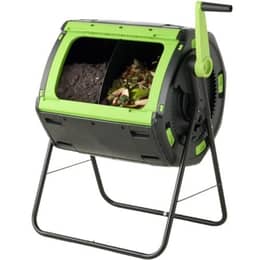
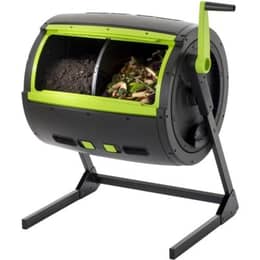
Maze 180L Dual-Chamber Rotating Composter
Effortless outdoor composting
$166.55 €149.17
Fast and odor-free, composting worms eat your food scraps and turn them into fertilizer for your plants.

From 2 to 4 trays, with an optional planter.

Up to 18 growing areas around a central worm composter.

Terracotta, with a flower pot.

From 2 to 4 trays, with a lower shelf.

Trays you add over time for easy vermicompost harvesting.

Turn your planters and flower beds into a worm composter: WORMacotta, In-Ground.
 Practical guide

From kitchen to garden, composting becomes simple, fast, and effective for everyone.
 Practical guide
 Practical guide
Live animals (worms and bait) and products to feed and care for pets and livestock.

Eisenia composting worms for your worm composter or compost bin.

Ultra-fresh worms: red worms, Dendros, and Canadian nightcrawlers from 3.5 oz (100 g) to 2.2 lb (1 kg).

Natural solutions dedicated to the well-being of horses, ponies, and donkeys.

Optimize the health and performance of your farm.

Mealworms: natural, nutritious supplements.
Beautify your home with our decorative pieces and care for your house in a natural, sustainable way.
Garden the eco-friendly way, in harmony with nature, for healthy, long-lasting plants.
EM-based products designed to enrich soil, protect plants, support animal health, and make everyday well-being and home care easier.

Contains a blend of 80 families of beneficial microorganisms.

Revitalize, purify, and improve water quality in all your applications.

Stimulate soil microbial activity and plant growth.

Clean and care for your surroundings naturally.

For the well-being and health of pets, livestock, and horses.

Enrich your body care and dietary routines with essential enzymes.
 Practical guidePractical guide

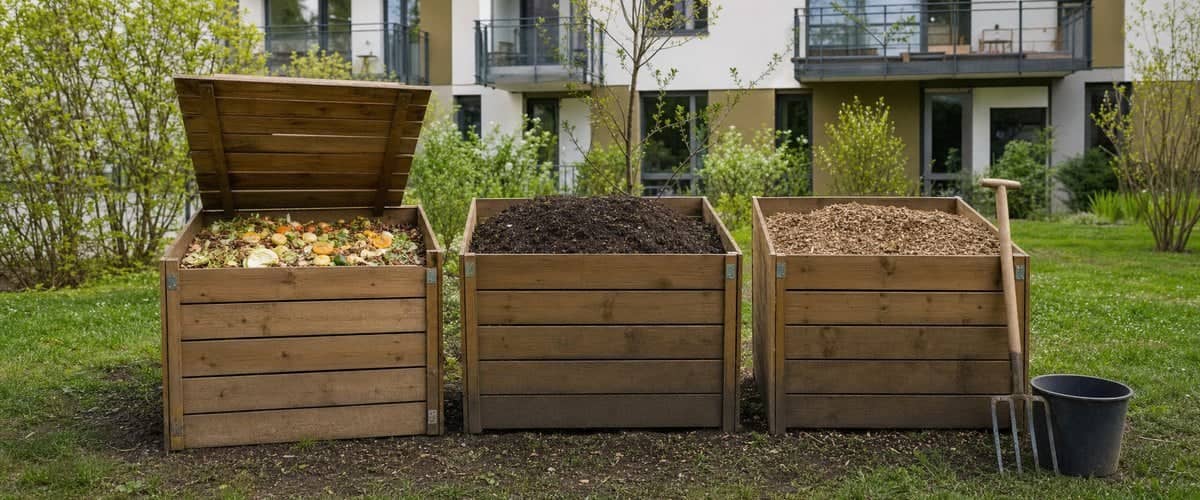
A compost bin right outside the apartment building, a few wooden bins in the corner of a small park, neighbors running into each other on a Saturday morning with their compost pails: shared composting has taken root in many towns and cities. It is a great solution for people without a yard, and often a wonderful way to bring neighbors together.
How does a shared compost bin work, how can you set one up in your building, and what rules should you follow to keep it clean and effective? Here is our practical guide.
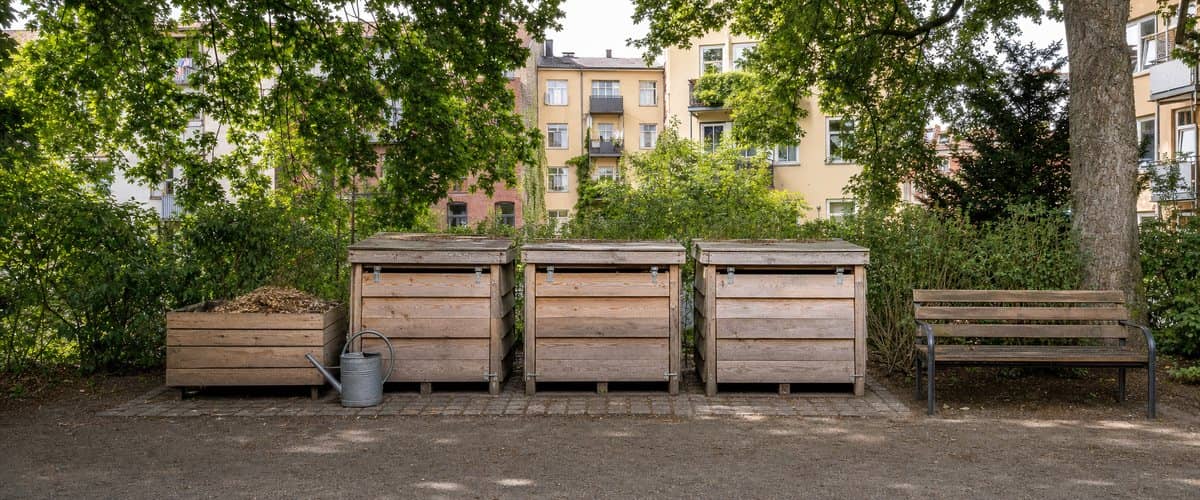
There are three forms of local composting: home composting, at your own place; shared composting, among several households; and on-site composting at institutions, where a school, cafeteria, or nursing home processes its own food scraps.
Shared composting itself comes in two forms:
If there is a community compost bin near you, you often just need to sign up with the group that runs it. Some sites are full and keep a waiting list. If that happens, it is time to consider a compost bin in your own building.
The process varies from one town to the next, but the same steps come up almost every time:
 Gather some motivated neighbors. Ideally, bring together 10 to 15 families; some cities require at least 7 participating households.
 Contact your city or county. Local government is responsible for food and yard waste, and many cities and counties support projects like this with equipment, training, and follow-up. Some only accept applications during campaigns with fixed dates.
 Get approval from the building's management. In a condo building, you will need the approval of the condo association board or the owners' meeting; in public housing, that of the landlord and, if there is one, the tenants' association.
 Choose the location. The bins sit directly on the soil, a little away from windows. For example, a minimum of 54 sq ft (5 m²) of outdoor space is sometimes required.
 Appoint site volunteers and plan from the start where the compost will be used.
Did you know?Many households still have no suitable way to compost their food scraps. Every new shared compost bin means dozens of households can benefit.
A shared compost bin depends on people, not just on bins. The site volunteer is a resident who donates their time. They advise their neighbors, keep an eye on how the compost is doing, and organize the harvest. It is best to have at least two, so they can cover for each other during vacations. Site volunteers can take a one-day training course.
The master composter is a trained professional, appointed by the local government or a local organization. They help choose the location, launch the site, and establish good habits. Ideally, this support lasts at least a year after launch; sometimes it is limited to eight months, followed by an annual visit.
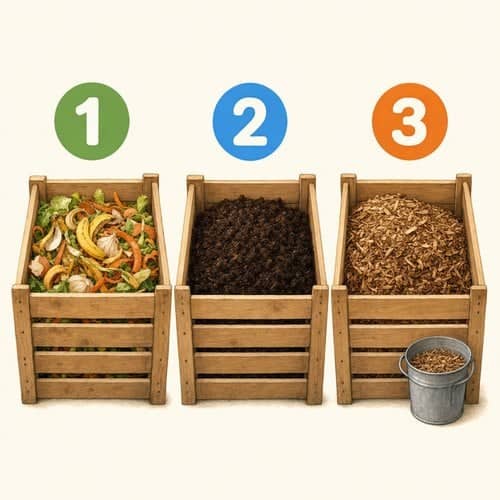 A shared site works with several bins, each with a clearly defined role:
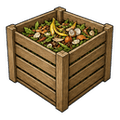 the input bin, which receives food scraps day by day;
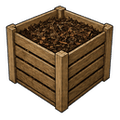 the maturing bin, where the compost rests once the first bin is full;
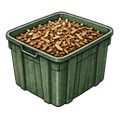 the dry-material bin (wood chips, dead leaves, shavings), essential for covering each addition.
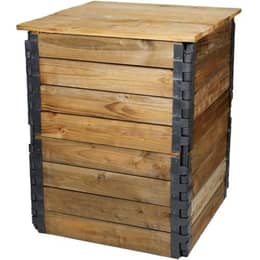
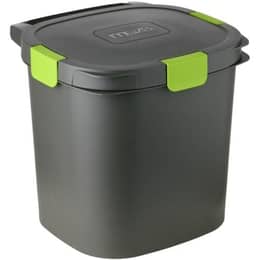
Plan for at least two bins, one of them for dry material. Some sites install three, for example two 159-gallon (600 L) bins and one 106-gallon (400 L) bin, and give each household a 1.8-gallon (7 L) compost pail. As for tools, an aerator such as the Brass'Compost lets you mix in new additions without turning the whole bin, and a compost collection cart makes the group harvest easier. On the diagram: the input bin (1), the maturing bin (2), and the dry-material bin (3).
In a shared compost bin, dozens of people drop off their scraps, often without knowing one another. To prevent odors and rodents, each site adopts a set of rules, posted on the bins. These rules are often more cautious than at home: some sites, for example, keep meat, fish, bones, dairy, sauces, bread, and large quantities of citrus out of the bin. We explain why these items are debated in our guide on citrus, meat, bread, and pet litter.
Good habits, wherever you are:
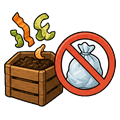 empty your food scraps in loose, without a bag, even a "compostable" one;
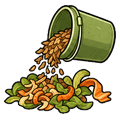 cover each addition with dry material, roughly one bucket of dry material for every bucket of food scraps;
 mix lightly on the surface if the site asks you to;
 stick to the drop-off hours of a community compost bin;
 when in doubt, ask the site volunteer rather than dropping it in.
If flies or rodents show up anyway, our guide on compost bin pests will help you find the cause.
Willy's tipCombine your trip to the compost bin with an errand you already run, like picking up bread or heading off to work: dropping off your scraps becomes a habit, and your compost pail never overflows.
A shared compost bin that works well is a lively one. A few get-togethers are enough: a group turning session now and then, a shared harvest in the spring, an up-to-date sign. It is also a chance to explain the rules to newcomers.
Spring is the ideal time to get people involved. Many areas hold open houses and composting events at this time of year, and some countries run national awareness campaigns: check with your city or your local waste service to find out what is happening near you. It is a good opportunity to invite your neighbors to discover the site.
First, check that it is mature: dark, crumbly, with a pleasant forest-floor smell. Our simple tests are explained in the guide How to tell if your compost is ready.
The compost is then shared among the participants, for their houseplants, balcony planters, or the building's green spaces. That is why you need to plan these uses from the start: some local governments will not support a site that does not have enough of them. Local rules sometimes also specify that this compost must not be sold or given away, since it has not been tested. Check the rules with your city or county.
Key takeawaysA successful shared compost bin comes down to three things: trained site volunteers, clear rules, and dry material always on hand.
Whether it is outside your apartment building or in your neighborhood, shared composting lets people without a yard put their food scraps to good use close to home. To set one up, gather a few neighbors, contact your city or county, get approval from your building's management, and appoint at least two site volunteers. After that, it all comes down to simple, clearly posted rules for what goes in, a supply of dry material, and a little community spirit. If there is no shared option near you, our guide Composting in an apartment presents the other options, such as the worm composter.
Scan the code or visit mouttafarm.com/guide: all our how-to guides, with links to the products mentioned.



 France
 Belgium
 Switzerland
 Germany
 Austria
 United Kingdom
 Italy
 Spain
 Holland
 Portugal
 Ireland
 Sweden
 Finland
 Denmark
 Greece
 Poland
 Rumania
 Czech Republic
