












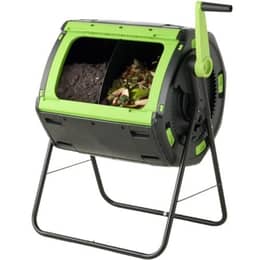
Maze 180L Dual-Chamber Rotating Composter
Effortless outdoor composting
$166.55 €149.17
Fast and odor-free, composting worms eat your food scraps and turn them into fertilizer for your plants.

From 2 to 4 trays, with an optional planter.

Up to 18 growing areas around a central worm composter.

Terracotta, with a flower pot.

From 2 to 4 trays, with a lower shelf.

Trays you add over time for easy vermicompost harvesting.

Turn your planters and flower beds into a worm composter: WORMacotta, In-Ground.
 Practical guide

From kitchen to garden, composting becomes simple, fast, and effective for everyone.
 Practical guide
 Practical guide
Live animals (worms and bait) and products to feed and care for pets and livestock.

Eisenia composting worms for your worm composter or compost bin.

Ultra-fresh worms: red worms, Dendros, and Canadian nightcrawlers from 3.5 oz (100 g) to 2.2 lb (1 kg).

Natural solutions dedicated to the well-being of horses, ponies, and donkeys.

Optimize the health and performance of your farm.

Mealworms: natural, nutritious supplements.
Beautify your home with our decorative pieces and care for your house in a natural, sustainable way.
Garden the eco-friendly way, in harmony with nature, for healthy, long-lasting plants.
EM-based products designed to enrich soil, protect plants, support animal health, and make everyday well-being and home care easier.

Contains a blend of 80 families of beneficial microorganisms.

Revitalize, purify, and improve water quality in all your applications.

Stimulate soil microbial activity and plant growth.

Clean and care for your surroundings naturally.

For the well-being and health of pets, livestock, and horses.

Enrich your body care and dietary routines with essential enzymes.
 Practical guidePractical guide

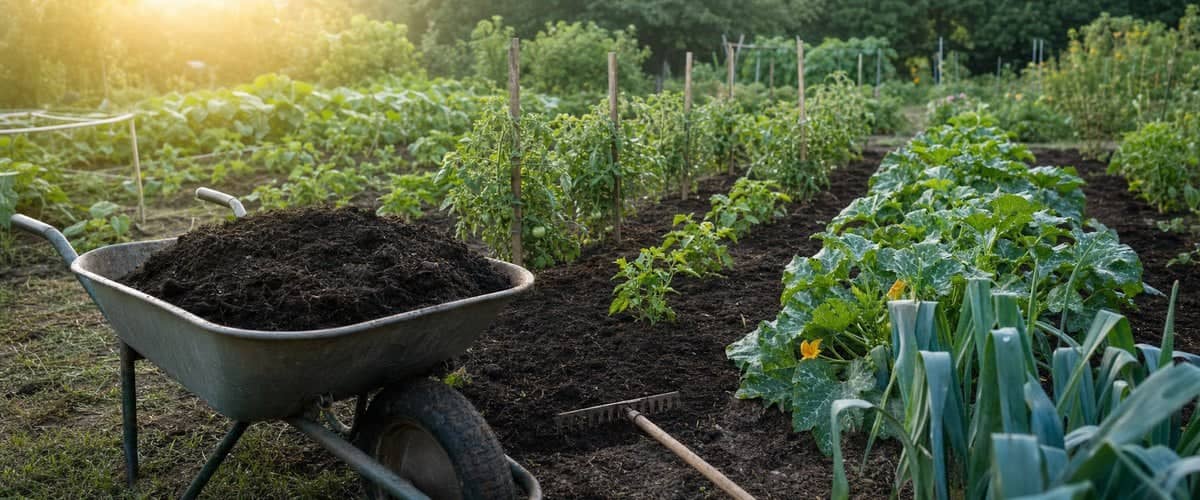
Your compost is finished, harvested, and maybe sifted. How much should you use, and where? It's tempting to spread it generously everywhere, figuring it can't do any harm. In reality, compost should be measured out like any other garden amendment: according to each plant's needs, at the right time, and always mixed into the soil.
The amounts below are yearly guidelines, given in pounds per square foot (with kilograms per square meter in parentheses). We arrived at them by comparing the recommendations of several reliable guides. Where these sources differ, we chose cautious ranges: a little less every year is better than a lot all at once.
Before talking about amounts, you need to know what kind of compost you're working with.
If you're not sure what stage your compost has reached, the tests in our guide How to tell if your compost is finished will help you decide.
Not all vegetables have the same needs. They fall into three groups.
Tomatoes, eggplants, peppers, potatoes, squash, zucchini, cucumbers, melons, leeks, celery, artichokes, and corn. These are the vegetables that benefit most from compost. Some guides give a slightly lower range, 0.6–0.8 lb/sq ft (3–4 kg/m²), so stay at the low end of the range if your soil is already rich.
Carrots, beets, spinach, lettuce, beans, peas, parsley, asparagus.
Garlic, onions, shallots, radishes, turnips, mâche, fava beans, and herbs are perfectly happy with what's left in the soil after the previous crop. They can do without any added compost, although some guides allow a thin layer. Cabbage is classified differently depending on the source, either as a light feeder or a heavy feeder: a moderate amount is a good compromise.
Willy's tipNo scale in the garden? Here's a simple rule of thumb: a layer of compost about 0.4 in (1 cm) thick works out to roughly 0.6–1 lb per square foot (3–5 kg per square meter). That's the right amount for heavy feeders. For moderate feeders, a thinner layer is enough.
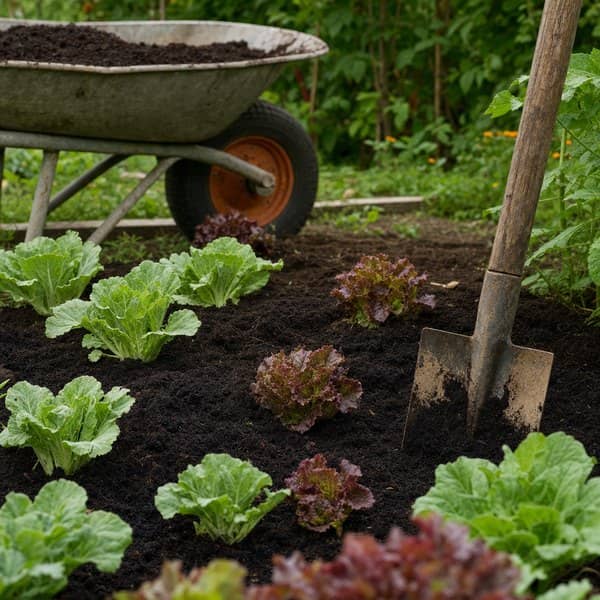
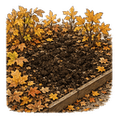 In the fall or late winter, spread on the surface and lightly raked in;
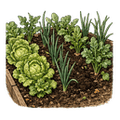 in spring, between the rows, before mulching over the top;
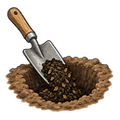 at planting time, at the bottom of the hole, covered with a little soil so the roots reach it as they grow without touching it directly.
Between rows of fruiting vegetables (tomatoes, cucumbers, peppers), a layer of compost about 0.8 in (2 cm) thick can also serve as a nourishing mulch.
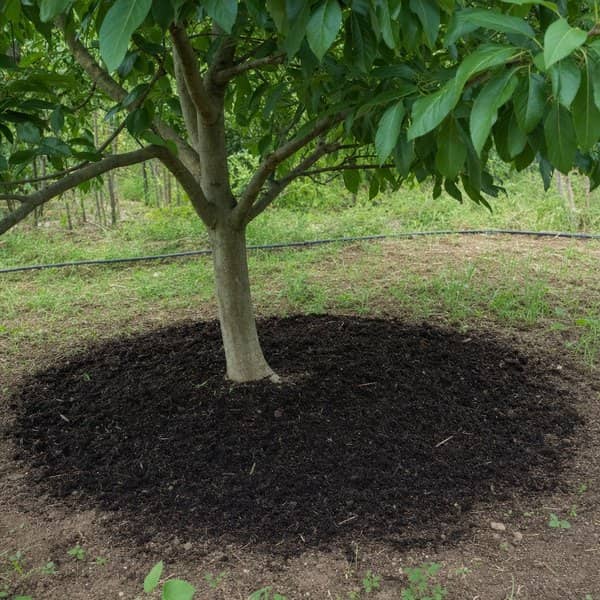
For ongoing care, spread a layer of compost about 0.4 in (1 cm) thick every year over the whole area under the canopy: allow 0.6–1 lb/sq ft (3–5 kg/m²) for trees and 0.4–0.6 lb/sq ft (2–3 kg/m²) for bushes (red currants, raspberries, black currants). You can cover it all with straw.
At planting time, mix about 20% compost into the soil in the hole, that is, one part compost to four parts soil.
When starting a new lawn, before seeding, work 1.6–2 lb/sq ft (8–10 kg/m²) of compost into the top 4 in (10 cm) of soil. For ongoing care, spread 0.2–0.4 lb/sq ft (1–2 kg/m²) at the start of each spring, finely sifted so it settles between the blades of grass.
At planting time, 1.6–2 lb/sq ft (8–10 kg/m²) worked in to a depth of about 6 in (15 cm). After that, 0.4–0.6 lb/sq ft (2–3 kg/m²) every two years is enough, lightly raked in between the plants.
When creating a new bed, 1–1.6 lb/sq ft (5–8 kg/m²) worked in while digging. For maintaining perennials, you have two options: a layer of well-finished compost about 0.8 in (2 cm) thick around the plants in the fall, which also protects the crowns from the cold, or 0.6–1 lb/sq ft (3–5 kg/m²) raked into the surface in spring.
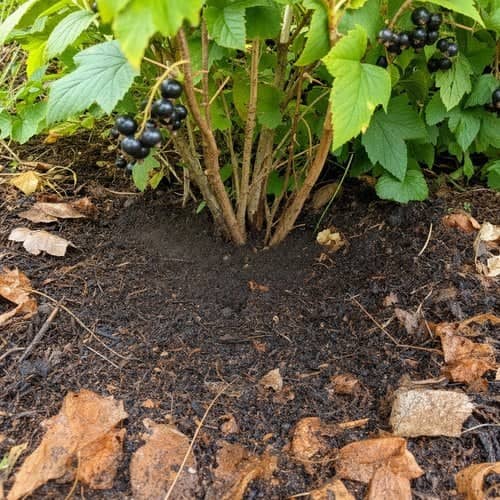 Young or semi-finished compost makes an excellent mulch: it feeds the soil gradually, reduces evaporation, and slows down weeds. On flower beds and in the vegetable garden, stick to about 0.8 in (2 cm) of compost. Some guides recommend thicker layers, but compost is still a rich material: if you want a thicker mulch, top it off with fallen leaves, straw, or wood chips instead.
Two precautions: keep the mulch an inch or two away from stems and trunks, and if possible, cover the compost with a plant-based mulch to protect it from rain and sun.
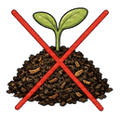 Sowing or planting in pure compost. This is the most important rule: compost should always be mixed with soil. For your containers and seedlings, follow the recipes in our guide Making your own potting mix.
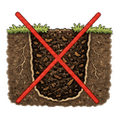 Burying it deep. Compost works in the top inch or two of soil. Digging it in deeply serves no purpose.
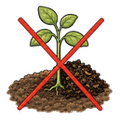 Putting young compost in contact with seedlings or young roots.
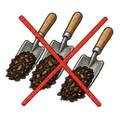 Overdoing it. Compost also supplies nutrients: beyond what the plants need, the excess is likely to be washed away by rain instead of feeding your crops.
Compost is first and foremost a soil amendment: it feeds the soil more than the plant. It increases organic matter, helps the soil hold water, makes it better aerated and easier to work, and releases its nutrients slowly over the months. Soil that regularly gets compost also attracts earthworms, whose role we explain in our guide The ecological role of earthworms. If your garden is short on them, our guide Reintroducing worms into the garden walks you through simple methods, using our Eisenia composting worms.
Did you know?A long-term field trial began in 1998: a cultivated plot receives compost made from food and yard waste roughly every two years. Between 1998 and 2011, the carbon stock in its surface layer rose from about 18 to 26 tons per acre (40 to 58 metric tons per hectare), while it dropped slightly on the plot that received nothing. Depending on the treatment, 60 to 73% of the carbon supplied by the compost stayed in the soil. These figures apply to a farm field and farm-scale application rates, but they clearly show the lasting effect of compost on organic matter.
Key takeawaysHeavy feeders: 0.6–1 lb/sq ft (3–5 kg/m²) per year. Moderate feeders: 0.2–0.6 lb/sq ft (1–3 kg/m²). Light feeders: little or none. Fruit trees: 0.6–1 lb/sq ft (3–5 kg/m²), fruit bushes: 0.4–0.6 lb/sq ft (2–3 kg/m²). Lawn: 0.2–0.4 lb/sq ft (1–2 kg/m²) every spring. And never sow or plant in pure compost.
Compost should be applied according to the plants' needs: generously for heavy feeders and fruit trees, more lightly for moderate feeders, lawns, and hedges, and hardly at all for garlic, onions, or radishes. Young compost stays on the surface as mulch; finished compost is raked into the top inch or two of soil. Mixed with soil, never used pure, and applied every year rather than all at once, it improves your soil for the long haul, as long-term field trials confirm.
Scan the code or visit mouttafarm.com/guide: all our how-to guides, with links to the products mentioned.



 France
 Belgium
 Switzerland
 Germany
 Austria
 United Kingdom
 Italy
 Spain
 Holland
 Portugal
 Ireland
 Sweden
 Finland
 Denmark
 Greece
 Poland
 Rumania
 Czech Republic
