















 Vermicomposting
Kitchen caddy: what is it for in composting and vermicomposting?
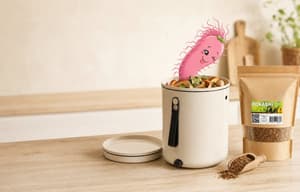
A kitchen caddy is more than just a small bin for peelings. It gets your waste ready for the worms, saves you trips to the composter and helps you get the mix right. Here is how to use one well, and which model to choose.

- In the kitchen caddy, waste starts to break down, so the worms in the wormery can eat it straight away.
- Kept in the kitchen, it saves you a trip to the composter after every meal: you empty it when it is full.
- Mix peelings and cardboard in it: the compost is better balanced and the caddy smells less.
Peelings, cores, coffee grounds, eggshells: in any kitchen, organic waste builds up every day. The kitchen caddy is there to collect it. It is often seen as just a small bin, but it does two really useful jobs: it gets the waste ready for the worms in your wormery, and it saves you trips back and forth to the composter.
For the wormery: waste that is ready to eat
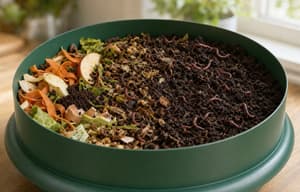
Compost worms do not eat a freshly cut peeling. They feed on material that has started to break down: softened, mouldy, rotting. Micro-organisms attack the waste first, then the worms take over.
Fresh waste placed straight into the wormery therefore sits for several days before it is eaten. If you leave it in the kitchen caddy for a few days first, decomposition is already under way in the kitchen. When you give it to the worms, they can eat it straight away.
To find out what your worms like and what is best avoided, read our guide What do earthworms eat?
Worms in a wormery eat peelings as soon as you give them, even when they are completely fresh.
Well spotted!Not quite… Worms feed on material that has started to break down. A few days in the kitchen caddy are enough to get decomposition going: once in the wormery, the waste is eaten without delay.
For the composter: no more back-and-forth
Is your composter at the bottom of the garden, and your wormery in the garage or utility room? Without a kitchen caddy, you would have to go out after every meal. With a caddy in the kitchen, the waste builds up over the days, and you only go and empty it when it is full. In winter, when it gets dark early and it is raining, you soon feel the difference.
The right habit: mix peelings and cardboard
Do not put only peelings in your kitchen caddy. Add dry, carbon-rich materials too: pieces of plain cardboard, egg boxes, kitchen roll tubes.
- Cardboard soaks up the juice from fruit and vegetables: less liquid at the bottom of the caddy, and fewer smells.
- The mix is already done when you empty the caddy: the composter or wormery gets both wet and dry materials at once.
- Worms love cardboard: softened by the juice from the peelings, it gives them both food and shelter.
To get the balance right, see our guide Green and brown materials.
Which kitchen caddy should you choose?
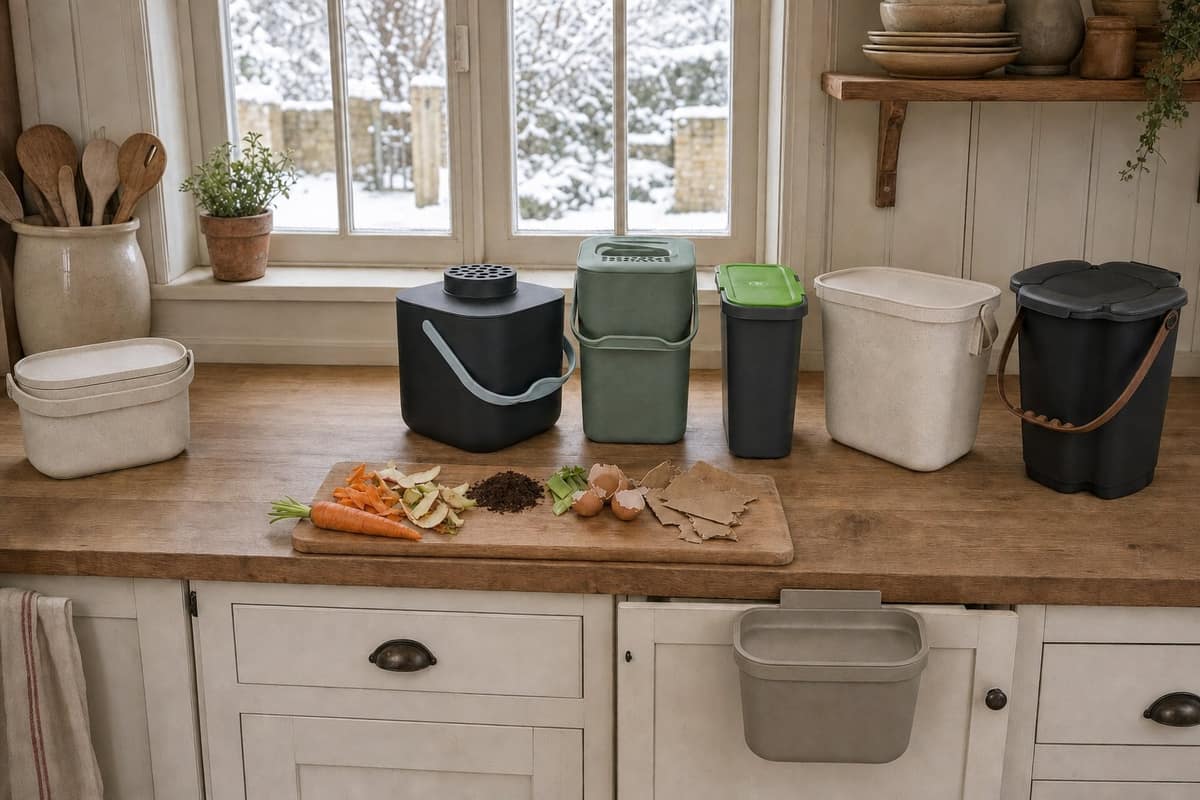
The farm offers seven models, all with a lid. The difference lies in their capacity and where you want to put them.
Small sizes, for emptying often
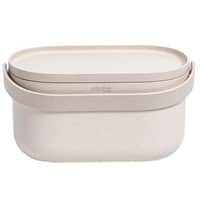
- Urbalive kitchen caddy 3.7 L: a low, elongated caddy with a handle that sits on the worktop. It is made with recycled coffee grounds.
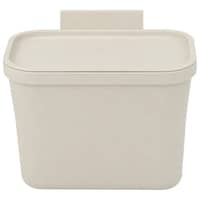
- Urbalive hanging kitchen caddy 4.1 L: it hooks onto a cupboard door, with no drilling, and frees up the worktop.
- Kajo compost caddy 5 L: a compact caddy with a handle and an activated carbon filter against odours, made in Switzerland.
Large sizes, for keeping waste for several days
- Urbalive compost bin 6 L: with a removable inner basket that lets air circulate and makes cleaning easier. It also contains recycled coffee grounds.
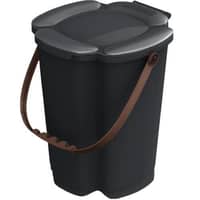
- Kaylis compost bin 7 L: made in France from recycled plastic, with a faux-leather handle. Its lid stays open against the handle while you fill it.
- Kajo compost caddy 7.5 L: with a carbon filter and wall bracket, made in France.
- Maze compost bin 9 L: the largest, yet very slim. Its wide opening lets you clear a plate or a chopping board in one go.
To keep smells down, activated carbon filters for kitchen caddies are also sold in packs of 5.
You will find them all in our Kitchen caddies and compost bins section.
A small caddy, two big benefits: better-fed worms and fewer trips. Torn between two models? Write to us, and the farm team will help you choose.
Products mentioned
Going further
New posts, tips and behind the scenes: Willy and Emy write to you.


 France
 Belgium
 Switzerland
 Germany
 Austria
 United Kingdom
 Italy
 Spain
 Holland
 Portugal
 Ireland
 Sweden
 Finland
 Denmark
 Greece
 Poland
 Rumania
 Czech Republic