











Best Seller

Pack of 5 must-have accessories | Square
Choice of mat shape: Square, Round, Rectangle, or Oval
$19.30 €17.18
Fast and odor-free, composting worms eat your food scraps and turn them into fertilizer for your plants.

From 2 to 4 trays, with an optional planter.

Up to 18 growing areas around a central worm composter.

Terracotta, with a flower pot.

From 2 to 4 trays, with a lower shelf.

Trays you add over time for easy vermicompost harvesting.

Turn your planters and flower beds into a worm composter: WORMacotta, In-Ground.
From kitchen to garden, composting becomes simple, fast, and effective for everyone.
Live animals (worms and bait) and products to feed and care for pets and livestock.

Eisenia composting worms for your worm composter or compost bin.

Ultra-fresh worms: red worms, Dendros, and Canadian nightcrawlers from 3.5 oz (100 g) to 2.2 lb (1 kg).

Natural solutions dedicated to the well-being of horses, ponies, and donkeys.

Optimize the health and performance of your farm.

Mealworms: natural, nutritious supplements.
Beautify your home with our decorative pieces and care for your house in a natural, sustainable way.
Garden the eco-friendly way, in harmony with nature, for healthy, long-lasting plants.
EM-based products designed to enrich soil, protect plants, support animal health, and make everyday well-being and home care easier.

Contains a blend of 80 families of beneficial microorganisms.

Revitalize, purify, and improve water quality in all your applications.

Stimulate soil microbial activity and plant growth.

Clean and care for your surroundings naturally.

For the well-being and health of pets, livestock, and horses.

Enrich your body care and dietary routines with essential enzymes.

Your Eisenia worms have no natural tendency to escape: because they are sensitive to light, they prefer to stay buried in the material rather than expose themselves to daylight. So if you ever see some climbing up the sides or clustering under the lid, it's a signal worth paying attention to rather than normal behavior — but rest assured, it's rare, and always temporary.
Don't confuse this with a real escape: it's perfectly normal to see a few worms briefly come up to the surface, for example right after you've added food. It's only a concern when they are really trying to get out of the worm composter — crossing the edge of a tray or gathering against the lid for several days.
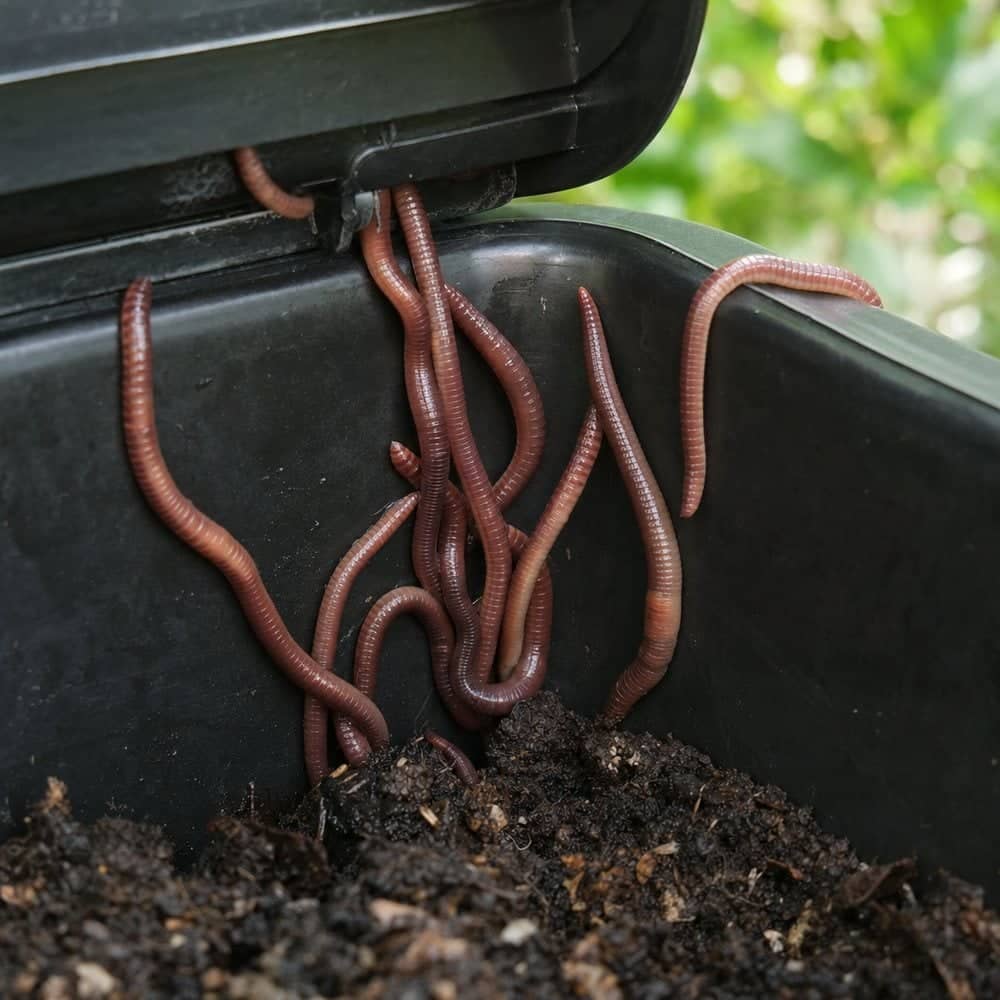 This behavior mostly shows up in the very first days after they arrive. Your worms are discovering a new environment, and part of their exploring behavior is precisely to check whether there's somewhere better than their new home — this is normal, and it settles down as they acclimate. Several factors can prolong or worsen this period:
After the first few days, an escape attempt is more likely a sign that the environment no longer suits your worms: most often too much moisture, which you can correct by adding paper or cardboard, or conditions that have become too acidic (which may also be linked to the forbidden foods mentioned above), which you can easily rebalance with crushed eggshells or a lime-based mix (RegulaWorm).
Willy's tipIf your bedding is made entirely of cardboard, be sure to moisten it well before adding your worms. The test is simple: it should sound like a damp sponge when you squeeze it in your hand, without actually dripping. Bedding that is too dry is just as likely to send your worms looking elsewhere as bedding that is too wet.
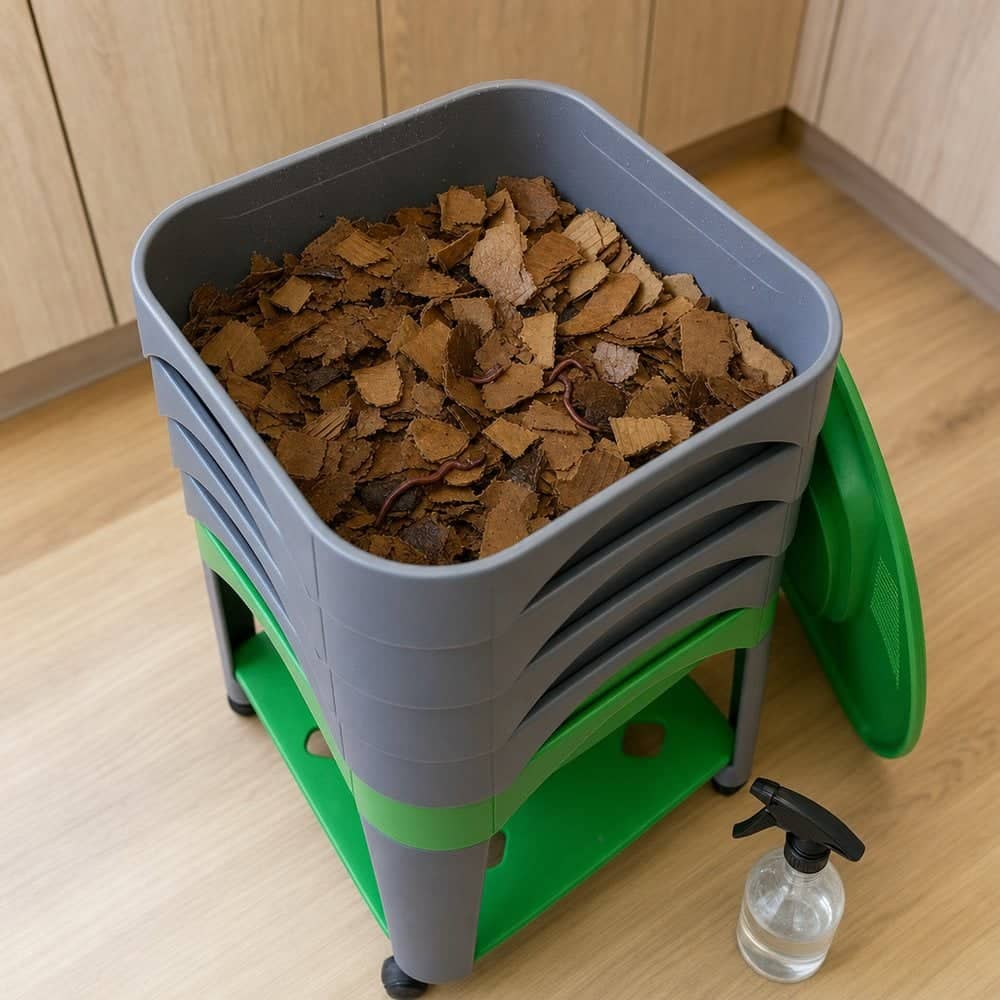 If you have a few adventurers, the simplest technique is to add a new tray on top of the first one and fill it halfway with moistened pieces of cardboard. Your worms will usually take refuge there for a few days while they settle in, and then everything goes back to normal.
If a few worms have already gotten out, place a damp floor cloth at the foot of the worm bin, if your floor allows it. Rather than wandering off to explore a few feet away and drying out on the floor, they will make their own way underneath it to shelter, away from the light and where it's cool. Then just lift the cloth to collect them and put them back in the worm bin.
Willy's tipSave this as a last resort, since it's less eco-friendly: a low light source placed on the worm composter for 2 to 3 days is also enough to keep your worms from coming out, since they are sensitive to light — they will simply stay buried deeper.
Always keep the bottom tray filled with maturing compost, even when you're not harvesting yet. This tray serves as a natural refuge for your worms if their living conditions are temporarily disrupted — temperature (see our guide Protecting from cold and heat), moisture, or food.
Escaping worms are a rare and almost always temporary occurrence, most often linked to the first few days after setup. A new refuge tray of moistened cardboard, a little patience, and the right balance of moisture and acidity day to day are, in the vast majority of cases, all it takes to get your worms back snug in their bedding.


 France
 Belgium
 Switzerland
 Germany
 United Kingdom
 Italy
 Spain
 Holland
 Portugal
 Ireland
 Sweden
 Finland
 Denmark
 Greece
 Poland
 Rumania
 Czech Republic
